
Quarry Ballast Crushing Equipment: A Comprehensive Catalog of Factory Solutions
Introduction
In the demanding world of quarrying and aggregate production, ballast serves as the foundational material for railway tracks, road sub-bases, and concrete structures. The process of transforming large, extracted rock into precisely sized ballast is a multi-stage operation requiring robust, high-capacity machinery. This article presents a detailed catalog of quarry ballast crushing equipment, examining the primary, secondary, and tertiary crushing stages, as well as the auxiliary components that constitute a modern processing plant. The focus is on equipment types commonly manufactured by specialized factories, their operational principles, and their specific roles in producing high-quality ballast.
Primary Crushing Equipment: The First Stage of Size Reduction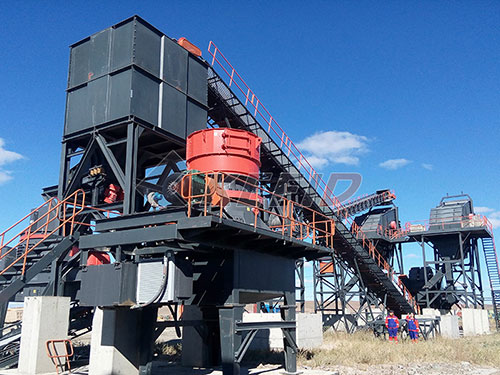
Primary crushing is the initial mechanical breakdown of run-of-mine (ROM) rock, typically reducing material from up to 1,500 mm down to 100–300 mm. Factories offer several equipment types for this arduous task.
Jaw Crushers are the most prevalent primary crushers in quarrying. These machines operate by compressing rock between a fixed jaw and a moving jaw. Modern factory models feature hydraulic adjustment for the closed-side setting (CSS), allowing precise control of the output size. They are renowned for their ability to handle hard, abrasive materials with a high reduction ratio. Key specifications include feed opening dimensions (e.g., 1,200 x 900 mm), throughput capacity (up to 1,000 t/h), and motor power (typically 110–250 kW). Factories manufacture both single-toggle and double-toggle variants, with the former being more common due to higher capacity and simpler maintenance.
Gyratory Crushers are the alternative for very high-capacity operations (over 1,500 t/h). A conical mantle gyrates within a concave chamber, continuously crushing material. While offering superior throughput and a more cubical product shape, gyratory crushers require significant capital investment and a large, reinforced foundation. Factories typically supply these for large-scale rail ballast quarries where a single unit must handle the entire mine output.
Impact Crushers (primary impactors) are used when the rock is less abrasive (e.g., limestone). They employ high-speed rotating hammers to shatter material against impact plates. These units produce a more uniform product with a higher proportion of fines, which may be desirable for certain ballast specifications. However, they are less effective on hard, siliceous rocks like granite or basalt.
Secondary and Tertiary Crushing: Achieving Ballast Specifications
After primary crushing, material is screened, and oversize is directed to secondary crushers for further size reduction. For ballast, the target size typically ranges from 25 mm to 63 mm (e.g., AREMA No. 4 or EN 13450 gradings).
Cone Crushers dominate secondary and tertiary stages. Factories produce two main types: standard cone crushers for secondary crushing (feed size up to 300 mm, product down to 20 mm) and short-head cone crushers for tertiary crushing (feed size up to 100 mm, product down to 5 mm). These machines use a gyrating mantle within a concave bowl. The key advantage is their ability to produce a highly cubical product with controlled particle size distribution—critical for ballast interlock and stability. Modern factory models feature hydraulic tramp release, automatic setting regulation (ASR), and liner retention systems. Capacities range from 50 to 800 t/h, with power requirements from 90 to 500 kW.
Vertical Shaft Impactors (VSI) are increasingly popular for tertiary and quaternary crushing to produce premium ballast. A VSI accelerates rock particles in a rotor and throws them against an anvil or rock-lined chamber. This results in a excellent cubical shape and a high reduction ratio. Factories offer both rock-on-rock (autogenous) and rock-on-anvil configurations. While VSI crushers generate more fines (10–20%), they are essential for meeting stringent flakiness and elongation indices required for high-speed rail ballast.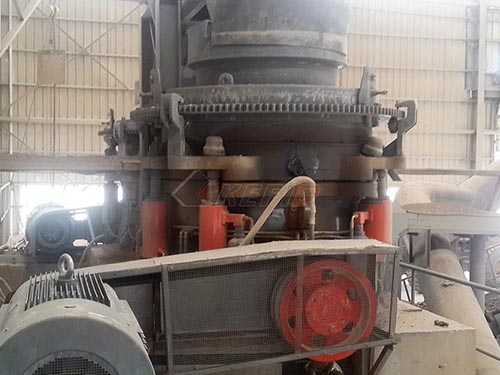
Hammer Mills and Impactors are also used in secondary stages for softer rock. However, for hard rock ballast, cone and VSI crushers are preferred due to lower wear costs and better shape control.
Screening Equipment: The Critical Classifier
No crushing catalog is complete without screening. Factories supply vibrating screens in various configurations: inclined, horizontal, and banana screens. For ballast production, multi-deck screens (typically 2–3 decks) are used to separate material into size fractions. The top deck might cut at 63 mm, the middle at 40 mm, and the bottom at 25 mm. High-efficiency screens with polyurethane or rubber panels reduce blinding and noise. Throughputs range from 100 to 1,000 t/h depending on width and stroke.
Auxiliary Equipment: Feeders, Conveyors, and Control Systems
Apron feeders or vibrating grizzly feeders receive ROM material and feed the primary crusher. They scalp fines and protect the crusher from oversized lumps. Factories manufacture heavy-duty apron feeders with wear-resistant pans and variable speed drives.
Belt conveyors transfer material between stages. Key specifications include belt width (800–1,400 mm), troughing angle (35–45°), and capacity (up to 2,000 t/h). Factories offer modular conveyor systems with magnetic separators and metal detectors to remove tramp iron.
Automation and control systems are integral to modern factories. Programmable logic controllers (PLCs) monitor crusher power draw, CSS, and feed rate. Automatic setting regulation (ASR) on cone crushers maintains consistent product size, while vibration sensors on screens prevent catastrophic failure. Remote monitoring via cloud platforms is now a standard offering from major manufacturers.
Factory Catalog Considerations: Selection and Sizing
When selecting equipment from a factory catalog, engineers must consider:
Conclusion
The catalog of quarry ballast crushing equipment is extensive, with each machine type serving a specific role in the size reduction chain. Primary jaw or gyratory crushers handle the initial breakdown; secondary and tertiary cone or VSI crushers refine the material to precise ballast specifications; screens classify; and feeders, conveyors, and automation ensure efficient, safe operation. Factories continuously innovate with hydraulic adjustment, wear-resistant materials, and digital monitoring to reduce downtime and improve product quality. For quarry operators, understanding this equipment catalog is essential for designing a plant that meets railway and construction standards while maximizing productivity and minimizing cost per ton. As ballast demand grows with infrastructure development, the evolution of crushing technology will remain a cornerstone of aggregate processing.
If you have any questions about our products, please feel free to contact us. We take all inquiries and suggestions very seriously.