
Gold Ore Crushing Equipment Fabricators Customization: Engineering Precision for Variable Ore Bodies
The extraction of gold from its host rock is a multi-stage metallurgical process, yet the foundational step—crushing—remains the most critical determinant of downstream recovery efficiency. Unlike bulk commodities such as iron ore or coal, gold ore presents a uniquely challenging set of physical and chemical variables: extreme hardness variations, clay-bound moisture content, abrasive gangue minerals, and the presence of brittle sulfides that require selective liberation. Consequently, off-the-shelf crushing equipment, designed for generic aggregate production, frequently underperforms in gold applications. This is where specialized fabricators offering deep customization enter the equation. This article provides a professional, objective examination of the role, methodologies, and engineering considerations involved in the customization of gold ore crushing equipment by specialized fabricators.
1. The Rationale for Customization: Why Standard Equipment Fails
Standard cone crushers, jaw crushers, and impact crushers are engineered for throughput and reduction ratios on homogeneous feed. Gold ore, however, is rarely homogeneous. The primary drivers for customization are:
2. Core Customization Parameters in Fabrication
A professional fabricator does not simply bolt on larger motors. Customization is a systematic engineering process addressing several mechanical and metallurgical parameters:
2.1 Chamber Geometry and Stroke Profile
The crushing chamber’s cross-section is not a fixed template. For gold ores, fabricators use computational fluid dynamics (CFD) and discrete element method (DEM) simulations to design a chamber with a specific “nip angle” (typically 18–22 degrees) and a “parallel zone” length that ensures the ore is compressed multiple times before discharge. For high-clay ores, the chamber is elongated with a steeper lower section to promote gravity flow. For high-hardness ores, the chamber is shortened to reduce the crushing force per stroke, preventing premature liner fatigue.
2.2 Eccentric Throw and Speed (RPM)
The eccentric throw (the distance the mantle moves) and the crusher speed dictate the particle size distribution (PSD). For gold, a narrow PSD is desirable to optimize downstream ball mill feed. Customization allows fabricators to adjust the throw from 20mm to 40mm and the speed from 200 to 400 RPM. For ores requiring high reduction ratios (e.g., from 600mm to 25mm in one stage), a custom “multi-action” crusher with a variable-speed drive (VFD) is fabricated, allowing real-time adjustment based on ore hardness feedback from load cells.
2.3 Drive Train and Power Delivery
Standard crushers use fixed-speed induction motors. Custom fabricators offer:
2.4 Material Selection and Heat Treatment
Beyond liners, the crusher’s main frame, shaft, and bearings require customization. For corrosive environments (e.g., high-sulfide ores with acid mine drainage), fabricators use:
3. The Fabrication Process: From Ore Sample to Commissioning
A reputable fabricator follows a rigorous, documented workflow:
Step 1 – Ore Characterization and Pilot Testing
The process begins with a representative ore sample (typically 500–1000 kg). The fabricator conducts:
Step 2 – Finite Element Analysis (FEA) and 3D Modeling
Using FEA software (e.g., ANSYS or Abaqus), the fabricator simulates stress distribution on the crusher frame under maximum load. This validates the frame’s thickness, rib placement, and weld seam design. For example, a custom cone crusher for a 20 MW operation will have a base frame fabricated from 100mm thick ASTM A36 steel with full-penetration welds, rather than the standard 50mm plate.
Step 3 – Modular Fabrication and Machining
Customization often involves modular construction. The crushing chamber, main shaft assembly, and hydraulic system are fabricated as separate modules. This allows:
Step 4 – Hydraulic and Lubrication System Customization
Gold ore crushers operate under heavy dust and high temperature. Custom fabricators design:
4. Case Study: Customization for a Refractory Sulfide Gold Ore
Consider a hypothetical but representative project: a gold mine in Nevada processing a refractory ore with 2.5% pyrite, 8% clay, and a Bond Wi of 18.5 kWh/t. A standard 7-foot Symons cone crusher would produce excessive fines (< 150 µm) at 35% of feed, leading to high cyanide consumption and poor leach kinetics.
A specialized fabricator would deliver the following customizations: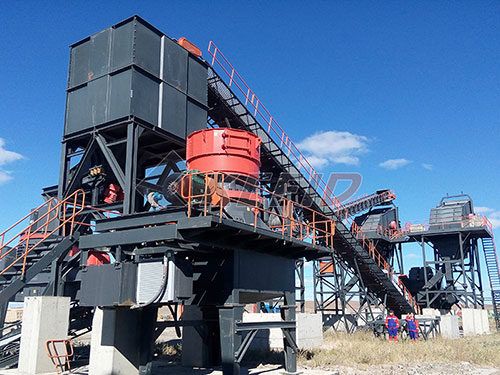
The result: a 15% increase in throughput, a 22% reduction in downstream grinding energy, and a 30% increase in gold recovery due to better liberation.
5. Quality Assurance and Compliance
Customization is meaningless without rigorous QA. Professional fabricators adhere to:
6. Economic Considerations and Total Cost of Ownership (TCO)
Customization carries a premium—typically 20–40% higher initial capital cost than standard equipment. However, the TCO analysis is favorable:
7. Future Trends in Custom Fabrication
The industry is moving toward:
Conclusion
Gold ore crushing is not a commodity transaction; it is a metallurgical engineering challenge. The decision to engage a specialized fabricator for customized equipment is not a luxury but a strategic necessity for orebodies with high competency, high clay, or refractory sulfide content. The value of customization lies not merely in the physical machine, but in the systematic application of ore characterization, mechanical simulation, and material science. A professional fabricator does not sell steel; it sells a guaranteed liberation curve, a specific energy consumption target, and a maintenance interval. For mining operators, the due diligence lies in verifying the fabricator’s test lab capabilities, FEA validation procedures, and the enforceability of performance warranties. In an industry where a 1% recovery difference can define a project’s economic viability, the precision of a custom-built crusher is not an expense—it is an investment in metallurgical certainty.
If you have any questions about our products, please feel free to contact us. We take all inquiries and suggestions very seriously.