Iron Ore Crushing Plant Companies: A Comprehensive Guide to Design Services
The iron ore industry forms the backbone of global steel production, and at the heart of every efficient mining operation lies a well-engineered crushing plant. The design of this plant is not merely an engineering task; it is a critical strategic investment that determines operational efficiency, product quality, long-term profitability, and environmental compliance. Companies specializing in the design service for iron ore crushing plants play a pivotal role in transforming raw, blasted material into precisely sized feedstock for beneficiation and agglomeration. This article provides a detailed, objective examination of these design services, covering their scope, key considerations, technological integrations, and the value proposition offered by leading firms in this highly specialized field.
The Scope of Professional Design Services
A comprehensive design service for an iron ore crushing plant extends far beyond simple equipment layout. It encompasses a holistic project lifecycle approach:
- Pre-Feasibility and Feasibility Studies: This initial phase involves analyzing the ore characteristics (competence, abrasiveness, moisture content, clay content), reserve geometry, and production targets. Design companies use this data to model flow sheets and provide high-level CAPEX (Capital Expenditure) and OPEX (Operational Expenditure) estimates.
- Flow Sheet Development: This is the conceptual blueprint. Engineers select the optimal crushing stages (typically three: primary, secondary, tertiary/quaternary) and equipment types (e.g., gyratory vs. jaw crushers for primary; cone crushers vs. high-pressure grinding rolls (HPGR) for subsequent stages). The goal is to achieve target size reduction (often to below 30mm or finer for beneficiation) with maximum energy efficiency and minimal over-grinding.
- Plant Layout and Civil/Structural Design: This involves spatially arranging massive equipment—crushers, screens, conveyors, bins, and transfer towers—to ensure smooth material flow, safe maintenance access, and structural integrity. Factors like topography, geotechnical conditions, and future expansion plans are meticulously considered.
- Mechanical & Electrical (M&E) Design: This includes detailed engineering of all mechanical systems (conveyor drives, chute linings, dust containment), electrical power distribution, motor control centers (MCCs), and cabling. Robustness to handle abrasive dust and remote location challenges is paramount.
- Automation and Process Control Systems Design: Modern plants are digitally integrated. Design firms engineer the control philosophy—Programmable Logic Controller (PLC) networks, Human-Machine Interface (HMI) screens, and sometimes advanced process control (APC) systems—to optimize throughput, ensure safety interlocks, and enable remote monitoring.
- Dust Suppression & Environmental Control Design: Iron ore crushing generates significant dust (PM10/PM2.5). A responsible design must integrate systems at transfer points and crusher cavities using methods like water spray foggers with surfactants or dry fog systems alongside comprehensive baghouse filtration systems to meet stringent environmental regulations.
- Commissioning & Operational Support: Reputable design companies provide support during plant commissioning to fine-tune the system against actual ore performance and train operational staff on best practices.
Critical Technical Considerations in Design
Specialist design firms must navigate a complex matrix of interdependent factors:
-
Ore Characteristics: The design is fundamentally dictated by the ore’s:
- Work Index/Bond Crushability: Defines the hardness and energy required for comminution.
- Abrasion Index: Influences liner material selection (e.g., manganese steel vs. composite alloys) and maintenance cycle planning.
- Moisture & Clay Content: Can cause clogging in crushers and screens; may necessitate pre-washing or specialized equipment like sizers.
-
Capacity & Availability Targets: The design must meet nominal throughput (e.g., 2,500 t/h) while ensuring high overall plant availability (>92%). This requires careful equipment redundancy planning (e.g., standby conveyors), strategic stockpiling between stages to de-bottleneck processes.
-
Product Size Specification: The target top size for downstream processes is critical. Achieving a finer product may require additional crushing stages or more advanced technology like HPGRs.
-
Energy Efficiency: Comminution is energy-intensive (~1% of global industrial electricity use). Leading designs prioritize low-specific-energy solutions: optimizing crusher settings over grinding mills where possible; adopting efficient variable frequency drives (VFDs); considering HPGRs which offer up to 20-30% energy savings over conventional circuits.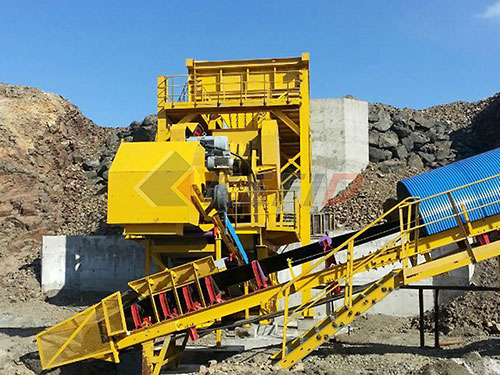
-
Modular vs. Fixed Plant Design: For remote greenfield sites or deposits with shorter lifespans modular designs—where pre-assembled skid-mounted sections are transported—can reduce on-site construction time/cost.
Technological Integration in Modern Designs
The cutting edge of crushing plant design is defined by several key technologies: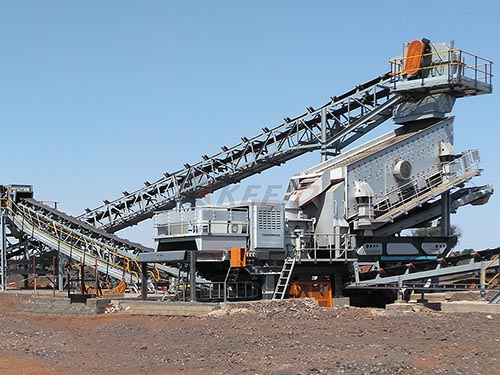
- High-Pressure Grinding Rolls (HPGR): Increasingly used as tertiary/quaternary crushers or even secondary units HPGRs apply inter-particle compression achieving significant energy savings producing micro-cracks beneficial downstream liberation while generating more fines which must be managed within circuit balance constraints
- Advanced Automation & Digital Twins: Modern control systems use real-time data from sensors measuring power draw cavity level pressure feed rates etc not just automate but optimize performance via model predictive control MPC Furthermore digital twins virtual replicas allow operators simulate different scenarios test changes predict wear schedule maintenance proactively
- Wear Monitoring Technologies: Embedded sensors RFID tags within liner packages ultrasonic thickness measurement enable predictive maintenance scheduling liner changes based actual wear rather than fixed calendar intervals maximizing utilization minimizing unplanned downtime
- Dust Control Innovations: Beyond traditional baghouses new designs incorporate intelligent suppression activating only when material flow detected reducing water usage automated filter cleaning sequences ensure consistent emission compliance
Selecting a Design Service Provider: Key Criteria
When evaluating companies offering iron ore crushing plant design services clients should assess:
- Proven Track Record & References: Demonstrable experience with similar ore types capacities geographic locations especially challenging environments Arctic tropical etc
- In-House Testwork Capabilities Ability conduct pilot-scale testing using customer’s actual sample crucial validating flow sheet predicting performance accurately
- Technology Agnosticism Provider should recommend optimal solution based project economics technical requirements not merely push proprietary equipment portfolio
- Lifecycle Cost Approach Focus should be minimizing total cost ownership TCO through energy-efficient reliable easy-maintain designs not just minimizing initial capital outlay
- Safety-by-Design Philosophy Safety features guardrails access platforms lock-out/tag-out LOTO points must be integral part layout from outset not added retrospectively
- Sustainability Integration Expertise designing water recycling circuits noise abatement measures biodiversity management plans increasingly important securing social license operate meeting investor ESG Environmental Social Governance criteria
Conclusion
The design of an iron ore crushing plant is a sophisticated multidisciplinary endeavor where engineering excellence directly translates into competitive advantage mining operations Partnering with competent experienced design service company represents strategic decision that impacts project’s financial viability environmental footprint operational safety decades come As industry faces pressures decarbonize improve resource efficiency reduce water consumption role these specialist firms becomes even more vital They are tasked integrating novel technologies optimizing every kilowatt-hour managing increasingly complex orebodies all while ensuring robust operable facilities Ultimately successful design seamlessly blends deep metallurgical understanding mechanical engineering prowess digital innovation create plant that not only crushes rock but also crushes its cost production targets setting stage profitable sustainable steelmaking value chain
