
Iron Ore Crushing Plant in China: A Sample of Process Design, Equipment Configuration, and Operational Practice
Abstract
Iron ore crushing is a critical front-end stage in the Chinese steel supply chain, determining downstream grinding efficiency, energy consumption, and overall beneficiation performance. This article presents a representative sample of a Chinese iron ore crushing plant, examining its process flowsheet, equipment selection, design philosophy, and operational characteristics. Drawing on typical configurations found in China’s major iron ore regions—including the Anshan-Benxi area, Hebei Province, and Inner Mongolia—the sample illustrates how Chinese operators balance capital cost, energy efficiency, and product size requirements under challenging ore conditions. The discussion covers primary, secondary, and tertiary crushing stages, screening circuits, dust control, and the increasing integration of high-pressure grinding rolls (HPGR) and intelligent control systems. The article concludes with observations on technological trends and the operational lessons that this sample configuration offers for similar projects.
1. Introduction
China is the world’s largest steel producer and, correspondingly, one of the largest consumers of iron ore. Although a substantial share of Chinese iron ore demand is met through imports—principally from Australia and Brazil—domestic mining of low-grade magnetite and hematite ores remains strategically important. Domestic Chinese iron ores are typically characterized by low iron grades (often 25–35% Fe), fine dissemination of valuable minerals, and high hardness, all of which place significant demands on comminution circuits.
Crushing plants therefore occupy a pivotal position in Chinese iron ore beneficiation flowsheets. A well-designed crushing plant reduces run-of-mine (ROM) ore from typical feed sizes of 800–1,200 mm down to 10–30 mm ahead of grinding, thereby minimizing energy consumption in the highly intensive grinding stage. This article presents a detailed sample of a typical Chinese iron ore crushing plant, describing its design basis, flowsheet, equipment, and operational considerations. The sample is representative of medium-to-large domestic operations with throughputs in the range of 1,000–3,000 t/h.
2. Design Basis and Ore Characteristics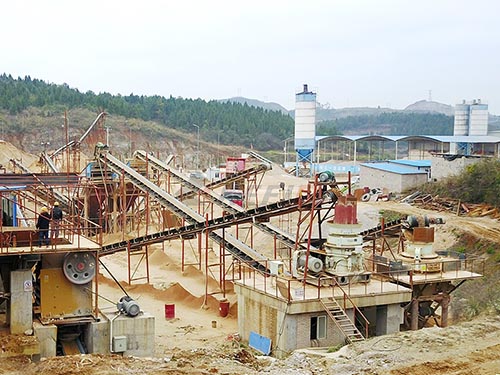
The sample plant is designed to process magnetite-bearing ore with the following representative characteristics:
These parameters are typical of magnetite ores from the Anshan-Benxi region and Hebei Province. The relatively high hardness and abrasiveness drive equipment selection toward robust jaw or gyratory crushers with manganese steel wear parts, while the moderate moisture content requires attention to chute design and screening efficiency.
The plant is designed for a nominal throughput of 2,000 t/h with an availability target of 85% and an annual operating time of 7,000 hours, yielding approximately 11.9 Mtpa of crushed product.
3. Process Flowsheet
The sample plant employs a three-stage crushing circuit with closed-circuit screening, a configuration widely adopted in Chinese iron ore operations for its balance of product quality and capital efficiency.
3.1 Primary Crushing
ROM ore is delivered by rear-dump haul trucks (typically 90–150 t class) to a primary dump hopper equipped with a static grizzly. A hydraulic breaker is stationed at the grizzly to handle oversize boulders. The primary crusher is a gyratory crusher (60–89 or 54–75 size class) or, in some variants, a large jaw crusher. The gyratory option is preferred at this throughput for its continuous operation, lower maintenance intensity per tonne, and ability to accept large feed openings.
Primary crushing reduces the ore to a nominal 80% passing (P80) of approximately 150–200 mm. The crusher discharges onto a heavy-duty apron feeder or belt feeder, which transfers ore to the secondary crushing stage via a conveyor equipped with a belt scale and metal detector.
3.2 Secondary Crushing
Secondary crushing is performed in a cone crusher—typically a standard-head or high-capacity secondary cone—operating in open circuit ahead of the screening station. The secondary crusher reduces the ore to a P80 of approximately 50–60 mm. Discharge is conveyed to a double-deck vibrating screen (typically 2.4 m × 6.0 m or larger), where the ore is separated at a cut point of 20–25 mm.
Screen undersize reports directly to the fine ore stockpile or grinding circuit; oversize is conveyed to the tertiary crushing stage. The use of a pre-screening step ahead of tertiary crushing is a key efficiency measure, as it removes finished material and reduces the load on the tertiary crushers.
3.3 Tertiary Crushing
Tertiary crushing is carried out in high-speed cone crushers (short-head configuration) operating in closed circuit with the screens. The tertiary crushers reduce the ore to a final product P80 of 12–20 mm. Closed-circuit operation ensures that all product meets the size specification, with circulating loads typically in the range of 100–150%.
In an increasing number of Chinese plants—and in a variant of this sample configuration—HPGR units are installed either as a tertiary crusher replacement or as a pre-grinding stage. HPGR offers advantages in energy efficiency and in generating micro-cracks that improve downstream grinding performance, particularly for hard magnetite ores. Where HPGR is used, the product target is often −12 mm, and the circuit may be configured in a finish-grinding or pre-grinding arrangement with edge recycle.
3.4 Screening and Product Handling
Final screening is performed on double- or triple-deck vibrating screens with polyurethane or rubber screen media. Screen efficiency is maintained above 85% through proper bed-depth control and regular media inspection. Crushed product is conveyed to a covered fine ore stockpile with a live capacity of 8–12 hours of plant throughput, providing buffering between the crushing and grinding circuits.
4. Equipment Configuration Summary
The sample plant’s principal equipment is summarized below:
| Stage | Equipment | Quantity | Key Parameters |
|---|---|---|---|
| Primary | Gyratory crusher | 1 | 60–89, 500 kW, feed opening 1,000 mm |
| Secondary | Cone crusher (standard) | 2 | 500 kW each, CSS 30–40 mm |
| Tertiary | Cone crusher (short-head) | 3 | 400 kW each, CSS 8–12 mm |
| Screening | Double-deck vibrating screens | 4 | 2.4 m × 6.1 m, 22 kW each |
| Conveying | Belt conveyors | 12 | 1,200–1,600 mm width |
| Dust control | Baghouse + water sprays | — | 99.5% collection efficiency |
This configuration reflects the standard Chinese practice of installing multiple parallel secondary and tertiary crushers to provide operational flexibility and maintain production during maintenance. The redundancy also accommodates the wear-related performance decline of cone crushers over the liner life.
5. Auxiliary Systems and Environmental Controls
5.1 Dust Control
Dust generation is a significant concern in crushing plants, and Chinese environmental regulations—particularly the ultra-low emission requirements introduced in key regions—have driven substantial investment in dust control. The sample plant employs a combination of enclosed transfer points, baghouse dust collectors on crusher discharge and screen discharge points, and water spray systems on conveyor transfer stations. Collection efficiency exceeds 99.5%, and stack emissions are maintained below 10 mg/m³, consistent with current Chinese ultra-low emission standards for the steel and mining sectors.
5.2 Wear Management
Wear parts management is a major operational cost driver. The sample plant adopts a liner life management system that tracks crusher liner wear through power draw and closed-side setting (CSS) monitoring, scheduling liner changes during planned maintenance windows. Manganese steel liners in the primary and secondary crushers typically achieve 800–1,200 hours of service, while tertiary liners may last 400–600 hours depending on ore abrasiveness.
5.3 Automation and Intelligent Control
Modern Chinese crushing plants increasingly incorporate automated control systems. The sample plant features a distributed control system (DCS) with interlocks, start/stop sequencing, and real-time monitoring of crusher power draw, CSS, belt scales, and bin levels. More advanced variants include crusher feed control based on power draw (maintaining operation at 80–90% of rated power), automatic CSS adjustment, and predictive maintenance analytics based on vibration and temperature data. These measures improve throughput stability and reduce unplanned downtime.
6. Operational Performance and Lessons
The sample configuration demonstrates several operational lessons relevant to Chinese iron ore crushing practice:
7. Conclusion
This sample of a Chinese iron ore crushing plant illustrates a mature, well-engineered approach to comminution front-end design. The three-stage crushing circuit with closed-circuit screening, supported by robust equipment selection, comprehensive dust control, and increasing automation, represents the mainstream configuration for medium-to-large domestic iron ore operations. As Chinese ore grades decline and energy costs and environmental standards rise, the trends evident in this sample—toward HPGR integration, intelligent control, and stricter environmental performance—are likely to accelerate. The configuration described here provides a useful reference for engineers designing or benchmarking similar facilities, both within China and in other regions processing comparable magnetite and hematite ores.
If you have any questions about our products, please feel free to contact us. We take all inquiries and suggestions very seriously.