Certified JC5000 Jaw Crusher Design Service: Engineering Excellence for Demanding Comminution
In the rigorous world of mineral processing, mining, and quarrying, the primary crushing stage is a critical bottleneck that dictates downstream efficiency, operational cost, and overall plant productivity. At this pivotal point, equipment selection transcends mere procurement; it becomes a strategic investment in reliability and performance. The Certified JC5000 Jaw Crusher Design Service represents the pinnacle of this philosophy. It is not merely about supplying a robust piece of machinery—the JC5000 jaw crusher itself—but about delivering a comprehensive, engineered solution backed by expert design validation and application-specific optimization. This service ensures that the crusher is not just a component, but a perfectly integrated system designed for maximum uptime, optimal output, and long-term economic value.
Understanding the Core: The JC5000 Jaw Crusher
Before delving into the design service, it is essential to understand the machine at its heart. The JC5000 is typically classified as a heavy-duty, high-capacity jaw crusher designed for stationary primary crushing applications. It often features:
- Robust Frame Construction: A heavily ribbed, stress-relieved steel frame to withstand immense cyclical loading and high shock forces from uncrushable material.
- Large Feed Opening: Accommodating sizable feed material (often up to 1 meter or more in size), making it suitable for run-of-mine ore and large quarry stone.
- Advanced Crushing Geometry: Engineered jaw dies with optimal nip angle and crushing chamber design to enhance throughput, reduce liner wear, and improve product shape.
- High Eccentric Throw: Facilitating effective breakage of hard, abrasive materials.
- Reliable Toggle System: Often incorporating a hydraulic toggle relief system for automatic protection against tramp iron and uncrushables, minimizing downtime from mechanical overloads.
- Durable Bearing Assemblies: Large-diameter spherical roller bearings capable of handling high radial and thrust loads.
However, specifying such a machine based on catalog data alone is fraught with risk. This is where the Certified Design Service transitions from selling equipment to delivering guaranteed performance.
The Pillars of the Certified Design Service
The “Certified” designation implies a formalized, documented process conducted by qualified engineers. This service typically encompasses several key phases:
1. Pre-Sale Application Engineering & Site Analysis:
This foundational stage moves beyond basic tonnage requirements. Certified engineers conduct a thorough analysis of:
- Material Characteristics: Comprehensive testing of feed material for compressive strength, abrasiveness (e.g., Bond Abrasion Index), moisture content, clay content, and work index. This data directly informs wear predictions and power requirements.
- Feed Size Distribution: Precise analysis to ensure the crusher’s gape and capacity are correctly matched to prevent bridging or choking.
- Product Requirements: Defining desired product size (P80), shape factors (flakiness index), and gradation curves for downstream processes.
- Site-Specific Constraints: Evaluating installation space (including maintenance clearances), feed arrangement (dump truck direct vs. apron feeder), discharge conveyor design, dust suppression needs, and environmental conditions.
2. Dynamic Simulation & Performance Modeling:
Using advanced Discrete Element Method (DEM) software and proprietary crushing algorithms, engineers create a virtual prototype of the JC5000 processing the client’s specific material.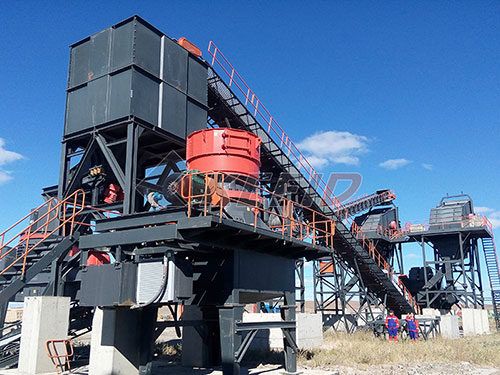
- Chamber Optimization: Simulating particle flow and breakage patterns to optimize chamber geometry (e.g., jaw plate profile) for maximum efficiency and even wear distribution.
- Throughput Verification: Predicting precise throughput rates under various conditions rather than relying on theoretical maximums.
- Power Draw Analysis: Ensuring drive motor sizing is adequate without being excessive, optimizing energy consumption—a major operational cost.
3. Structural & Mechanical Integrity Certification:
This involves Finite Element Analysis (FEA) on critical components:
- Frame Stress Analysis: Simulating peak loads from crushing forces and shock events to validate frame integrity over decades of service. Areas of high stress are identified and reinforced in design.
- Shaft & Bearing Life Analysis: Calculating dynamic loads on the eccentric shaft and verifying bearing selection for a target L10 life (often exceeding 50-100k hours).
- Toggle System Validation: Ensuring the toggle plate/beam or hydraulic system can safely absorb overloads without compromising structural health.
4. Integration & Plant Interface Design:
A crusher does not operate in isolation. The certified service includes:
- Foundation Design Recommendations: Providing dynamic load data for civil engineers to design foundations that dampen vibration and prevent settling.
- Feed Hopper & Chute Design: Engineering hoppers to ensure even distribution across the crushing chamber without dead zones or segregation; designing chutes with correct impact angles to minimize wear liners’ wear.
- Discharge System Synchronization: Ensuring discharge conveyors are sized for peak capacity with appropriate start/stop sequencing.
5. Maintenance & Serviceability Engineering:
Designing for maintainability is integral to reducing life-cycle cost. This includes:
- Component Accessibility: Designing frames with strategically placed access doors; ensuring liners can be replaced safely with standard plant tools or automated systems where applicable.
- Predictive Maintenance Planning: Identifying key wear components (jaw dies, cheek plates) and providing accurate wear life forecasts based on material testing data.
Tangible Benefits of Certification
Investing in this level of design service yields measurable returns:
- Risk Mitigation: Eliminates guesswork in sizing. The performance guarantees backed by simulation data significantly reduce the risk of under-performance—a costly error in capital-intensive industries.
- Optimized Total Cost of Ownership (TCO): While upfront engineering incurs cost, it leads to substantial savings through higher availability (less downtime), lower specific energy consumption per ton crushed optimized liner life/replacement costs reduced maintenance man-hours
.
.
.
.
.
.
.
.
.
Conclusion
The Certified JC5000 Jaw Crusher Design Service embodies modern engineering best practices applied to heavy industrial equipment It transforms what would otherwise be standard catalog item into bespoke production asset By rigorously analyzing application demands simulating performance certifying structural integrity designing seamless integration this service delivers more than machine—it delivers predictable profitable reliable comminution process For any operation where crushing availability defines profitability such comprehensive engineered approach not luxury but necessity It represents partnership between manufacturer client founded shared goal maximizing return investment through science precision engineering Ultimately certified design ensures that formidable power JC5000 jaw crusher harnessed directed most efficient effective manner possible laying foundation successful productive plant lifetime
