Certified Gold Ore Crushing Equipment Manufacturing: Standards, Technologies, and Operational Excellence
Introduction
In the global mining industry, the extraction of gold from ore is a capital-intensive, technically demanding process where profitability hinges on operational efficiency, recovery rates, and compliance with stringent international standards. Among the critical stages in the gold beneficiation flowsheet, crushing is arguably the most foundational. It is the first mechanical process that liberates gold-bearing minerals from the host rock matrix, preparing the material for downstream grinding, gravity separation, flotation, or cyanidation. Consequently, the manufacturing of certified gold ore crushing equipment has evolved into a specialized engineering discipline, governed by international quality benchmarks, safety directives, and metallurgical performance criteria. This article provides a comprehensive examination of the certified manufacturing landscape, the technical requirements for gold ore crushing, the certification frameworks that validate equipment integrity, and the operational advantages of sourcing from accredited manufacturers.
1. The Metallurgical Context: Why Gold Ore Crushing is Unique
Gold ore is not a homogeneous commodity. It varies from free-milling quartz veins to complex refractory sulfides, from alluvial placers to carbonaceous shales. The crushing circuit must therefore be designed to accommodate a wide range of physical properties: compressive strength (typically 50–300 MPa), abrasiveness (silica content), moisture levels, and clay content. Unlike aggregate production, where particle shape is often the primary concern, gold ore crushing prioritizes:
- Maximizing liberation: Reducing ore to a size where gold grains are exposed for subsequent recovery.
- Minimizing over-crushing: Producing excessive fines can lead to slime generation, which hampers gravity recovery and increases reagent consumption in leaching.
- Preserving gold particle integrity: For coarse gold, excessive impact can flatten or smear gold, complicating downstream separation.
Certified manufacturing ensures that equipment is engineered not merely to crush rock, but to do so with metallurgical predictability. This requires a deep understanding of comminution theory—specifically, the relationship between specific comminution energy (kWh/t) and particle size distribution, as modeled by the Bond Work Index and the JK Drop Weight Test.
2. Certification Frameworks Governing Crushing Equipment
The term “certified” in the context of gold ore crushing equipment is not a marketing label; it refers to verifiable compliance with a hierarchy of international, regional, and industry-specific standards. A certified manufacturer must demonstrate adherence to:
- ISO 9001:2015 (Quality Management Systems): Ensures consistent design, production, and servicing processes. For mining equipment, this extends to traceability of critical components, from manganese steel liners to hydraulic cylinders.
- ISO 14001:2015 (Environmental Management): Addresses dust suppression, noise abatement, and lubrication containment—critical for mine site environmental permits.
- CE Marking (European Conformity): Mandatory for equipment sold in the European Economic Area, covering the Machinery Directive 2006/42/EC, which mandates risk assessment, guarding, and emergency stop protocols.
- MSHA (Mine Safety and Health Administration) Compliance: For equipment deployed in U.S. mines, MSHA approval is required for electrical components, conveyor guarding, and dust control systems.
- AS/NZS 4024 (Australian Standard): Often adopted in Australasian and African operations, specifying safety distances, interlocking, and isolation procedures.
- ATEX or IECEx Certification: For equipment operating in potentially explosive atmospheres (e.g., sulfide dust), electrical components must be explosion-proof.
A certified manufacturer maintains an auditable trail: material certificates for wear parts (e.g., ASTM A128 for Hadfield steel), weld procedure specifications (WPS) qualified to ASME Section IX, and non-destructive testing (NDT) reports for critical welds. Without these, a crusher is merely a machine; with them, it is a certified asset with predictable lifecycle costs.
3. Core Equipment Types and Their Certification-Specific Design Features
Gold ore crushing typically follows a multi-stage flow: primary (jaw or gyratory), secondary (cone), and tertiary (cone or HPGR). Each stage demands distinct certified design attributes.
3.1 Primary Jaw Crushers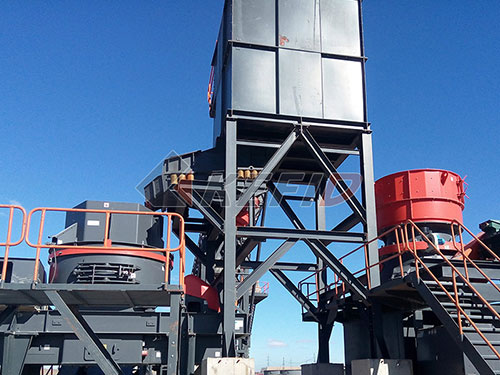
For run-of-mine (ROM) ore up to 1,200 mm, certified jaw crushers feature:
- Hydraulic wedge adjustment: Allows CSS (closed side setting) changes without manual shims, reducing downtime. Certified units include pressure-relief valves to prevent overload.
- Toggle plate as sacrificial component: Certified designs specify the exact metallurgy and dimensions to ensure it fails before the pitman or frame, protecting the core structure.
- Labyrinth seals with automatic lubrication: Certified to ISO 6743-9, preventing dust ingress—a leading cause of bearing failure in gold mines.
3.2 Secondary and Tertiary Cone Crushers
For fine crushing to 6–12 mm, certified cone crushers (e.g., high-performance models from Metso, Sandvik, FLSmidth, and Thyssenkrupp) incorporate:
- Hydroset™ or hydraulic tramp release: Certified systems must relieve uncrushable material (e.g., drill bits, bucket teeth) within milliseconds, with pressure accumulators certified to ASME BPVC Section VIII.
- Automated control systems: Certified to IEC 61508 (functional safety), these systems monitor power draw, CSS, and liner wear, adjusting feed rate to maintain choke-fed condition—essential for maximizing gold liberation.
- Liner material certification: Manganese steel (18% Mn) or martensitic alloys must be certified for hardness (HB 200–250) and impact toughness, with traceability to heat numbers.
3.3 High-Pressure Grinding Rolls (HPGR)
Increasingly adopted for gold ore, especially for heap leach and refractory applications, certified HPGRs require:
- Roll surface protection: Tungsten carbide studs or hardfacing certified to withstand abrasion, with wear measurement protocols.
- Hydraulic system certification: Operating pressures up to 300 bar, with hoses and fittings certified to EN 853 or SAE J517.
- Frame integrity: Finite element analysis (FEA) validated by physical strain gauging, with certification to AS 4100 or AISC.
4. The Manufacturing Process: From Certified Steel to Factory Acceptance Test
A certified manufacturing facility operates under a controlled quality plan. Key stages include:
- Raw material verification: Steel plates and castings are quarantined until mill certificates and chemical analysis (OES or XRF) confirm compliance.
- Fabrication and welding: Welders are certified to ISO 9606 or ASME IX. Critical welds undergo ultrasonic testing (UT) or magnetic particle inspection (MPI).
- Machining: Bores and bearing seats are machined to tolerances of ±0.02 mm, verified by CMM (coordinate measuring machines).
- Assembly: Torque values for bolts are specified and logged. Hydraulic systems are flushed and tested to ISO 4406 cleanliness levels (typically 18/16/13).
- Factory Acceptance Test (FAT): The crusher is run under no-load and load conditions (with simulated ore or actual ore). Certified FAT includes:
- Vibration analysis (ISO 10816-3).
- Temperature rise monitoring on bearings.
- Power draw verification against nameplate.
- Safety interlock testing (e.g., pull cords, guard switches).
Only after FAT is a Certificate of Conformity issued, accompanied by a documentation package: O&M manuals, spare parts lists, wiring diagrams, and NDT reports.
5. Operational and Economic Benefits of Certified Equipment
The procurement of certified gold ore crushing equipment entails a higher initial capital expenditure—typically 10–20% above non-certified alternatives. However, the total cost of ownership (TCO) analysis reveals substantial advantages:
- Reduced unplanned downtime: Certified equipment experiences 30–40% fewer hydraulic and bearing failures, translating to 200–400 additional operating hours per year. For a 10,000 tpd gold mine, each hour of downtime costs $50,000–$100,000 in lost production.
- Predictable wear life: Certified liners and wear parts have documented wear curves, allowing planned maintenance windows. This avoids emergency shutdowns that disrupt the entire beneficiation circuit.
- Energy efficiency: Certified crushers are designed to operate near the theoretical minimum specific energy consumption. For example, a certified cone crusher may consume 1.2 kWh/t versus 1.6 kWh/t for an uncertified unit—saving 400 kWh per hour at 1,000 tph.
- Regulatory compliance: In jurisdictions like Australia, Canada, and South Africa, mine operators are legally required to use equipment certified to local safety standards. Non-compliance can result in fines, shutdowns, or criminal liability.
- Resale and financing: Certified equipment retains higher residual value and is more readily financed by banks and leasing companies, which view certification as a risk mitigant.
6. Challenges and Future Trends in Certified Manufacturing
Despite the clear benefits, certified manufacturing faces challenges:
- Supply chain complexity: Global sourcing of castings and forgings can introduce variability. Certified manufacturers mitigate this by auditing sub-suppliers to ISO 9001 and requiring material traceability.
- Customization vs. standardization: Gold ores vary widely; a certified “standard” crusher may require application-specific modifications (e.g., different liner profiles, variable speed drives). Certification must extend to these modifications.
- Digital integration: The rise of Industry 4.0 means certified equipment must include sensors for predictive maintenance. Certification bodies are developing standards for data integrity and cybersecurity (e.g., IEC 62443).
Future trends include:
- Modular certified plants: Pre-engineered, containerized crushing circuits certified as a whole, reducing site erection time.
- Electric and hybrid drives: Certified to IE4 or IE5 efficiency standards, reducing carbon footprint.
- AI-based optimization: Certified algorithms that adjust crusher parameters in real time based on ore hardness sensors (e.g., near-infrared spectroscopy).
7. Selecting a Certified Manufacturer: A Due Diligence Checklist
For mine operators, verifying certification is essential. Key questions include:
- Can the manufacturer provide a current ISO 9001 certificate with a recognized accreditation body (e.g., UKAS, ANAB)?
- Are the crushers CE-marked or MSHA-approved, with a technical file available for review?
- Does the manufacturer offer a factory acceptance test witnessed by a third-party inspector (e.g., SGS, Bureau Veritas)?
- Are wear parts traceable to heat numbers, with material test certificates (EN 10204 3.1 or 3.2)?
- Does the manufacturer provide lifecycle cost analysis and references from similar gold operations?
- Is there a documented after-sales service program, including certified technicians and genuine spare parts?
Conclusion
Certified gold ore crushing equipment manufacturing is not a bureaucratic hurdle; it is the foundation of safe, efficient, and profitable gold extraction. As ore grades decline and energy costs rise, the margin for error in comminution shrinks. Certified equipment—backed by rigorous design, traceable materials, validated testing, and international standards—delivers the reliability and performance that modern gold mines demand. For operators, the choice is clear: invest in certification upfront, or pay for uncertainty in downtime, safety incidents, and lost gold recovery. In an industry where every ounce counts, certified crushing is not a luxury—it is a strategic imperative.
