
Title: Quarry Ballast Crushing Equipment Trading Company: Market Dynamics, Pricing Structures, and Strategic Procurement
Introduction
The global railway infrastructure expansion, coupled with the relentless demand for high-grade construction aggregates, has positioned quarry ballast—the coarse, angular crushed stone laid beneath railway tracks—as a critical commodity. Unlike ordinary construction aggregate, ballast must meet stringent specifications for particle size distribution (typically 25–50 mm), angularity, flakiness index, and resistance to attrition (Los Angeles Abrasion value ≤ 25%). Producing such material requires specialized crushing circuits, which in turn drives a robust market for quarry ballast crushing equipment. A trading company operating in this niche does not merely sell machines; it acts as a technical intermediary, logistics coordinator, and financial buffer between global manufacturers (e.g., Metso, Sandvik, Terex, or Chinese OEMs like SBM and Shanghai Joyal) and end-users—quarry operators, railway contractors, and civil engineering firms.
This article provides a professional, objective, and data-driven analysis of the trading company’s role, the technical specifications of ballast crushing equipment, and the complex pricing architecture that governs this market. The focus keyword, “Quarry Ballast Crushing Equipment Trading Company Price,” will be dissected into its three core components: equipment type, trading value-add, and price determinants.
1. The Technical Landscape of Ballast Crushing Equipment
To understand pricing, one must first understand the machinery. A typical ballast production line comprises three or four stages of crushing, each with distinct equipment classes:
Primary Crushing: Jaw crushers (e.g., C106, C120) or heavy-duty impact crushers. For ballast, a jaw crusher with a feed opening of at least 800×600 mm is standard. Throughput ranges from 150 to 600 t/h. Prices for a primary jaw crusher from a tier-1 brand typically range from $150,000 to $450,000 depending on capacity and automation level.
Secondary Crushing: Cone crushers (e.g., HP300, CH440) are preferred for producing cubical shapes. A secondary cone crusher with a 200–300 t/h capacity costs between $180,000 and $520,000. Hydraulic adjustment systems and metal detection sensors add 15–20% to the base price.
Tertiary/Quaternary Crushing: Vertical Shaft Impactors (VSI) or high-speed cone crushers are used to achieve the final ballast shape (cubicity > 90%). A VSI (e.g., Barmac B7150) ranges from $120,000 to $280,000. For high-volume operations, a full tertiary circuit with screens and conveyors can exceed $1.2 million.
Screening and Washing: Vibrating screens (triple-deck) for size classification cost $40,000–$120,000 each. Washing systems (log washers, hydrocyclones) add $80,000–$250,000 if clay contamination is an issue.
Mobile vs. Stationary: Mobile crushing plants (track-mounted) command a 30–50% premium over stationary equivalents due to mobility, reduced civil works, and faster setup. A mobile jaw + cone + screen train for ballast production can cost $1.5–$3.5 million for a complete set.
2. The Role of the Trading Company: Beyond a Simple Reseller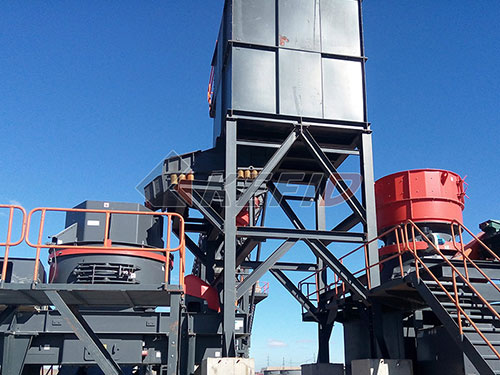
A trading company specializing in quarry ballast equipment does not manufacture; it aggregates. Its value proposition is multi-layered:
Sourcing and Quality Assurance: Trading firms maintain relationships with multiple OEMs across Europe, North America, and Asia. They perform factory audits, witness load tests, and verify compliance with ISO 9001 and CE standards. This reduces buyer risk, especially when purchasing from emerging-market manufacturers.
Customization and Engineering Support: Ballast specifications vary by railway authority (e.g., AREMA in the US, BS EN 13450 in Europe, or Indian Railways RDSO). A competent trading company reconfigures crusher settings—closed-side settings (CSS), eccentric throw, and chamber profiles—to meet these standards. This engineering consultation is often bundled into the price.
Logistics and Customs Management: Crushing equipment is heavy (a single cone crusher can weigh 20–40 tons) and often requires special permits for road transport, port handling, and inland delivery. Trading companies handle freight forwarding, marine insurance, and import duties. For a $500,000 crusher, logistics costs can add $25,000–$60,000 depending on distance (e.g., from Shanghai to Lagos vs. from Rotterdam to Warsaw).
After-Sales and Spare Parts: The true margin for trading companies often lies in spare parts (wear liners, manganese bowls, hydraulic accumulators). A typical wear parts package for a cone crusher (mantle + concave) costs $8,000–$25,000 and needs replacement every 3–6 months under continuous ballast production. Trading companies offer stock-holding agreements, reducing downtime.
Financing and Leasing: Many trading companies provide structured payment terms—e.g., 30% advance, 40% on shipment, 20% on installation, 10% after performance guarantee. Some offer leasing options with 3–5 year terms, effectively lowering the entry barrier for mid-sized quarries.
3. Price Determinants: A Multi-Factorial Model
The price quoted by a trading company for ballast crushing equipment is not a single number but a composite of several variables. Understanding these is essential for any procurement manager.
3.1. Brand and Country of Origin
European/North American OEMs (Metso, Sandvik, Terex): Premium pricing. A Metso HP300 cone crusher may cost $350,000–$550,000 with a lead time of 6–9 months. These machines offer superior automation (IC70C control system), higher resale value, and lower maintenance costs per ton.
Chinese Tier-1 OEMs (SBM, Shanghai Joyal, Liming Heavy Industry): Prices are 30–45% lower. A comparable Chinese cone crusher (e.g., Symons 4.25 ft) costs $120,000–$200,000. However, the trading company must factor in higher risk of quality inconsistency, longer commissioning time, and lower energy efficiency (often 5–10% higher power consumption per ton).
Indian and Turkish Manufacturers (e.g., Propel, Meka): Positioned in the mid-tier, with prices 20–30% below European brands but with better regional support in Africa, the Middle East, and South Asia.
3.2. New vs. Used vs. Refurbished
New Equipment: Full warranty (12–24 months), performance guarantees, and latest technology. Price includes installation supervision (usually 2–4 weeks on-site).
Used Equipment: Trading companies often source used machines from decommissioned quarries in Europe or Australia. A used 2018 Sandvik QJ341 jaw crusher might sell for $180,000–$250,000 versus $400,000+ new. However, the buyer assumes wear risk. Trading companies typically offer a 90-day mechanical warranty only.
Refurbished: The trading company replaces all wear parts, reconditions the main frame, and repaints. Price is 60–70% of new. For example, a refurbished HP200 cone crusher could be $150,000–$180,000 with a 6-month warranty. This is a popular option for budget-constrained railway projects in developing nations.
3.3. Scope of Supply (The “Package” Effect)
A trading company rarely quotes a single machine. The typical quotation includes:
Adding a complete package can increase the base machine price by 40–70%. For instance, a standalone jaw crusher at $200,000 becomes a $320,000–$340,000 package when conveyors, hopper, and electrical works are included.
3.4. Performance Guarantees and Penalty Clauses
Professional trading companies include performance tests: throughput (t/h), product gradation, and power consumption. If the equipment fails to meet the guaranteed output (e.g., 250 t/h of 25–50 mm ballast with <5% oversize), the trading company may face liquidated damages of 1–2% of contract value per week of delay. This risk is priced into the quote—typically adding 3–5% to the base price for “performance assurance.”
3.5. Market Conditions and Raw Material Costs
Steel prices (especially manganese steel for wear parts), global shipping container rates, and currency exchange fluctuations (EUR/USD/CNY) directly affect quotes. In 2023–2024, global steel plate prices rose by 18%, and ocean freight from China to West Africa increased by 35% due to Red Sea disruptions. A trading company must hedge these costs; hence, quotes are often valid for only 30–45 days.
4. Price Benchmarking: Realistic Figures (2024–2025)
Based on current market data from international tenders and trading company price lists, the following are indicative ranges for a complete ballast production line (200–300 t/h, stationary, European-branded):
For a Chinese-branded equivalent, the same package would be $550,000 – $850,000. For a mobile train (jaw + cone + screen on tracks), expect $1.8 – $2.8 million for European brands and $1.1 – $1.7 million for Chinese brands.
5. Strategic Procurement Advice for Buyers
When evaluating a trading company’s price, buyers should not focus solely on the initial CAPEX. The total cost of ownership (TCO) over a 10-year period includes:
Energy consumption: A 300 t/h line consumes 400–600 kW. At $0.10/kWh, this is $30,000–$50,000 per month. A 5% efficiency difference between brands translates to $1,500–$2,500/month.
Wear parts cost: For ballast (abrasive granite or basalt), manganese wear parts cost $0.10–$0.20 per ton of crushed material. For 1 million tons per year, this is $100,000–$200,000 annually.
Downtime cost: A trading company that offers a local spare parts warehouse and a 24-hour hotline justifies a 10–15% price premium. A single day of unplanned downtime in a railway project can cost $10,000–$50,000 in penalties.
6. Conclusion
The price of quarry ballast crushing equipment from a trading company is a sophisticated amalgamation of engineering capability, logistical complexity, brand equity, and risk mitigation. A professional trading company provides transparency in its quotation—breaking down machine cost, freight, insurance, customs, installation, and training. It does not simply sell a crusher; it sells a guaranteed production rate, a particle shape specification, and a service response time.
For a buyer, the optimal strategy is to issue a detailed technical inquiry (including ballast gradation curves, feed material characteristics, and annual production targets) to at least three trading companies—one European, one Chinese, and one regional. Compare not just the total price, but the scope exclusions (e.g., civil works, anchor bolts, first set of wear parts), the warranty terms, and the penalty clauses. In this market, the lowest quote is rarely the cheapest in the long run. A fair price for a trading company’s service is typically 8–15% above the OEM ex-works price, justified by local representation, credit terms, and after-sales coordination. Ultimately, the “price” is a contract for performance, not a transaction for hardware.
If you have any questions about our products, please feel free to contact us. We take all inquiries and suggestions very seriously.