Quarry Ballast Crushing Equipment Distributors Catalog: A Comprehensive Industry Reference
Introduction
In the global railway infrastructure and heavy construction sectors, ballast—the crushed stone layer that supports railway sleepers—remains a non-negotiable component for track stability, drainage, and load distribution. The production of high-quality ballast demands specialized crushing machinery capable of delivering consistent gradation, high cubicity, and resistance to abrasion. Consequently, the role of distributors who supply, service, and support quarry ballast crushing equipment has become increasingly critical. This article provides a professional, objective, and detailed examination of the distributor landscape, cataloging the major equipment categories, key distributor profiles, selection criteria, and emerging market trends. The goal is to serve as a practical reference for quarry operators, procurement engineers, and project managers seeking reliable sourcing channels.
1. The Nature of Ballast and Its Crushing Requirements
Before delving into distributor catalogs, one must understand the physical demands placed on crushing equipment. Railway ballast typically consists of angular, crushed hard rock (e.g., granite, basalt, quartzite, or limestone) with a nominal size range of 25–50 mm, depending on national standards (e.g., AREMA in North America, EN 13450 in Europe, or Indian Railway specifications). The crushing process must achieve:
- High reduction ratio from blasted rock (often >500 mm) to ballast size.
- Cubical particle shape – flaky or elongated particles reduce interlock and cause track settlement.
- Controlled fines generation – excessive fines (<10 mm) impair drainage and must be minimized.
- Wear resistance – ballast must withstand repeated dynamic loading without degradation.
These requirements dictate the use of multi-stage crushing circuits: primary jaw crushers, secondary cone crushers, and tertiary vertical shaft impactors (VSI) or high-pressure grinding rolls (HPGR). Additionally, screening and washing equipment are integral to the circuit.
2. Major Equipment Categories in a Distributor Catalog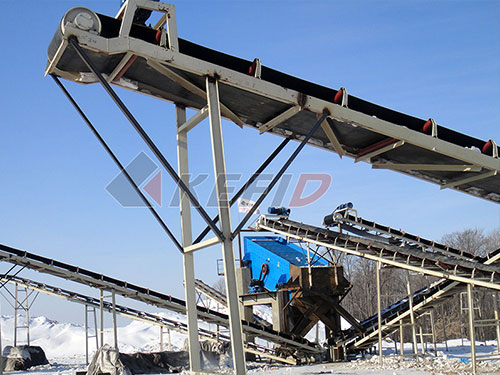
A comprehensive distributor catalog for quarry ballast crushing equipment typically organizes products into the following categories:
2.1 Primary Crushers
- Jaw Crushers – Available in capacities from 150 t/h to over 1,200 t/h. Distributors offer models with hydraulic wedge adjustment, automatic lubrication, and toggle plate protection. Leading brands include Metso (C Series), Sandvik (J Series), Terex Finlay, and McCloskey.
- Gyratory Crushers – For very large quarries (>3,000 t/h), though less common for ballast due to oversizing.
2.2 Secondary and Tertiary Crushers
- Cone Crushers – The workhorse for ballast production. Distributors list models with different chamber configurations (coarse, medium, fine) and eccentric throw settings. Key specifications include closed side setting (CSS) range (typically 6–50 mm), motor power (90–400 kW), and automation features (e.g., ASRi by Sandvik, IC series by Metso).
- Impact Crushers (Horizontal Shaft – HSI) – Used for softer rocks or as a secondary stage to improve cubicity. However, they generate more fines and are less favored for hard abrasive rock.
- Vertical Shaft Impactors (VSI) – Essential for final shaping. Distributors offer both rock-on-rock and rock-on-anvil configurations, with rotor speeds adjustable to control particle shape.
2.3 Screening Equipment
- Vibrating Screens – Multi-deck screens (typically 2–3 decks) with wire mesh or polyurethane panels. Distributors specify screen area (e.g., 6 m² to 24 m²), stroke, and inclination angle. For ballast, screens must handle high impact loads and separate oversize, product, and fines.
- Banana Screens – For high-capacity classification with variable slope.
2.4 Washing and Dewatering Systems
- Log Washers – To remove clay and silt from feed material.
- Sand Screws and Hydrocyclones – For fines recovery, though less critical for ballast (which is coarse), but often included for environmental compliance.
2.5 Auxiliary Equipment
- Feeders – Apron feeders or vibrating grizzly feeders with adjustable speed.
- Conveyors – Belt widths, lengths, and motor ratings.
- Dust Suppression Systems – Dry fog, water spray, or baghouse filters.
3. Structure of a Professional Distributor Catalog
A credible distributor catalog is not merely a list of machines. It includes:
- Technical datasheets – Dimensions, weight, power consumption, throughput curves, and wear part life estimates.
- Application guides – Recommended crusher settings for specific rock types (e.g., compressive strength, abrasiveness index).
- Spare parts inventory – Lists of manganese liners, bearings, belts, and hydraulic components with part numbers.
- Service and maintenance schedules – Preventive maintenance intervals, lubrication charts, and troubleshooting guides.
- Compliance certifications – CE marking, ISO 9001, ISO 14001, and local safety standards.
- Case studies – Real-world installations with tonnage outputs and uptime statistics.
4. Leading Distributors and Their Global Footprint
The distribution of quarry ballast crushing equipment is dominated by a mix of OEM-authorized dealers and independent multi-brand distributors. Below is an objective overview of representative players, without endorsing any single entity.
4.1 OEM-Authorized Distributors
- Metso Outotec (now Metso) – Operates a global network of authorized distributors (e.g., Wirtgen Group in some regions, local dealers in Africa, Asia, and Latin America). Their catalog emphasizes the Nordberg® and Lokotrack® series, with mobile and stationary options.
- Sandvik Rock Processing Solutions – Distributes through regional subsidiaries and certified partners. Their catalog includes CH and CS cone crusher series, plus the new CG800i gyratory range.
- Terex MPS – Through dealers like Powerscreen (for mobile) and Cedarapids (for stationary), they offer a comprehensive range of jaw, cone, and impact crushers.
4.2 Independent Multi-Brand Distributors
- H-E Parts International – A global distributor of aftermarket parts and remanufactured equipment, but also supplies new crushers from selected OEMs. Their catalog focuses on wear parts and service contracts.
- Quarry & Mining Manufacturing (QMM) – Based in Australia, they distribute and service a wide range of crushers, screens, and feeders, with a strong emphasis on custom engineering.
- BJD Crushers (UK) – Specializes in impact crushers and offers a niche catalog for ballast applications in European markets.
4.3 Regional Distributors in Emerging Markets
- Africa – Companies like Pilot Crushtec (South Africa) distribute Metso, Sandvik, and their own Doppstadt lines. Their catalog includes mobile jaw and cone crushers tailored for remote quarry sites.
- India – Distributors like Propel Industries and Puzzolana offer locally manufactured crushers with global component sourcing. Their catalogs are price-competitive and include extensive after-sales support.
- Middle East – Distributors such as Al Barrak Crushers (UAE) supply complete turnkey crushing plants, with catalogs that include primary, secondary, and tertiary stages plus screening.
5. Selection Criteria for Quarry Operators
When evaluating a distributor catalog, quarry operators should apply objective technical and commercial filters:
5.1 Technical Fit
- Feed size vs. crusher opening – Ensure the primary crusher accepts the maximum blasted rock dimension.
- Throughput capacity – Match the crusher’s nominal capacity (t/h) to the quarry’s annual production target, considering a safety factor of 10–15%.
- Product gradation – Review the crusher’s typical particle size distribution curves for the desired ballast specification. A distributor should provide test data from similar rock types.
- Power and energy efficiency – Compare specific energy consumption (kWh/t) across models. Modern cone crushers with variable frequency drives can reduce energy use by up to 20%.
5.2 Reliability and Serviceability
- Mean Time Between Failures (MTBF) – Request historical data from the distributor.
- Availability of spare parts – Check lead times for critical wear parts (manganese liners, main shafts). A distributor with local warehousing is preferable.
- Technical support – Does the distributor offer on-site commissioning, operator training, and remote diagnostics?
5.3 Total Cost of Ownership (TCO)
- Initial capital cost – Compare quotes, but do not ignore installation, foundation, and electrical costs.
- Wear part consumption – Manganese liners for cone crushers typically last 1,500–3,000 hours depending on feed abrasiveness. Ask for cost per ton of ballast produced.
- Maintenance labor – Automated lubrication and easy access to crushing chambers reduce downtime.
5.4 Compliance and Safety
- CE or OSHA compliance – Ensure guards, emergency stops, and dust control meet local regulations.
- Noise levels – Ballast plants often operate near residential areas; check sound power levels (dB) and vibration isolation options.
6. Digital Transformation in Distributor Catalogs
Modern distributor catalogs are no longer printed booklets. Leading distributors now offer:
- Interactive 3D models – Allowing engineers to rotate crushers, view internal components, and simulate wear patterns.
- Online configurators – Where operators input rock type, feed size, and target output to receive a recommended crusher model and settings.
- IoT-enabled telemetry – Distributors provide dashboards showing real-time crusher load, CSS, and wear status. This data helps predict maintenance needs and optimize ballast quality.
- Augmented Reality (AR) service manuals – Technicians can point a tablet at a crusher to see overlaid instructions for liner replacement.
7. Challenges and Future Trends
7.1 Supply Chain Disruptions – Post-pandemic, distributors face longer lead times for hydraulic components and bearings. Catalogs now include “alternative equivalent” parts to mitigate shortages.
7.2 Sustainability Pressures – Quarries are being forced to reduce carbon footprints. Distributors are responding with:
- Electric or hybrid mobile crushers (e.g., Metso’s Lokotrack e-series).
- Energy recovery systems in VSI crushers.
- Recycled ballast processing lines – where crushed old ballast is re-screened and re-crushed.
7.3 Automation and AI – Distributors are integrating AI-based vision systems that analyze crushed particle shape in real time and automatically adjust crusher settings. This is particularly relevant for ballast, where shape consistency is paramount.
7.4 Modular and Containerized Plants – For temporary or remote railway projects, distributors offer containerized crushing units that can be transported by rail or truck and assembled within days.
8. Conclusion
The distributor catalog for quarry ballast crushing equipment is a critical procurement tool that bridges the gap between engineering specifications and operational reality. A professional catalog goes beyond listing machines; it provides technical depth, application knowledge, and lifecycle support. For quarry operators, the selection of a distributor should be based on objective criteria: technical fit, reliability, total cost of ownership, and compliance. As the industry moves toward digitalization and sustainability, distributors who embrace these trends will offer the most value. Ultimately, the right distributor does not merely sell a crusher—they enable the consistent, cost-effective production of the very foundation upon which modern railways run. Whether sourcing a single cone crusher or a complete turnkey plant, a meticulous review of the distributor’s catalog, backed by site visits and reference checks, remains the most prudent path to success.
