
Quarry Ballast Crushing Equipment Company Customization: Engineering Precision for Heavy-Duty Rail Infrastructure
The global railway network—spanning over 1.3 million kilometers of track—relies on a seemingly mundane yet critically engineered material: ballast. This angular, crushed stone layer beneath sleepers distributes locomotive loads, drains water, and resists lateral track movement. Producing this ballast is not a simple matter of crushing any rock; it demands specific particle size distribution, shape, durability, and fracture faces. Consequently, quarry operators face a unique challenge: off-the-shelf crushing plants often fail to meet stringent railway standards (e.g., AREMA, EN 13450, or Indian Railways specifications). This is where quarry ballast crushing equipment company customization becomes not a luxury, but a necessity. This article provides a professional, objective examination of what customization entails, why it is indispensable, the technical parameters involved, and the strategic benefits for quarry operators.
1. The Fundamental Difference Between Aggregate Crushing and Ballast Crushing
Standard construction aggregates (e.g., for concrete or asphalt) typically require a nominal size range of 5–20 mm. Ballast, however, is a coarse aggregate with a nominal size range of 25–50 mm (or 31.5–50 mm under EN 13450), with strict limits on the percentage of undersized and oversized particles. More critically, ballast must have a high proportion of crushed faces (typically >90% for two faces), a flakiness index below 15–20%, and a Los Angeles abrasion loss of less than 20–25%. These requirements demand a crushing circuit that is fundamentally different from a standard aggregate plant.
A generic jaw crusher followed by a cone crusher may produce acceptable sizes, but it often yields elongated or flaky particles due to improper chamber geometry and inadequate reduction ratios. Customization, therefore, begins at the crusher selection stage. A ballast-specific company will engineer the primary, secondary, and tertiary stages to achieve a cubical shape, which is essential for interlocking and load-bearing capacity. For example, a customized cone crusher with a specific stroke, eccentric throw, and crushing chamber profile (e.g., short-head versus standard) can be tuned to produce the required particle shape without excessive fines generation.
2. Key Customization Parameters in Equipment Design
When a quarry operator commissions a ballast crushing equipment company, the customization process is not merely about adjusting a few settings. It involves a deep engineering review of several parameters:
Feed Material Characteristics: The company must analyze the rock type (e.g., basalt, granite, quartzite, limestone). Hardness (Mohs scale), abrasiveness (Ai index), and compressive strength (typically 150–300 MPa for ballast rock) dictate the crusher type, liner material (e.g., manganese steel vs. high-chrome), and power requirements. For instance, a high-silica quartzite demands a different mantle profile and a slower speed to prevent excessive wear, whereas a softer limestone may allow a higher throughput with a standard chamber.
Closed Side Setting (CSS) and Reduction Ratios: Ballast production requires a multi-stage reduction. A customized primary jaw crusher might be set at a CSS of 150–200 mm to produce a 0–200 mm feed for the secondary stage. The secondary cone crusher is then customized to operate at a CSS of 40–60 mm, with a specific eccentric throw to maximize the crushing force at the choke point. The tertiary crusher (often a vertical shaft impactor, VSI, or a high-performance cone) is engineered to achieve the final 25–50 mm product with a minimal amount of 0–5 mm fines (typically <10%). The company will calculate the exact reduction ratio per stage to avoid over-crushing, which wastes energy and produces unwanted dust.
Screening and Classification Systems: Customization extends to the screening deck. Ballast requires a two-deck or three-deck vibrating screen with specific aperture sizes (e.g., 50 mm top deck, 25 mm middle deck, and 5 mm bottom deck). The screen’s stroke, amplitude, and inclination angle are customized to ensure efficient stratification and to prevent blinding (clogging) by clay or fine particles. Additionally, a customized washing system may be integrated if the feed material contains excessive fines or clay, which would otherwise compromise the ballast’s drainage properties.
Wear Parts and Liner Geometry: This is perhaps the most technical aspect. A ballast-specific company will use computational fluid dynamics (CFD) and discrete element method (DEM) simulations to design the crushing chamber. The liner profile (e.g., a curved versus a straight profile) is customized to ensure that the rock is crushed by compression rather than attrition, which produces flaky particles. The company may also offer interchangeable liners for different feed conditions—e.g., a coarse liner for primary crushing and a fine liner for the final shaping stage.
3. The Customization Process: From Site Audit to Commissioning
A reputable ballast crushing equipment company does not sell a standard plant. Instead, it follows a structured engineering protocol:
Step 1 – Site and Material Audit: Engineers visit the quarry to collect representative rock samples. These are subjected to laboratory tests: point load index, Los Angeles abrasion, sodium sulfate soundness, and petrographic analysis. The results determine the crusher type, power rating, and wear material.
Step 2 – Process Flow Design: Based on the audit, the company designs a customized flow sheet. For example, a typical ballast plant might include: a vibrating grizzly feeder (to remove fines <50 mm) → a jaw crusher (primary) → a secondary cone crusher → a tertiary VSI or cone crusher → a double-deck screen → a ballast storage silo. The flow sheet is optimized for maximum yield of the 25–50 mm fraction, typically targeting a 70–80% yield from the feed.
Step 3 – Equipment Sizing and Motor Selection: The company calculates the required throughput (e.g., 200–500 tons per hour) and selects the appropriate crusher model. For ballast, the motor power is often oversized by 10–15% to handle occasional oversize boulders or hard patches. The drive system (e.g., V-belt vs. direct drive) is also customized for energy efficiency and maintenance ease.
Step 4 – Automation and Control Integration: Modern customization includes a programmable logic controller (PLC) system that monitors crusher load, CSS, and conveyor speeds. The system can automatically adjust the CSS to maintain product consistency, even as the feed material hardness varies. This is critical for meeting railway specifications, which often require a tolerance of ±5 mm on the nominal size.
Step 5 – On-Site Installation and Tuning: The equipment is installed, and the company conducts a trial run. During this phase, engineers take samples every 30 minutes, perform sieve analysis, and adjust the crusher settings (e.g., eccentric speed, CSS, and screen amplitude) until the product meets the exact specification. This iterative tuning is the essence of customization—it cannot be done remotely or with a generic manual.
4. Why Standard Equipment Fails for Ballast Production
To appreciate the value of customization, one must understand the failure modes of standard equipment:
Excessive Fines Generation: A standard cone crusher set to produce 25–50 mm will typically generate 20–30% of material below 5 mm. This is unacceptable for ballast, as fines reduce drainage and cause track settlement. Customized crushers use a slower speed (e.g., 300–400 rpm vs. 600–800 rpm) and a longer crushing chamber to minimize attrition.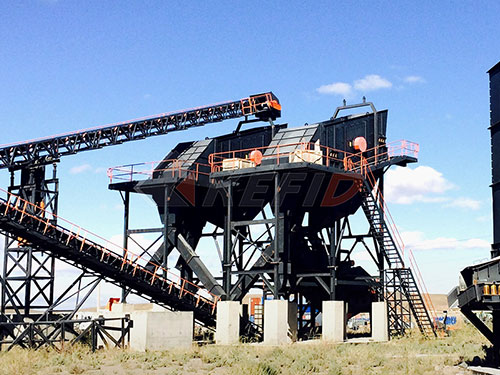
Poor Particle Shape: Standard crushers often produce a high flakiness index (30–40%), which leads to ballast that breaks down under cyclic loading. Customized crushers, especially those with a VSI stage, use a rock-on-rock crushing action to produce a cubical shape with a flakiness index below 15%.
Inconsistent Gradation: Railway specifications require a narrow gradation envelope. For example, EN 13450 requires that 100% of the material passes a 50 mm sieve, 90–100% passes a 40 mm sieve, and 0–5% passes a 25 mm sieve. A standard plant may produce a wide gradation due to inconsistent feed or inadequate screening. Customized plants use high-frequency screens with precise aperture control and a closed-circuit system (where oversize material is recirculated to the crusher) to guarantee this narrow envelope.
High Operating Costs: Standard equipment may be cheaper upfront but often has higher wear rates (e.g., 0.5 kg of liner per ton of ballast vs. 0.2 kg for customized liners). Customization includes the use of high-chrome or composite liners, which have a longer lifespan and reduce downtime.
5. Economic and Operational Benefits of Customization
Investing in a customized ballast crushing plant yields measurable returns:
Higher Yield and Profitability: A customized plant can achieve a 75–85% yield of the desired ballast fraction, compared to 50–60% for a standard plant. This directly increases revenue per ton of quarried rock.
Compliance and Market Access: Railway contracts are often long-term (5–10 years) and high-value. Only suppliers who can demonstrate consistent compliance with specifications are pre-qualified. Customized equipment ensures that the product passes third-party testing (e.g., Los Angeles abrasion <20%, magnesium sulfate soundness <5% loss) on the first attempt, avoiding costly re-crushing.
Reduced Maintenance and Downtime: Customized wear parts are designed for the specific rock type, reducing the frequency of liner changes. For example, a standard manganese liner may last 200 hours on abrasive granite, while a customized high-chrome liner may last 400 hours. This halves maintenance costs and increases plant availability.
Energy Efficiency: A customized crushing circuit uses less energy per ton of ballast because it avoids over-crushing. For instance, a properly tuned VSI can produce the final shape with 30% less energy than a standard cone crusher operating at the same setting.
6. Case Study: Customization for a High-Speed Rail Project
Consider a quarry supplying ballast for a high-speed rail line (e.g., 350 km/h). The specification requires a nominal size of 31.5–50 mm, a flakiness index <10%, and a Los Angeles abrasion loss <15%. The rock is a hard, abrasive granite with a compressive strength of 280 MPa.
A standard plant would fail due to excessive flakiness and high liner wear. A customized solution might include:
The result: a yield of 82% of the 31.5–50 mm fraction, a flakiness index of 8%, and a liner life of 450 hours. The plant operates at 350 tons per hour, meeting the project’s demand of 2 million tons over three years.
7. Selecting the Right Customization Partner
Not all equipment companies offer true customization. Quarry operators should evaluate potential partners based on:
Conclusion
Quarry ballast crushing equipment company customization is a rigorous, engineering-driven process that transforms a generic crushing plant into a precision tool for railway infrastructure. It involves a deep understanding of rock mechanics, particle shape, screening dynamics, and wear science. For quarry operators, the decision to invest in customization is not an expense but a strategic move to secure high-value railway contracts, reduce operational costs, and ensure long-term sustainability. As global rail networks expand—particularly in high-speed and heavy-haul segments—the demand for specification-compliant ballast will only grow. Those who embrace customization will lead the market; those who rely on standard equipment will be left behind, literally and figuratively, on the sidelines of the tracks.
If you have any questions about our products, please feel free to contact us. We take all inquiries and suggestions very seriously.