
ODM 250–300 TPH Stone Crushing Plant Makers: Engineering, Customization, and Global Supply Chain Dynamics
The global aggregate and mining industry is defined by a relentless demand for high-throughput, energy-efficient, and durable crushing solutions. Within this landscape, the 250–300 tons per hour (TPH) stone crushing plant occupies a strategic niche—large enough to serve commercial quarries, road construction, and dam projects, yet modular enough to be configured for varied feed materials. However, the term “ODM” (Original Design Manufacturer) in this context carries profound implications. Unlike an OEM (Original Equipment Manufacturer) that builds to a standard catalog, an ODM for 250–300 TPH plants assumes responsibility for the design architecture, process flow optimization, and often the proprietary mechanical components. This article provides a professional, objective examination of ODM makers in this specific capacity class, focusing on their engineering capabilities, customization parameters, quality assurance, and the evolving role of Chinese and international suppliers in the global market.
1. Defining the ODM Role in 250–300 TPH Crushing Systems
To appreciate the value of an ODM, one must first delineate the technical envelope of a 250–300 TPH plant. This is not a single machine but a complete system comprising primary jaw crushers (typically 900×1200 mm or equivalent), secondary cone crushers (e.g., 2200 series or HP300-class), vertical shaft impactors (VSI) for tertiary shaping, vibrating screens (2–3 decks), and a network of belt conveyors, feeders, and dust suppression units. The “ODM” label means the maker does not merely assemble off-the-shelf components. Instead, it designs the entire crushing circuit—including the surge hopper capacity, crusher cavity profiles, screen deck angles, and conveyor transfer points—based on the client’s raw material properties (hardness, abrasiveness, moisture), final product specifications (gradation, flakiness index), and site constraints (footprint, elevation, power availability).
A credible ODM in this class will have its own R&D department that performs finite element analysis (FEA) on crusher frames, dynamic simulation of the crushing chamber, and computational fluid dynamics (CFD) for dust extraction. They also hold proprietary design rights to key wear parts—such as jaw plates, mantle liners, and rotor tips—which are often cast in their own foundries. This vertical integration is critical because a 250–300 TPH plant operates under severe cyclic loading; any design flaw in the main shaft or eccentric bushing can lead to catastrophic downtime. Therefore, the ODM’s design maturity is directly proportional to the plant’s mean time between failures (MTBF).
2. Core Engineering Competencies of Leading ODM Makers
The top-tier ODM manufacturers for this capacity range—predominantly headquartered in China (e.g., Zhejiang, Henan, Shanghai clusters), with notable players in South Korea and Turkey—share several non-negotiable engineering competencies.
First, process simulation and mass balance accuracy. A 250–300 TPH plant must maintain a stable feed rate to each crusher. An ODM uses software like Bruno or AggFlow to simulate the entire circuit, ensuring that the secondary crusher receives a consistent 150–180 TPH while the tertiary screen handles the recirculating load. This prevents choke feeding or starvation, which directly impacts product shape and liner life. The ODM’s design team calculates the exact belt speed, idler spacing, and motor power for each conveyor, often using a safety factor of 1.25–1.5 to accommodate surge loads.
Second, structural integrity of the steel frame. The main crushing plant structure—including the support frames for the jaw crusher and cone crusher—must withstand dynamic vibrations of up to 6 mm/s. Leading ODMs use high-strength low-alloy (HSLA) steel (e.g., Q345B or S355JR) with a minimum yield strength of 345 MPa. They employ robotic welding with full penetration on critical joints, followed by stress-relief heat treatment. A professional ODM will provide a detailed structural calculation report, including deflection analysis under maximum eccentric load.
Third, hydraulic and lubrication system design. For a 250–300 TPH cone crusher, the hydraulic adjustment system must respond within 2–3 seconds to tramp iron passage. ODM makers design their own hydraulic power units (HPUs) with proportional valves and accumulators, ensuring smooth crusher setting changes. The lubrication system uses a dedicated oil pump with a flow rate of 80–120 L/min, equipped with dual filters (25 μm and 10 μm) and a temperature-controlled cooler. The ODM’s expertise lies in integrating these systems into a compact skid, reducing field installation time.
3. Customization Parameters: Beyond Standard Configurations
The true test of an ODM is its ability to deviate from a standard layout. For a 250–300 TPH plant, customization typically occurs along four axes:
Feed Material Variability: An ODM must design for either hard rock (granite, basalt with compressive strength >250 MPa) or softer, abrasive materials (limestone, river gravel). For hard rock, the ODM will specify a heavy-duty jaw crusher with a deeper crushing chamber and a higher eccentric throw. For river gravel, the design may incorporate a high-frequency screen to remove natural fines before the primary crusher, thereby increasing effective capacity.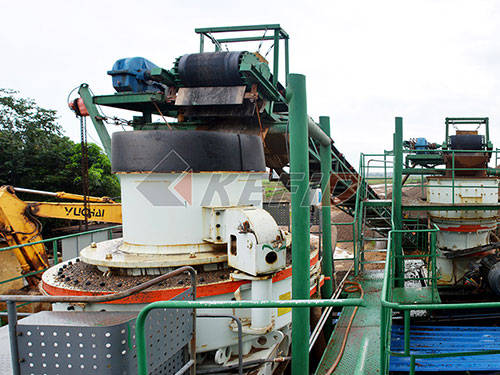
Mobility vs. Stationary: While 250–300 TPH is often considered a stationary capacity, many ODMs offer semi-mobile or skid-mounted configurations. This requires a redesign of the chassis to meet road transport width (3.5 m) and weight (≤60 tons per module) limits. The ODM must calculate the dynamic load distribution for crane lifting and ensure that the modular connections do not introduce structural weak points.
Final Product Gradation: If the client requires high-quality manufactured sand (0–5 mm) in addition to coarse aggregates, the ODM must integrate a VSI crusher with a rock-on-rock chamber and a wet or dry classification system. This changes the entire mass flow: the VSI may need a dedicated feed hopper with a variable-speed feeder to control the rotor throughput. The ODM’s expertise in air-swept classifiers or hydro-cyclones becomes essential.
Environmental Compliance: Modern ODMs design for zero-discharge water systems and dust-tight enclosures. This involves calculating the air volume for baghouse filters (typically 15,000–25,000 CFM) and designing a closed-loop water spray system with settling tanks. The ODM must also ensure that the plant’s noise level at 1 meter distance does not exceed 85 dB(A), which requires acoustic cladding on crusher housings and vibration-isolated mounts.
4. Quality Assurance and Testing Protocols
A professional ODM does not ship a plant without rigorous factory acceptance tests (FAT). For a 250–300 TPH system, the FAT includes:
No-load test run: The entire assembly—crushers, screens, conveyors—is run for 8–12 hours. Vibration amplitude on bearing housings is measured with accelerometers; acceptable values are below 2.3 mm/s RMS. Oil temperature must stabilize below 60°C.
Load test with dummy material: The ODM uses a calibrated aggregate (e.g., 0–300 mm limestone) to simulate 70% of rated capacity. This verifies the actual throughput, power draw (kW), and product gradation. The test data is compared against the simulation; a deviation of more than 5% in capacity or 10% in power draw triggers a design review.
Wear part metallurgy verification: The ODM provides a mill certificate for each batch of manganese steel (e.g., Mn13Cr2 or Mn18Cr2) used in jaw plates and cone liners. Hardness is tested to be 170–220 HB in the core and 380–450 HB on the work-hardened surface. The ODM also conducts a Charpy V-notch impact test to ensure toughness at low ambient temperatures (e.g., -20°C for cold regions).
Electrical and control system validation: The PLC (Programmable Logic Controller) is tested for all interlock sequences—e.g., if the secondary crusher trips, the feeder and primary crusher must stop within 5 seconds. The ODM verifies that the remote monitoring interface (SCADA) accurately displays motor currents, bearing temperatures, and belt deviation alarms.
5. The Global Supply Chain and ODM Advantage
The term “ODM” also implies a certain supply chain maturity. Leading makers maintain strategic inventories of critical spare parts—such as eccentric shafts, main frames, and hydraulic cylinders—at regional warehouses (e.g., Dubai, Johannesburg, Lima). This is a decisive factor for a 250–300 TPH plant, where a single bearing failure can cost $10,000–$20,000 per day in lost production. An ODM with a global parts network can guarantee a 48-hour dispatch for standard wear parts and a 7-day dispatch for major components.
Moreover, ODMs often offer a “design-build-operate” (DBO) contract, where they not only design and supply the plant but also provide a resident engineer for the first 3–6 months of operation. This is particularly valuable for clients in emerging markets where local technical expertise is scarce. The ODM’s commissioning team will train local operators on crusher setting optimization, liner rotation schedules, and predictive maintenance using vibration analysis.
6. Economic and Operational Considerations
From a capital expenditure (CAPEX) perspective, an ODM-designed 250–300 TPH plant typically costs 10–15% more than a generic OEM equivalent, but the total cost of ownership (TCO) is often lower. This is due to:
Higher energy efficiency: A well-designed crushing chamber can reduce specific energy consumption to 0.8–1.2 kWh per ton, versus 1.5–2.0 kWh for poorly matched equipment. Over a 10-year lifespan (2 million tons per year), this saves 1.4–2.8 million kWh.
Lower wear cost: Optimized liner profiles extend wear life by 20–30%. For a cone crusher processing basalt, this translates to a wear cost of $0.08–$0.12 per ton, compared to $0.15–$0.20 for generic designs.
Reduced installation time: A modular ODM design can be erected in 4–6 weeks, versus 8–10 weeks for a site-built plant. This saves $200,000–$500,000 in temporary works and lost production.
7. Selecting a Reliable ODM: Objective Criteria
When evaluating ODM makers for a 250–300 TPH plant, procurement professionals should apply the following objective criteria:
Reference plants in similar applications: Ask for a list of at least 10 installations running at 250–300 TPH for over 5 years. Verify the actual throughput and uptime (should be >90% on an annual basis).
In-house casting and machining: The ODM must own its foundry for wear parts and a heavy-duty machining workshop (e.g., 5-meter vertical lathe, 160 mm floor-type boring mill). This ensures quality control and short lead times for spare parts.
Third-party certification: The ODM should hold ISO 9001:2015 for quality management, ISO 14001 for environmental management, and CE certification for the European market. Additionally, the crushers should be tested according to ISO 21873-1 for mobile crushers or relevant national standards.
After-sales response time: The ODM must provide a written service level agreement (SLA) with a guaranteed response time for technical support (e.g., 2 hours for remote diagnostics, 72 hours for on-site engineer arrival).
8. Conclusion: The Strategic Value of ODM Partnerships
In the competitive world of aggregate production, a 250–300 TPH stone crushing plant is not a commodity purchase; it is a long-term capital investment that dictates the profitability of a quarry for decades. The ODM model offers a distinct advantage over simple equipment procurement: it aligns the manufacturer’s design incentives with the operator’s operational goals. By choosing an ODM with proven engineering depth, rigorous testing protocols, and a global supply chain, the client gains a plant that is not only tailored to their specific rock type and product mix but also backed by a partner who understands the physics of fragmentation and the economics of downtime.
The best ODM makers do not merely sell machines; they sell a process guarantee—a commitment that the plant will produce 250–300 TPH of correctly graded, cubical aggregate at the lowest possible cost per ton. As the industry moves toward automation, digital twins, and predictive maintenance, the role of the ODM will expand further, integrating sensors and AI algorithms into the very fabric of the crushing plant. For any serious investor or contractor, engaging a professional ODM is not an option but a strategic necessity to remain competitive in the global aggregates market.
If you have any questions about our products, please feel free to contact us. We take all inquiries and suggestions very seriously.