
A Comprehensive Analysis of Iron Ore Crushing Plant Factories: Capital and Operational Cost Structures
Introduction
The global steel industry, the backbone of modern infrastructure and manufacturing, relies fundamentally on a steady, cost-effective supply of iron ore. Before iron ore can be fed into blast furnaces or direct reduction plants, it must undergo a series of comminution processes to reduce its size and liberate valuable minerals from waste rock (gangue). This critical first step occurs at iron ore crushing plant factories—facilities that range from small, mobile units to massive, stationary complexes. Understanding the cost dynamics of these factories is essential for investors, operators, and industry analysts. This article provides a detailed, objective examination of the capital expenditure (CAPEX) and operational expenditure (OPEX) associated with establishing and running an iron ore crushing plant factory, while also exploring the key variables that influence these costs.
1. Defining the Scope: What Constitutes an Iron Ore Crushing Plant Factory?
An iron ore crushing plant factory is an industrial facility designed to reduce run-of-mine (ROM) ore from sizes often exceeding 1,000 mm down to a product size typically ranging from 0 to 50 mm, depending on downstream requirements (e.g., for grinding mills or direct shipping). A typical plant includes several stages:
The cost of such a factory is not a single figure but a complex function of throughput capacity, ore characteristics, location, automation level, and environmental regulations.
2. Capital Expenditure (CAPEX): The Initial Investment
CAPEX for an iron ore crushing plant factory can be broadly categorized into equipment, civil works, infrastructure, and indirect costs.
2.1 Equipment Costs
Equipment typically accounts for 40–60% of total CAPEX. For a plant with a capacity of 500 tonnes per hour (t/h), a common scale for medium-sized operations, the following estimates are indicative (in USD, 2024 basis):
Thus, equipment alone for a 500 t/h plant ranges from $1.65 million to $4.2 million. For a larger plant (2,000 t/h), equipment costs can scale non-linearly, reaching $8–15 million.
2.2 Civil Works and Infrastructure
Civil works include foundations, retaining walls, access roads, and drainage. For a stationary plant, these costs can be 20–30% of total CAPEX. A 500 t/h plant may require $500,000–$1,000,000 in civil works. Infrastructure—power supply (substation, cabling), water supply, and site preparation—adds another $300,000–$800,000.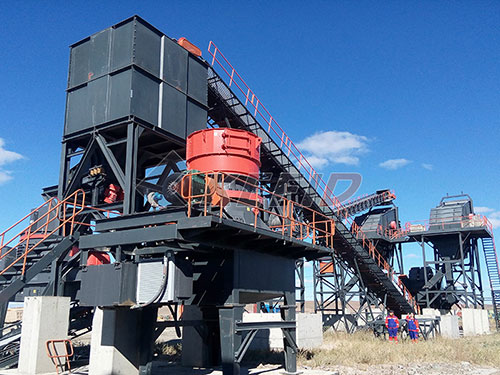
2.3 Indirect Costs
Engineering, procurement, and construction management (EPCM) fees, permits, environmental impact assessments, and contingency typically add 15–25% to the direct costs. For a 500 t/h plant, total CAPEX often falls between $3.5 million and $7 million. For a 2,000 t/h plant, CAPEX can range from $15 million to $30 million, depending on location and automation.
2.4 Mobile vs. Stationary Plants
Mobile crushing plants (track-mounted or wheel-mounted) have lower initial CAPEX for small capacities (e.g., 100–300 t/h) but higher per-tonne costs. A mobile plant for 200 t/h may cost $1.5–3 million. Stationary plants are more economical for high capacities and long mine lives.
3. Operational Expenditure (OPEX): The Ongoing Costs
OPEX is typically expressed per tonne of ore processed. Major components include energy, wear parts, labor, maintenance, and consumables.
3.1 Energy Costs
Crushing is energy-intensive. Electricity or diesel consumption depends on ore hardness (Bond Work Index), reduction ratio, and equipment efficiency. For a typical iron ore with a Bond Work Index of 12–16 kWh/t, crushing energy consumption ranges from 1.5 to 3.0 kWh/t for primary and secondary crushing. At an electricity price of $0.10/kWh, energy cost is $0.15–$0.30 per tonne. In remote locations using diesel generators, this can triple.
3.2 Wear Parts and Consumables
Crusher liners, screen meshes, and conveyor belts wear out. For hard iron ore, liner life may be 500–1,500 hours. Wear parts cost can range from $0.20 to $0.60 per tonne. Lubricants and hydraulic fluids add $0.05–$0.10 per tonne.
3.3 Labor
A 500 t/h plant may require 10–20 operators and maintenance staff per shift, with 2–3 shifts. At a fully loaded labor cost of $50,000–$100,000 per employee per year in developed countries (or $10,000–$30,000 in developing regions), labor cost per tonne ranges from $0.10 to $0.50.
3.4 Maintenance and Repairs
Planned and unplanned maintenance typically accounts for 10–20% of OPEX. This includes labor, spare parts, and external services. For a well-run plant, maintenance cost is $0.15–$0.40 per tonne.
3.5 Total OPEX
Summing these, total OPEX for a typical iron ore crushing plant ranges from $0.60 to $1.80 per tonne in developed countries, and $0.40 to $1.20 per tonne in regions with lower labor and energy costs. For a 500 t/h plant operating 6,000 hours per year (3 million tonnes annually), annual OPEX is $1.8–$5.4 million.
4. Key Factors Influencing Cost
4.1 Ore Characteristics
Hardness, abrasiveness, moisture content, and clay content drastically affect costs. High abrasiveness increases wear part consumption. High moisture causes clogging, requiring additional equipment and downtime.
4.2 Plant Capacity and Utilization
Larger plants benefit from economies of scale. CAPEX per tonne of annual capacity decreases as capacity increases. However, utilization rate is critical: a plant operating at 50% capacity has nearly double the per-tonne fixed cost.
4.3 Location and Infrastructure
Remote locations increase CAPEX for roads, power lines, and housing. They also increase OPEX for diesel, labor, and logistics. A plant near a port or existing power grid has significantly lower costs.
4.4 Automation and Technology
Higher automation reduces labor costs but increases CAPEX. Advanced process control can optimize energy and wear, lowering OPEX. The trade-off depends on labor costs and expected plant life.
4.5 Environmental and Regulatory Compliance
Dust suppression, water recycling, noise control, and permitting add to both CAPEX and OPEX. In stringent jurisdictions, environmental costs can be 10–20% of total costs.
5. Cost Estimation Example: A 1,000 t/h Stationary Plant
Consider a 1,000 t/h plant processing medium-hard iron ore, operating 6,000 hours per year (6 million tonnes annually).
6. Conclusion
The cost of iron ore crushing plant factories is highly variable, shaped by capacity, ore properties, location, and technology. CAPEX for a medium-sized stationary plant typically ranges from $3.5 million to $18 million, while OPEX ranges from $0.40 to $1.80 per tonne. For investors, the key is to conduct a detailed feasibility study that accounts for local conditions, energy prices, labor markets, and ore variability. As the steel industry moves toward lower-grade ores and stricter environmental standards, crushing plants will need to invest in more efficient, automated, and sustainable technologies—costs that must be balanced against long-term operational savings. Ultimately, a well-designed and well-managed crushing plant factory remains a cornerstone of profitable iron ore mining, and understanding its cost structure is the first step toward informed decision-making.
If you have any questions about our products, please feel free to contact us. We take all inquiries and suggestions very seriously.