
The extraction of gold from its ores is a complex metallurgical process that begins with a critical, yet often underappreciated, stage: crushing and primary processing. The efficiency, design, and specification of this initial comminution and concentration circuit directly dictate downstream recovery rates, operational costs, and overall project viability. This article provides a detailed, objective analysis of gold ore crushing equipment and processing plant specifications, covering principles, equipment selection, flow sheet design, and key technical parameters.
Gold rarely exists in pure, liberated form. It is typically encapsulated within host rocks like quartz, sulfides (pyrite, arsenopyrite), or tellurides. The primary objective of the crushing plant is to reduce the run-of-mine (ROM) ore to a specific particle size range that optimally liberates the gold particles for subsequent processes—most commonly cyanide leaching (CIL/CIP) or gravity concentration. Inadequate liberation leads to poor recovery; over-grinding increases energy consumption and can create problematic slimes. Therefore, the crushing circuit acts as the foundational preparation step.
Before any equipment is selected, thorough ore characterization is mandatory:
A modern gold processing plant typically employs a multi-stage crushing circuit.
A. Primary Crushing
The first reduction stage, handling ROM ore up to 1m in size.
B. Secondary Crushing
Further reduces primary crusher product to 50-100mm.
C. Tertiary/Quaternary Crushing
For plants requiring very fine feed (<20mm) for ball mill circuits or high-pressure grinding rolls (HPGR).
D. High-Pressure Grinding Rolls (HPGR)
An increasingly adopted technology as an energy-efficient alternative to tertiary crushing or even SAG milling.
Crushing does not occur in isolation; it is an integrated system.
A standard specification document must detail:
A. Plant Capacity & Availability
Defined as tonnes per hour (tph) based on annual throughput with a design availability factor (~75-85%). Includes surge capacity provisions via ROM pads and coarse ore stockpiles.
B. Process Flow Diagram (PFD) & Piping & Instrumentation Diagram (P&ID):
The PFD outlines the major equipment sequence—e.g., ROM Bin → Jaw Crusher → Primary Screen → Coarse Ore Stockpile → Cone Crusher(s) in closed circuit with screens → Fine Ore Stockpile → Grinding Mill Feed.The P&ID details all instrumentation for automated control loops like crusher power draw-based feed rate control or CSS adjustment.
C. Layout & Civil/Structural Design
Equipment placement must consider maintenance access headroom crane coverage truck dump pocket geometry foundation loads seismic factors
D. Electrical & Control Systems
Full specification of motor voltages soft starters/VSDs PLC/DCS system architecture instrumentation list level sensors belt scales online particle size analyzers
E. Performance Guarantees
Suppliers often guarantee:
Overall plant throughput
Final product P80 particle size
Specific power consumption kWh/t
Wear part consumption g/t
Modern plants emphasize:
Energy Efficiency HPGR adoption hybrid SAG-ball mill circuits with pebble crushing
Automation Advanced process control APC systems using real-time data to optimize CSS feeder speeds maximize throughput
Modular Pre-assembled skid-mounted crushing plants reduce capital cost time-to-production smaller remote deposits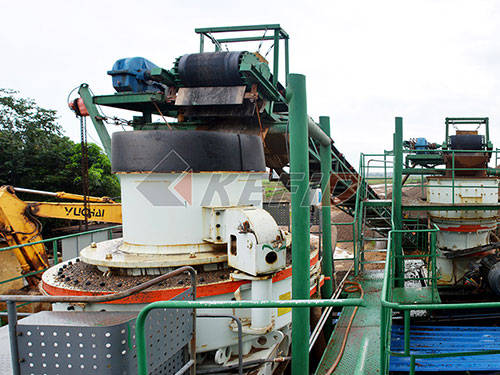
The specification of gold ore crushing equipment processing plant is a meticulous engineering discipline balancing rock characteristics economic constraints metallurgical requirements A well-specified plant one where primary secondary tertiary stages are correctly sized integrated robust auxiliary systems will deliver consistent optimally sized feed to leaching recovery circuits thereby forming the indispensable foundation upon which profitable sustainable gold extraction operations are built Continuous advancements automation energy-efficient comminution promise further evolution this critical field mineral processing
If you have any questions about our products, please feel free to contact us. We take all inquiries and suggestions very seriously.