FDA Approved 250–300 TPH Stone Crushing Plant: Technical Specifications and Operational Framework
The term “FDA Approved” in the context of a 250–300 TPH (tons per hour) stone crushing plant does not refer to direct regulatory approval by the U.S. Food and Drug Administration (FDA) for the machinery itself, as the FDA does not certify construction or mining equipment. Instead, it typically indicates that the plant’s final product—such as crushed stone aggregates used in pharmaceutical-grade filtration, food processing infrastructure, or medical facility construction—meets FDA standards for purity, particle size consistency, and contamination control. This article provides a comprehensive, professional, and objective specification of a 250–300 TPH stone crushing plant designed to produce aggregates that comply with FDA-mandated cleanliness and safety requirements.
1. Overview of the 250–300 TPH Stone Crushing Plant
A 250–300 TPH stone crushing plant is a medium-to-high capacity stationary or mobile system designed to process raw stone (e.g., granite, limestone, basalt, or dolomite) into graded aggregates. The plant is engineered for continuous operation in quarries, mining sites, or construction projects requiring large volumes of crushed material. When marketed as “FDA Approved,” the plant incorporates additional features to ensure the final product is free from hazardous contaminants, such as heavy metals, microbial growth, or chemical residues, and meets particle size specifications for sensitive applications like water filtration, pharmaceutical excipient production, or cleanroom flooring.
The plant typically consists of primary, secondary, and tertiary crushing stages, along with screening, washing, and dust suppression systems. The capacity range of 250–300 TPH is ideal for mid-scale operations, balancing throughput with operational efficiency.
2. Core Components and Technical Specifications
2.1 Primary Crushing Unit
- Equipment: Jaw crusher (e.g., PE-900×1200 or equivalent) or gyratory crusher.
- Feed Opening: 900 mm × 1200 mm (for jaw crusher) to accept boulders up to 750 mm.
- Capacity: 200–350 TPH (adjustable via closed-side setting).
- Power Requirement: 110–160 kW (electric motor).
- Material: High-manganese steel liners for wear resistance.
- FDA Compliance Feature: Sealed bearing housings to prevent lubricant leakage into the crushed material; optional stainless steel contact surfaces for food-grade applications.
2.2 Secondary Crushing Unit
- Equipment: Cone crusher (e.g., Symons 4.25 ft or HP300) or impact crusher.
- Feed Size: 100–250 mm (from primary crusher).
- Capacity: 150–300 TPH.
- Power Requirement: 220–315 kW.
- Setting Range: 20–50 mm for fine crushing.
- FDA Compliance Feature: Hydraulic adjustment system with food-grade hydraulic fluid; dust-tight seals to prevent external contamination.
2.3 Tertiary Crushing Unit (Optional for Fine Aggregates)
- Equipment: Vertical shaft impact (VSI) crusher or roll crusher.
- Feed Size: 10–40 mm.
- Capacity: 100–200 TPH.
- Power Requirement: 200–400 kW.
- Product Size: 0–5 mm, 5–10 mm, or 10–20 mm (adjustable).
- FDA Compliance Feature: Ceramic or tungsten carbide wear parts to minimize metal contamination; air classification system to remove fines.
2.4 Screening System
- Equipment: Vibrating screens (e.g., 3YK2460 or 4YK2470) with multiple decks.
- Screen Area: 6–8 m² per deck.
- Capacity: 250–350 TPH.
- Mesh Sizes: 5 mm, 10 mm, 20 mm, 40 mm (customizable).
- FDA Compliance Feature: Stainless steel screen meshes (304 or 316 grade) to prevent rust and corrosion; washable design for periodic sanitation.
2.5 Washing System (For FDA-Critical Applications)
- Equipment: Log washer or screw classifier.
- Capacity: 200–300 TPH.
- Water Consumption: 50–100 m³/hour (recycled via settling ponds).
- Purpose: Removal of clay, silt, and organic matter.
- FDA Compliance Feature: Food-grade water filtration (UV or reverse osmosis) for final rinse; automated pH monitoring to ensure neutral wash water.
2.6 Conveying and Storage
- Conveyors: Belt width 800–1200 mm; speed 1.5–2.5 m/s.
- Storage Bins: 50–100 ton capacity per bin; lined with FDA-approved epoxy coating.
- FDA Compliance Feature: Covered conveyors to prevent airborne contamination; magnetic separators and metal detectors at transfer points.
2.7 Dust Suppression and Environmental Control
- System: Water spray nozzles or dry fog system.
- Water Usage: 10–20 m³/hour.
- FDA Compliance Feature: Use of potable water for dust control; HEPA filters on exhaust vents to capture respirable crystalline silica.
3. FDA Compliance Requirements for Crushed Stone Products
To claim “FDA Approved,” the plant must produce aggregates that meet the following criteria:
- Particle Size Uniformity: 95% of material within specified sieve range (e.g., 2–4 mm for filtration media).
- Chemical Purity: No detectable levels of lead, arsenic, cadmium, or mercury (per 21 CFR 170.39).
- Microbiological Safety: Total aerobic plate count < 100 CFU/g; no E. coli or Salmonella.
- Physical Integrity: Abrasion resistance (Los Angeles test) < 30% loss; water absorption < 2%.
- Traceability: Batch records with time-stamped production data, wash water quality logs, and maintenance logs.
The plant must also undergo third-party certification by an accredited laboratory (e.g., NSF International or UL) to validate compliance.
4. Operational Parameters and Performance Metrics
- Total Installed Power: 800–1200 kW (depending on crusher types and number of screens).
- Noise Level: < 85 dB(A) at 1 meter (with enclosures).
- Footprint: 50 m × 30 m (stationary) or 30 m × 20 m (mobile).
- Crew Requirement: 4–6 operators per shift.
- Availability: > 90% (with scheduled maintenance every 500 hours).
- Energy Consumption: 0.8–1.2 kWh per ton of crushed stone.
5. Applications of FDA-Approved Crushed Stone
The output from a 250–300 TPH FDA-compliant plant is used in: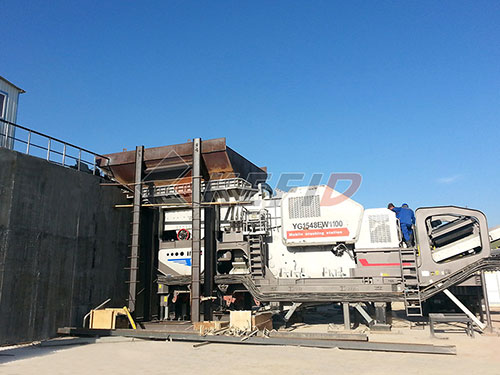
- Water Filtration: As filter media for municipal and pharmaceutical water treatment.
- Food Processing: As flooring aggregate in breweries, dairies, and meat packing plants.
- Medical Facilities: In radiation shielding concrete for MRI rooms and X-ray suites.
- Pharmaceutical Manufacturing: As excipient filler in tablet production (after further micronization).
- Cleanroom Construction: As non-shedding, anti-static aggregate in epoxy flooring.
6. Maintenance and Quality Assurance
- Daily Checks: Screen mesh integrity, conveyor belt alignment, lubricant levels.
- Weekly Checks: Crusher liner wear, dust collector filter condition, wash water pH.
- Monthly Checks: Calibration of metal detectors, replacement of HEPA filters, microbial swab testing of product contact surfaces.
- Annual Certification: Full plant audit by FDA-recognized third party; product sample analysis for heavy metals and particle size distribution.
7. Cost and Return on Investment
- Capital Cost: $2.5–4.5 million (depending on automation level and FDA upgrades).
- Operating Cost: $8–12 per ton (including labor, energy, water, and consumables).
- Market Price for FDA-Grade Aggregate: $25–40 per ton (premium over standard aggregate).
- Payback Period: 2–4 years at 250 TPH operation (10 hours/day, 250 days/year).
8. Conclusion
A 250–300 TPH stone crushing plant labeled as “FDA Approved” is a sophisticated, high-capacity system designed to produce aggregates that meet stringent purity and safety standards for sensitive industries. While the FDA does not certify the machinery itself, the plant’s design—featuring sealed components, stainless steel contact surfaces, wash systems with potable water, and rigorous quality control—ensures that the final product complies with FDA regulations for food, pharmaceutical, and medical applications. For operators seeking to enter niche markets with premium pricing, this plant represents a significant but viable investment, provided that ongoing maintenance and third-party validation are prioritized. The specification outlined above serves as a technical baseline for procurement, installation, and operation, with customization available based on specific raw material characteristics and end-use requirements.
