
Slag Crusher Plant: Private Label Manufacturer Datasheet
Document Type: Technical Datasheet and OEM/Private Label Manufacturing Overview
Revision: 1.0
Intended Audience: Procurement engineers, project consultants, EPC contractors, and industrial buyers seeking private label (OEM) slag crushing solutions.
This datasheet defines the technical, operational, and commercial parameters for a slag crusher plant offered under a private label (OEM) manufacturing arrangement. It is intended to provide a complete reference for buyers who wish to source a slag crushing plant manufactured to their own brand identity, specifications, and market positioning. The document covers process design, equipment configuration, material handling, automation, quality assurance, and the contractual framework governing private label production.
A slag crusher plant is a specialized processing facility designed to reduce metallurgical slag—typically generated by steel mills, foundries, and non-ferrous smelters—into graded, saleable aggregates and recoverable metal fractions. Unlike conventional aggregate crushing plants, slag processing requires accommodation for abrasive, variable, and occasionally hot feed material, as well as integrated metal separation to maximize recovery value and protect downstream equipment.
The plant is engineered to accept the following typical feed conditions. Actual design values are confirmed during the technical kick-off meeting and may be adjusted to suit site-specific slag chemistry.
| Parameter | Typical Range | Design Basis |
|---|---|---|
| Feed material | Steelmaking slag, blast furnace slag, ladle slag, non-ferrous slag | Per customer specification |
| Feed size (max.) | 0–600 mm (up to 800 mm on request) | 600 mm nominal |
| Bulk density | 1.4–2.2 t/m³ | 1.8 t/m³ |
| Moisture content | 2–12% | 8% |
| Temperature at feed | Ambient to 120 °C (hot-slag variants to 300 °C on request) | Ambient |
| Free metal content | 3–15% by mass | 8% |
| Abrasiveness | High (Mohs 6–7 typical) | High-abrasion duty |
The plant follows a multi-stage crush–screen–separate flowsheet, configurable in either a single-line or dual-line arrangement depending on capacity requirements.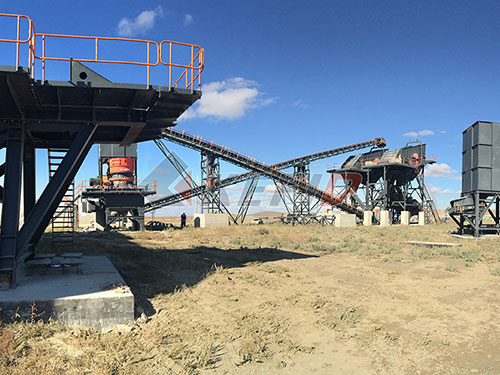
3.1 Receiving and Feeding. Run-of-mill slag is received in a reinforced feed hopper with a grizzly grid to reject oversize lumps. A heavy-duty apron feeder or vibrating grizzly feeder withdraws material at a controlled rate and discharges it onto the primary crushing stage. Feeders are lined with replaceable wear plates in abrasion-resistant steel (Hardox 450 or equivalent).
3.2 Primary Crushing. A single-toggle jaw crusher is the standard primary unit, selected for its tolerance of slabby, irregular feed and its high reduction ratio. The jaw chamber is configured with a corrugated profile suited to slag, and the discharge setting is hydraulically adjustable. An overband magnetic separator is mounted at the primary discharge conveyor to extract large ferrous pieces early in the flow, reducing wear on downstream crushers.
3.3 Secondary and Tertiary Crushing. Secondary reduction is typically performed by a cone crusher (hydraulic or spring type) in closed circuit with a vibrating screen. For finer product gradations, a tertiary vertical-shaft impactor (VSI) or high-pressure grinding arrangement may be specified. Crusher selection is finalized against the target product curve and the required liberation size for metal recovery.
3.4 Screening and Classification. Multi-deck inclined or horizontal vibrating screens classify material into the required product fractions—commonly 0–5 mm, 5–10 mm, 10–20 mm, and 20–40 mm—with provisions for custom cut points. Screen media options include woven mesh, perforated plate, and polyurethane panels, selected according to abrasion and blinding characteristics.
3.5 Metal Recovery. Ferrous recovery is achieved through a combination of overband magnets, drum magnets, and—where non-ferrous values are present—eddy current separators. A dedicated metal recovery module can be supplied as an integrated or standalone unit, with recovered metal routed to collection bins for weigh-batching and sale.
3.6 Dust and Environmental Control. The plant is supplied with a dust suppression system comprising water spray nozzles at transfer points and, optionally, a centralized baghouse filtration unit. Enclosures, chutes, and skirtboards are designed to minimize fugitive emissions. Noise attenuation is addressed through rubber-lined chutes and acoustic enclosures on crushers where required by local regulation.
| Module | Standard Supply | Options |
|---|---|---|
| Feed hopper | 15–40 m³, grizzly grid | Larger capacity, hydraulic tipping grid |
| Feeder | Apron or vibrating grizzly feeder | Variable-frequency drive |
| Primary crusher | Single-toggle jaw crusher, 600–1,000 mm feed opening | Hydraulic gap adjustment |
| Secondary crusher | Cone crusher, closed circuit | Alternative impactor |
| Tertiary crusher | VSI (as required) | HPGR for fine liberation |
| Screens | 2–4 deck inclined vibrating screens | Horizontal screens, flip-flow for damp feed |
| Magnets | Overband + drum magnets | Eddy current separator |
| Conveyors | Belt conveyors, 500–1,200 mm width | Covered galleries, weightometers |
| Control system | PLC with HMI, interlocking, fault diagnostics | SCADA integration, remote telemetry |
| Structural steel | Bolted modular design for containerized shipment | Site-welded variant |
Standard plant configurations are offered across the following nominal capacity bands, expressed as tonnes per hour of feed:
Performance guarantees are stated in terms of throughput at defined feed conditions, product gradation compliance (typically ±5% on nominated cut sizes), and metal recovery efficiency (typically 90–97% of free ferrous content, verified by mass balance during performance testing).
6.1 Branding and Identity. All plant components, nameplates, control cabinets, documentation, and software interfaces are branded to the buyer’s identity. The manufacturer operates as an undisclosed production partner; no manufacturer branding appears on delivered equipment unless expressly requested.
6.2 Design Customization. The buyer may specify flowsheet modifications, equipment make-or-buy preferences, paint systems, component brands (motors, gearboxes, bearings, PLC platforms), and documentation standards. Customization is formalized through a design freeze document prior to release to production.
6.3 Documentation Package. The private label documentation set includes: general arrangement drawings, process flow diagrams, electrical schematics, operation and maintenance manuals, spare parts catalogues, commissioning procedures, and conformity declarations—all issued under the buyer’s brand and document numbering system.
6.4 Quality Assurance. Manufacturing is conducted under an ISO 9001-certified quality system. Inspection and test plans (ITPs) are agreed with the buyer and include in-process dimensional checks, weld inspection (visual, dye penetrant, or ultrasonic as specified), static run tests, and a full no-load and load commissioning protocol. Third-party inspection (e.g., SGS, TÜV, Bureau Veritas) can be accommodated at the buyer’s nomination.
6.5 Compliance and Certification. Equipment can be supplied to CE, UKCA, or other nominated market conformity requirements, with technical files prepared in the buyer’s name. Electrical equipment is configured to the destination market’s voltage, frequency, and enclosure standards.
6.6 Intellectual Property. The buyer retains rights to the branded identity and market-facing documentation. Background intellectual property in the underlying engineering remains with the manufacturer under a license arrangement; foreground IP developed specifically for the buyer is assigned per the supply agreement. A standard OEM agreement governs exclusivity, territory, confidentiality, and minimum order quantities.
Supervision services are available for mechanical erection, electrical installation, cold and hot commissioning, and operator training. Training programs cover operational control, preventive maintenance, wear-part replacement, and safety procedures. Warranty terms are typically 12–24 months from commissioning or a defined operating-hours threshold, whichever occurs first, with extended warranty and preventive maintenance contracts available as private-label service products.
This datasheet is a technical reference and does not constitute a binding offer. Final configuration, capacity, pricing, and delivery schedule are confirmed through a formal technical-commercial proposal following review of the buyer’s feed analysis, site layout constraints, product targets, and private-label requirements. Lead times for standard configurations typically range from 16 to 30 weeks from design freeze, depending on scope and customization level.
End of Datasheet.
If you have any questions about our products, please feel free to contact us. We take all inquiries and suggestions very seriously.