Quality Control in a Professional 250–300 TPH Stone Crushing Plant: A Systematic Approach to Product Consistency and Operational Reliability
Introduction
A 250–300 tonnes-per-hour (TPH) stone crushing plant represents a substantial industrial investment, typically configured to process limestone, granite, basalt, river gravel, or similar aggregates for construction, concrete, asphalt, and railway ballast applications. At this capacity, even minor deviations in product gradation, particle shape, or equipment availability can translate into significant financial losses, contractual penalties, and reputational damage. Consequently, quality control (QC) in such a plant is not a single inspection activity but an integrated management system spanning raw material characterization, process design, real-time monitoring, laboratory testing, equipment maintenance, and final product verification.
This article examines the principal dimensions of quality control in a professional 250–300 TPH stone crushing plant, with emphasis on the technical, operational, and managerial practices required to achieve consistent output that conforms to relevant standards such as ASTM C33, EN 12620, or project-specific specifications.
1. Raw Material Quality Control
Quality control begins at the quarry face or the feed stockpile. The physical and chemical properties of the feed material fundamentally determine what the crushing circuit can achieve. Key parameters requiring routine verification include:
- Feed size distribution: Oversized boulders beyond the design feed opening of the primary crusher (typically a jaw crusher with a 900–1200 mm feed opening) cause bridging, reduced throughput, and accelerated wear. A grizzly feeder with variable-speed control and pre-screening capability is essential to scalp fines and bypass material that would otherwise choke the secondary and tertiary stages.
- Bulk density and moisture content: High moisture (above 5–8%) promotes blinding of screens, agglomeration in cone crushers, and reduced screening efficiency. In wet seasons, covered stockpiles or in-line drying may be necessary.
- Abrasiveness and compressive strength: These properties dictate the selection of wear parts (manganese liners, ceramic inserts) and the crusher chamber configuration. A professional plant maintains a petrographic and mechanical characterization file for each feed source.
- Chemical composition: For concrete aggregates, deleterious substances such as chlorides, sulfates, and reactive silica must be monitored. X-ray fluorescence (XRF) analysis at the quarry laboratory provides rapid screening.
A formal raw material acceptance procedure should specify sampling frequency (e.g., one composite sample per 2,000 tonnes), test methods, and rejection criteria. Without this, downstream QC efforts are compromised from the outset.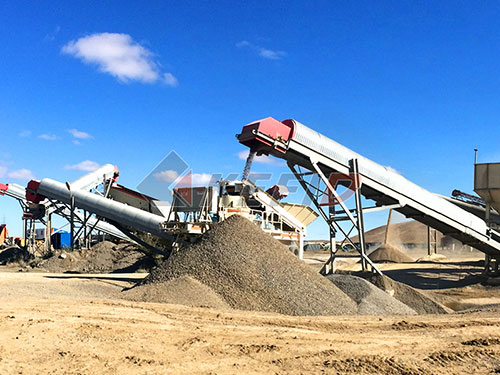
2. Process Design and Equipment Selection as a QC Foundation
Quality cannot be inspected into a product; it must be designed into the process. A 250–300 TPH plant typically employs a three-stage crushing configuration:
- Primary stage: Jaw crusher or gyratory crusher, reducing run-of-mine material to approximately 150–200 mm.
- Secondary stage: Cone crusher (e.g., HPGR or Symons-type) producing 40–60 mm material.
- Tertiary stage: Short-head cone crusher or vertical shaft impactor (VSI) for shaping and final reduction to 0–5 mm, 5–10 mm, 10–20 mm, and 20–40 mm fractions.
Critical design considerations for QC include:
- Closed-circuit operation: Tertiary crushers should operate in closed circuit with high-efficiency screens (e.g., banana screens or double-deck inclined screens) to ensure oversize recirculation and tight control of top size.
- Screen selection: Screen media type (polyurethane, rubber, or wire mesh), aperture size, and open area directly affect grading accuracy. Polyurethane decks reduce pegging and blinding in wet or sticky conditions.
- Surge bins and blending: Intermediate surge bins with variable-frequency discharge conveyors allow controlled blending of different size fractions, smoothing out short-term variations.
- Dust suppression and sealing: Enclosed transfer points, baghouse filters, and water spray systems not only meet environmental regulations but also prevent contamination of product stockpiles.
3. In-Process Monitoring and Automation
Modern 250–300 TPH plants increasingly rely on instrumentation and control systems to maintain quality in real time. A professional QC regime integrates:
- Belt scale and weighbridge data: Continuous measurement of feed rate and product tonnage allows calculation of yield and detection of unexpected losses.
- Crusher setting control: Hydraulic adjustment of cone crusher closed-side setting (CSS) with position feedback ensures consistent reduction ratios. Automatic CSS compensation for liner wear is a standard feature in premium crushers.
- Power draw monitoring: Motor current or power draw correlates with crushing force and chamber filling. Sudden increases may indicate tramp metal, packing, or excessive fines.
- Online particle size analysis: Laser diffraction or image-based analyzers installed on conveyor belts provide near-real-time gradation data, enabling operators to adjust screens or crusher settings before out-of-spec material reaches the stockpile.
- SCADA and PLC integration: A centralized control room with trend logging, alarm management, and historical data storage supports root-cause analysis and continuous improvement.
4. Laboratory Testing and Product Certification
Despite automation, physical laboratory testing remains the cornerstone of QC. A plant of this capacity should maintain an on-site laboratory capable of performing:
- Sieve analysis (gradation): Performed at least once per shift for each product fraction, using ASTM C136 or EN 933-1. Results are plotted against specification envelopes.
- Fineness modulus: For fine aggregate (0–5 mm), ensuring compliance with concrete mix design requirements.
- Particle shape indices: Flakiness and elongation indices (e.g., EN 933-3 and EN 933-4) are critical for asphalt and railway ballast. VSI crushers are typically employed to improve shape.
- Los Angeles abrasion and Micro-Deval: Assessing mechanical durability for high-wear applications.
- Soundness (sodium or magnesium sulfate): For freeze-thaw resistance.
- Clay lumps, friable particles, and lightweight particles: Deleterious content determination.
- Moisture content: For yield adjustment and concrete batching.
Sampling must follow a statistically valid protocol—preferably using automatic samplers on conveyor belts rather than manual grab samples, which are prone to bias. Chain of custody documentation and retention of reference samples for at least 90 days are recommended.
5. Stockpile Management and Contamination Control
Even a perfectly crushed product can be degraded by poor stockpile practices. Segregation occurs when material is discharged from a single point, causing coarse particles to roll to the periphery while fines remain in the center. Mitigation measures include:
- Using telescopic or radial stackers to build layered stockpiles.
- Limiting stockpile height to reduce compaction and segregation.
- Separating different fractions with physical barriers (concrete walls or earth berms) to prevent cross-contamination.
- Covering fine aggregate stockpiles to control moisture and prevent windborne loss.
- Avoiding traffic over stockpiles, which introduces foreign material and creates unstable zones.
6. Equipment Maintenance and Wear Part Management
Quality control is inseparable from maintenance management. Worn jaw plates, concave liners, mantle, and screen media produce off-spec material long before catastrophic failure occurs. A professional plant implements:
- Preventive maintenance schedules based on operating hours or tonnage processed.
- Wear measurement records: Regular measurement of liner thickness and screen aperture dimensions.
- Critical spares inventory: Ensuring that replacement liners, screens, and bearings are available to avoid extended downtime.
- Root-cause failure analysis: Investigating repeated failures to eliminate systemic issues rather than merely repairing symptoms.
7. Documentation, Traceability, and Continuous Improvement
A robust QC system generates records that demonstrate conformity to customers, regulators, and auditors. Essential documentation includes:
- Daily production and quality reports.
- Test certificates for each product batch.
- Calibration records for all weighing, measuring, and testing equipment.
- Non-conformance reports and corrective action logs.
- Training records for QC personnel.
Continuous improvement should be driven by statistical process control (SPC). Control charts for key parameters (e.g., percentage passing a critical sieve) help distinguish random variation from assignable causes, enabling timely intervention.
Conclusion
Quality control in a professional 250–300 TPH stone crushing plant is a multi-layered discipline that begins with raw material characterization and extends through process design, automation, laboratory testing, stockpile management, maintenance, and documentation. At this production scale, the cost of poor quality—rejected shipments, rework, customer claims, and downtime—far exceeds the investment required to implement a rigorous QC program. By integrating real-time monitoring with disciplined laboratory verification and a culture of continuous improvement, operators can consistently deliver aggregates that meet the most demanding specifications, ensuring both structural integrity in end-use applications and long-term profitability for the enterprise.
