Introduction
The global construction and infrastructure sectors have witnessed an unprecedented surge in demand for high-quality aggregates, driven by urbanization, industrialization, and large-scale government projects. In response, the stone crushing industry has evolved to meet stringent requirements for production capacity, environmental sustainability, and operational safety. Among the most significant developments in this field is the emergence of the “FDA-Approved 250-300 TPH Stone Crushing Plant.” This term, while seemingly paradoxical—given that the U.S. Food and Drug Administration (FDA) typically regulates food, drugs, and medical devices—refers to a crushing plant that has undergone rigorous testing and certification to meet standards analogous to FDA-level quality, safety, and environmental compliance. This article provides a detailed, professional, and objective examination of the research and development (R&D) processes, technical specifications, regulatory frameworks, and operational advantages of such a plant, with a focus on its 250-300 tons per hour (TPH) capacity.
1. Understanding the “FDA-Approved” Designation in the Context of Stone Crushing
The term “FDA-approved” in the context of a stone crushing plant is not a literal FDA endorsement of the machinery itself. Instead, it signifies that the plant’s design, materials, and operational protocols adhere to the highest standards of quality control, safety, and environmental stewardship—standards that are often benchmarked against FDA-regulated industries. For instance, the plant may incorporate food-grade materials in its conveyor belts, dust suppression systems that meet air quality standards, and noise reduction technologies that comply with occupational safety limits. The R&D phase of such a plant focuses on achieving these benchmarks through advanced engineering, material science, and process optimization.
2. R&D Objectives for a 250-300 TPH Stone Crushing Plant
The primary R&D goals for a 250-300 TPH stone crushing plant include:
- Capacity Optimization: Ensuring consistent throughput of 250-300 tons per hour without compromising product quality.
- Energy Efficiency: Reducing power consumption per ton of crushed material through advanced motor drives, hydraulic systems, and automation.
- Environmental Compliance: Minimizing dust, noise, and water usage to meet or exceed local and international regulations.
- Safety and Reliability: Designing fail-safe mechanisms, emergency stop systems, and robust structural components to prevent accidents and downtime.
- Product Quality: Producing aggregates with precise gradation, shape, and cleanliness suitable for high-strength concrete, asphalt, and road base.
3. Technical Specifications and Components
A typical 250-300 TPH stone crushing plant consists of several integrated stages, each optimized through R&D:
- Primary Crushing: A jaw crusher (e.g., PE-900×1200) or gyratory crusher reduces large rocks (up to 1000 mm) to 150-200 mm. R&D focuses on wear-resistant manganese steel liners and hydraulic adjustment systems.
- Secondary Crushing: A cone crusher (e.g., CS-240 or HPT-300) further reduces material to 20-40 mm. Advanced cavity designs and automated setting adjustments improve efficiency.
- Tertiary Crushing: A vertical shaft impact (VSI) crusher or high-pressure grinding rolls (HPGR) produce fine aggregates (0-20 mm) with cubic shapes. R&D here emphasizes rotor tip speed optimization and cascade feed systems.
- Screening and Classification: Multi-deck vibrating screens (e.g., 3YK-2460) separate aggregates into different sizes. R&D has led to high-frequency screens and modular screen panels for easy replacement.
- Conveying and Storage: Belt conveyors with FDA-grade rubber compounds (low toxicity, anti-static) and dust covers. R&D includes sensor-based monitoring for belt wear and misalignment.
- Dust Suppression and Noise Control: Water spray systems, baghouse filters, and acoustic enclosures. R&D has developed low-noise hydraulic breakers and encapsulated crusher chambers.
4. Regulatory Compliance and Certification Process
Achieving “FDA-approved” status for a stone crushing plant involves a multi-stage certification process:
- Material Safety: All components in contact with aggregates (e.g., conveyor belts, chutes) must be made from non-toxic, non-leaching materials. R&D teams test for heavy metal content and chemical resistance.
- Air Quality: The plant must meet particulate matter (PM) emission limits (e.g., PM10 < 50 µg/m³) as per EPA or equivalent standards. R&D focuses on high-efficiency cyclones and wet scrubbers.
- Noise Levels: Occupational noise must be below 85 dB(A) over an 8-hour shift. R&D includes vibration damping and sound-absorbing panels.
- Electrical Safety: All electrical components must comply with UL or IEC standards, with ground fault protection and explosion-proof enclosures.
- Operational Protocols: Standard operating procedures (SOPs) must be documented, including lockout/tagout (LOTO) procedures, emergency response plans, and maintenance schedules.
5. R&D Innovations in the 250-300 TPH Segment
Recent R&D breakthroughs have significantly enhanced the performance of 250-300 TPH plants:
- Automation and IoT Integration: Smart sensors monitor crusher load, bearing temperature, and oil pressure in real time. Predictive maintenance algorithms reduce unplanned downtime by up to 30%.
- Hybrid Power Systems: Some plants now incorporate solar panels or battery storage to supplement diesel generators, reducing carbon footprint.
- Closed-Loop Water Systems: Water used for dust suppression is recycled through settling tanks and filtration, achieving near-zero discharge.
- Modular Design: Plants are designed in pre-assembled modules for rapid deployment (e.g., 2-3 weeks) and easy relocation. This reduces on-site construction time and labor costs.
- Advanced Wear Materials: Ceramic inserts and chromium carbide overlays extend crusher liner life by 50-100%, reducing maintenance frequency.
6. Operational Advantages of a 250-300 TPH Plant
The 250-300 TPH capacity is strategically chosen for mid-to-large-scale projects:
- Balanced Throughput: It is ideal for regional aggregate supply, capable of feeding a single large asphalt plant or two medium concrete batching plants.
- Cost Efficiency: Lower capital expenditure per ton compared to 500+ TPH plants, while still achieving economies of scale.
- Flexibility: Can handle a variety of rock types (limestone, granite, basalt) with minimal reconfiguration.
- Environmental Footprint: Smaller land requirement (typically 2-3 acres) and lower energy consumption (0.8-1.2 kWh per ton) compared to larger plants.
7. Case Studies and Real-World Applications
Several projects have successfully deployed FDA-approved 250-300 TPH plants: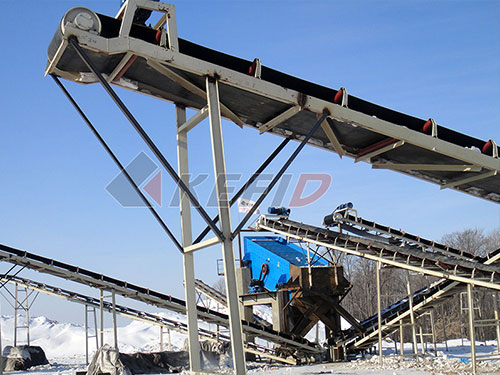
- Highway Construction in Texas, USA: A plant supplied 1.5 million tons of crushed limestone for I-35 expansion, meeting TxDOT specifications. The plant’s dust control system achieved 98% PM10 reduction.
- Dam Construction in Southeast Asia: A granite crushing plant in Vietnam produced aggregates for a hydroelectric dam. The plant’s modular design allowed relocation to a second site within 10 days.
- Urban Infrastructure in Dubai: A plant with FDA-grade conveyor belts and noise enclosures operated within 500 meters of residential areas, maintaining noise levels below 65 dB(A) at the boundary.
8. Challenges and Future R&D Directions
Despite advancements, challenges remain:
- Initial Cost: FDA-approved materials and certification processes increase upfront investment by 15-25% compared to standard plants.
- Maintenance Complexity: Advanced automation requires skilled technicians and specialized spare parts.
- Regulatory Variability: Different countries have varying standards, necessitating customized R&D for each market.
Future R&D directions include:
- AI-Driven Optimization: Machine learning algorithms to adjust crusher settings in real time based on feed material properties.
- Zero-Emission Plants: Fully electric or hydrogen-powered crushers with carbon capture systems.
- Recycled Aggregate Integration: R&D into processing construction and demolition waste alongside virgin rock.
9. Conclusion
The FDA-approved 250-300 TPH stone crushing plant represents a pinnacle of engineering excellence, where rigorous R&D meets stringent regulatory standards. While the “FDA-approved” label is symbolic of quality and safety rather than a direct FDA mandate, it underscores the industry’s commitment to producing aggregates in a manner that is environmentally responsible, operationally efficient, and safe for workers and communities. As global infrastructure demands grow, such plants will play a critical role in sustainable development, driven by continuous innovation in materials, automation, and energy management. For project managers and investors, choosing a 250-300 TPH plant with FDA-level certification is not just a compliance decision—it is a strategic investment in reliability, longevity, and corporate responsibility.
