
Eco-Friendly Gold Ore Crushing Equipment: Sample Configurations and Technical Evaluation
Abstract
The gold mining industry faces increasing pressure to reduce its environmental footprint while maintaining economic viability. Comminution, particularly crushing, is one of the most energy-intensive stages in gold ore processing. This article examines representative samples of eco-friendly gold ore crushing equipment, focusing on technical configurations, energy efficiency, dust and noise control, and integration with downstream processes. The objective is to provide a professional, objective reference for engineers, project developers, and environmental managers evaluating sustainable crushing solutions.
1. Introduction
Gold ore crushing typically involves primary, secondary, and tertiary stages to reduce run-of-mine material from up to 1,000 mm to below 10–20 mm before grinding. Conventional equipment—jaw crushers, cone crushers, and impact crushers—is effective but often associated with high energy consumption, dust generation, noise, and potential mercury or cyanide exposure in artisanal contexts. Eco-friendly crushing equipment aims to mitigate these impacts through improved drive systems, optimized crushing chambers, enclosed designs, and modular configurations that facilitate dust and noise containment.
This article presents sample configurations rather than endorsing specific brands. The term “sample” refers to representative equipment types and layouts that have demonstrated environmental advantages in laboratory, pilot, or industrial settings.
2. Criteria for Eco-Friendly Crushing Equipment
An equipment sample is considered eco-friendly if it meets several of the following criteria:
3. Sample Equipment Configurations
3.1 Primary Crushing: High-Efficiency Jaw Crusher with VFD
A representative sample is a single-toggle jaw crusher equipped with a variable frequency drive and a deep crushing chamber. The VFD allows the crusher to match throughput to downstream capacity, avoiding idle running and reducing peak power demand. Energy savings of 20–25% have been reported in gold operations where feed size distribution is variable. The crusher is enclosed in a sound-attenuated housing with an integrated dust extraction port connected to a baghouse. Water misting nozzles at the feed opening suppress dust without over-wetting the ore.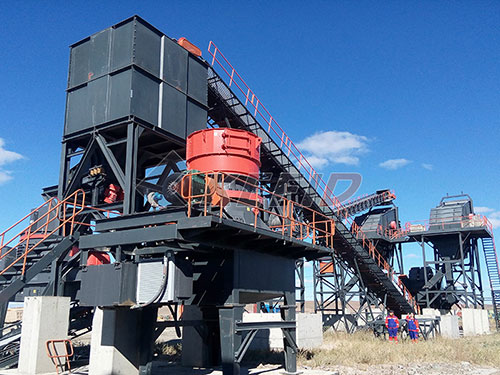
3.2 Secondary Crushing: Hydraulic Cone Crusher with Laminated Crushing Principle
For secondary reduction, a sample eco-friendly cone crusher uses a laminated crushing principle to produce a more uniform product with less fines. This reduces circulating load and energy consumption in subsequent grinding. The hydraulic adjustment system enables rapid setting changes, minimizing downtime and allowing the crusher to operate at optimal efficiency. The unit is fitted with an oil-lubricated seal system that eliminates dust ingress, extending bearing life and reducing maintenance-related waste. Noise levels are typically 80–83 dB(A) at 1 m, achieved through helical gears and rubber-mounted base frames.
3.3 Tertiary/Quaternary Crushing: High-Pressure Grinding Rolls (HPGR) as a Crushing Alternative
Although HPGR is often classified as a grinding technology, it functions as a highly efficient tertiary crusher for gold ore. A sample HPGR unit uses inter-particle comminution, which reduces energy consumption by 20–30% compared to cone crushers followed by ball mills. The HPGR produces micro-cracks in the ore, improving downstream leachability and reducing grinding energy. Environmentally, HPGR generates less dust due to the confined crushing zone and requires no grinding media, eliminating associated embodied energy and waste. Noise levels are lower than tumbling mills, and the compact footprint reduces site disturbance.
3.4 Mobile and Modular Crushing Plants
For small-scale and remote gold deposits, sample mobile crushing plants integrate a jaw crusher, cone crusher, and screen on a single chassis. These plants can be electrically driven from a hybrid diesel-battery system, reducing fuel consumption and CO₂ emissions by up to 40% compared to diesel-only drives. Dust is controlled via enclosed conveyors and water sprays. Noise is mitigated by mounting equipment on anti-vibration pads and using soundproof panels. Modular designs allow disassembly and relocation with minimal land disturbance, which is particularly beneficial for artisanal and small-scale mining (ASM) where rehabilitation is often neglected.
4. Environmental Performance Data (Illustrative Samples)
The following table summarizes typical performance ranges for the sample equipment described above. Data are drawn from published case studies and manufacturer specifications; actual results depend on ore hardness, feed size, and operating parameters.
| Equipment Sample | Specific Energy (kWh/t) | Dust Reduction vs. Baseline | Noise Level dB(A) | Key Eco-Feature |
|---|---|---|---|---|
| Jaw crusher + VFD | 0.8–1.2 | 60–80% | 82–85 | Demand-based power |
| Hydraulic cone crusher | 1.5–2.5 | 70–90% | 80–83 | Laminated crushing |
| HPGR | 1.0–1.8 | 80–95% | 78–82 | Inter-particle comminution |
| Mobile modular plant | 1.2–2.0 | 50–70% | 84–88 | Hybrid drive, enclosure |
5. Integration with Eco-Friendly Gold Recovery
Crushing equipment does not operate in isolation. Eco-friendly samples are designed to integrate with gravity separation, flotation, or cyanide-free leaching. For example, a crushing circuit that produces a narrow particle size distribution reduces the need for excessive grinding, which in turn lowers energy and reagent consumption in leaching. In mercury-free ASM, jaw crushers and cone crushers are paired with shaking tables and water-only centrifuges, eliminating mercury entirely. In larger operations, HPGR followed by bio-oxidation or thiosulfate leaching reduces cyanide use and tailings toxicity.
6. Challenges and Limitations
Eco-friendly crushing equipment often has higher capital costs than conventional alternatives. VFDs, sound enclosures, and dust extraction systems add 15–30% to upfront investment. Maintenance requirements for advanced systems may require specialized training. In remote locations, access to spare parts and qualified technicians can be limited. Furthermore, energy savings depend on consistent feed characteristics; highly variable ore hardness can reduce the benefits of VFD and HPGR. Finally, dust and noise control systems themselves consume energy and water, partially offsetting environmental gains unless designed with closed-loop water recycling.
7. Conclusion
Eco-friendly gold ore crushing equipment samples demonstrate that significant environmental improvements are technically feasible without sacrificing throughput or product quality. High-efficiency jaw crushers with VFDs, laminated cone crushers, HPGR units, and hybrid mobile plants offer reduced energy consumption, lower dust and noise emissions, and better integration with clean gold recovery methods. While capital costs and operational complexity remain barriers, the long-term benefits—lower operating costs, regulatory compliance, and reduced environmental liability—make these samples worthy of serious consideration. Future developments should focus on modular, water-lean dust suppression, and fully electric drives powered by renewable energy, further aligning gold comminution with global sustainability goals.
References
[1] Napier-Munn, T.J., et al. Mineral Comminution Circuits: Their Operation and Optimisation. JKMRC, 1996.
[2] Marsden, J.O., & House, C.I. The Chemistry of Gold Extraction. SME, 2006.
[3] van der Meer, F.P. “High Pressure Grinding Rolls for Gold Ore Processing.” Minerals Engineering, 2015.
[4] International Council on Mining and Metals (ICMM). Water and Dust Management in Mining. 2020.
[5] UN Environment Programme. Global Mercury Assessment. 2018.
If you have any questions about our products, please feel free to contact us. We take all inquiries and suggestions very seriously.