
Commercial Impact Crushers Producer: Engineering Excellence in Aggregate Processing
The global aggregate, mining, and recycling industries rely on a critical class of machinery to reduce large, unwieldy rock into usable, specification-grade material. Among the various crushing technologies—jaw, cone, and gyratory—the impact crusher occupies a unique niche. It is not merely a size-reduction tool; it is a high-velocity, high-energy device that leverages kinetic force to fracture material along natural cleavage planes. A commercial impact crusher producer is therefore not just a manufacturer of steel housings and rotors; it is an engineering partner that must balance metallurgy, physics, and application-specific customization. This article provides a professional, objective examination of what constitutes a leading commercial impact crusher producer, the technological distinctions within the product line, the manufacturing and quality assurance processes, and the evolving market dynamics that shape this specialized industry.
1. The Core Technology: Horizontal Shaft vs. Vertical Shaft
To understand the role of a commercial producer, one must first grasp the two primary architectures they manufacture. The first is the Horizontal Shaft Impactor (HSI) . In an HSI, a rotor spins horizontally at high speed, throwing feed material against stationary breaker plates or aprons. The reduction is achieved through three mechanisms: impact with the rotor bars, impact with the aprons, and inter-particle collision. HSIs are typically used in secondary and tertiary crushing applications for softer to medium-hard materials such as limestone, gypsum, and recycled concrete. Their key advantage is a high reduction ratio and a cubical product shape, which is essential for asphalt and concrete aggregate specifications.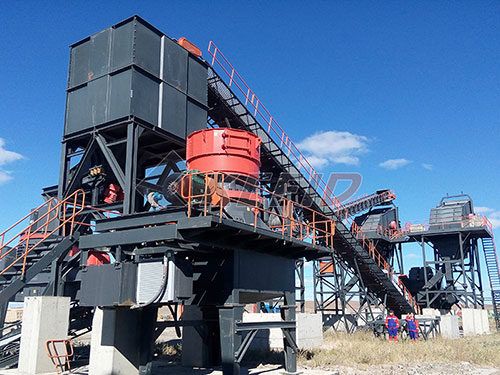
The second architecture is the Vertical Shaft Impactor (VSI) . In a VSI, material is accelerated in a high-speed rotor and then expelled against a stationary anvil ring or a rock-lined crushing chamber. VSIs are the industry standard for producing fine aggregates, manufactured sand, and premium-shaped coarse aggregate. They operate on the principle of rock-on-rock or rock-on-steel impact, offering superior particle shape and a lower wear cost per ton when processing abrasive materials.
A reputable commercial producer does not simply offer one type; they offer a portfolio. For instance, a full-line producer will provide primary impact crushers (for feed sizes up to 1,000 mm), secondary HSIs, and tertiary VSIs, alongside the necessary ancillary components like feed chutes, discharge conveyors, and hydraulic opening systems. The depth of this portfolio is a primary indicator of a producer’s engineering capability.
2. Metallurgy and Wear Life: The Economic Heart of the Machine
The commercial viability of an impact crusher is almost entirely dependent on wear part longevity. Unlike compression crushers, which crush slowly, impact crushers subject their internal components—blow bars, breaker plates, and rotor tips—to severe abrasion and repeated high-energy strikes. A leading producer invests heavily in metallurgical research. The standard material is high-chromium white iron, offering hardness in the range of 550–650 Brinell. However, for applications involving high silica content (e.g., granite or river gravel), a producer must offer composite alloys, ceramic-embedded inserts, or martensitic steel options.
The design of the blow bar itself is a matter of engineering nuance. Producers offer different profiles—striking face angles, thicknesses, and mounting systems—to optimize the angle of attack. A key innovation among top-tier producers is the reversible blow bar design, which allows the operator to flip the bar end-for-end to expose an unused edge, effectively doubling the wear life before replacement is necessary. Furthermore, the rotor body must be machined to precise tolerances to ensure dynamic balance. An unbalanced rotor at 800 RPM can generate destructive vibration, leading to bearing failure and structural fatigue. Therefore, a commercial producer must employ dynamic balancing equipment capable of correcting imbalances to within a few gram-millimeters.
3. Engineering Customization and Application Support
No two quarries are identical. Feed moisture, clay content, abrasiveness, and desired output gradation vary dramatically. A commercial impact crusher producer differentiates itself through pre-sale engineering support. This begins with a material test. Leading producers maintain laboratory-scale crushing rigs where a customer’s actual rock sample is processed to determine its Bond Work Index, abrasion index, and crushability. This data is not optional; it is the basis for calculating the required rotor power (kW), the number of blow bars, and the optimal rotor speed (peripheral velocity in meters per second).
For example, a producer may recommend a slower rotor speed (e.g., 30 m/s) for soft limestone to minimize fines, but a higher speed (e.g., 45 m/s) for hard basalt to achieve the necessary reduction. The producer must also provide detailed CAD models and installation drawings that account for the crusher’s footprint, weight distribution, and dynamic loads on the supporting structure. The best producers offer modular designs where the crusher housing can be split hydraulically, allowing for rapid maintenance access without disconnecting the entire feed system. This “serviceability by design” is a hallmark of a producer that understands total cost of ownership (TCO).
4. Manufacturing Quality Assurance and Testing
The production facility of a commercial impact crusher producer is a heavy-industrial environment requiring precision. The process begins with steel plate cutting—typically using CNC plasma or laser systems—followed by welding of the main frame. The frame must be stress-relieved in a large furnace to prevent distortion during operation. Post-weld machining of the bearing housings is critical; these are often line-bored to ensure perfect concentricity between the two main bearings.
Quality assurance extends to non-destructive testing (NDT). Ultrasonic testing of critical welds and magnetic particle inspection of the rotor shaft are standard procedures for reputable producers. Furthermore, every crusher should undergo a no-load test run prior to shipment. During this test, engineers monitor bearing temperatures, vibration levels (using accelerometers), and noise signatures. Some advanced producers use remote telemetry systems that allow them to monitor a crusher’s operational health in the field, providing predictive maintenance alerts to the end-user. This shift from reactive parts replacement to proactive condition monitoring is a defining trait of modern, technology-driven producers.
5. The Recycling and Circular Economy Segment
Beyond virgin aggregate, commercial impact crusher producers have seen explosive growth in the construction and demolition (C&D) recycling sector. Impact crushers are uniquely suited for processing reinforced concrete, asphalt millings, and brick. The key challenge here is the presence of rebar and wire mesh, which can wrap around the rotor and cause catastrophic damage. A specialized producer addresses this with features such as:
Producers who serve this market must also comply with regional emissions and noise regulations, leading to the development of fully enclosed, sound-attenuated units that can operate in urban environments.
6. Global Standards and Safety Compliance
A professional commercial producer adheres to international safety standards, including CE marking in Europe and OSHA compliance in North America. This involves the integration of safety interlocks on inspection doors, emergency stop systems, and lockout/tagout (LOTO) points. The design must also prevent the “fly-rock” hazard—ensuring that the feed chute is designed to maintain a material bed that acts as a seal against projectile ejection. Additionally, producers must provide comprehensive documentation, including detailed operation and maintenance manuals, hydraulic schematics, and a complete spare parts list with part numbers and lead times.
7. Market Dynamics and Strategic Sourcing
The global market for impact crushers is dominated by a mix of multinational conglomerates and specialized regional players. Key producers include names like Metso Outotec, Sandvik, Terex MPS, and Hazemag, alongside strong regional manufacturers in China and India. The competitive landscape is driven by three factors: energy efficiency, wear cost per ton, and automation.
Energy efficiency is becoming a critical selling point. A producer might offer a crusher with a “smart” feed control system that uses a laser level sensor in the crushing chamber to modulate the feeder speed, ensuring the crusher operates at full cavity without overloading. This reduces idle time and power consumption by up to 15%.
Wear cost per ton is the ultimate metric for a quarry operator. A producer who can demonstrate, through documented field trials, that their blow bars last 20% longer than a competitor’s—even at a 10% higher initial price—will win the contract. This requires the producer to maintain a global supply chain for high-quality alloy steel and to have in-house heat treatment facilities to control the metallurgical transformation precisely.
8. Aftermarket Support: The True Differentiator
The sale of the crusher is only the beginning. The most respected commercial impact crusher producers generate a significant portion of their revenue from aftermarket parts and service. A robust aftermarket program includes:
9. Future Trends: Automation and Digital Twins
Looking forward, the commercial impact crusher producer is transitioning into a data-centric enterprise. The integration of IoT sensors on the crusher—measuring rotor speed, bearing temperature, vibration spectrum, and hydraulic pressure—allows for the creation of a “digital twin.” This virtual model runs in parallel with the physical machine, allowing the producer to simulate wear progression and predict the optimal time for blow bar rotation or replacement. Furthermore, autonomous setting adjustment is emerging, where the crusher adjusts its gap settings based on real-time particle size analysis from downstream screens.
Conclusion
A commercial impact crusher producer is far more than a fabricator of heavy steel. The industry demands a synthesis of advanced metallurgy, dynamic mechanical engineering, rigorous quality control, and deep application knowledge. The producers that lead the market are those that understand the economic reality of their customers: the cost per ton of finished product is the only metric that matters. By offering customizable crushing chambers, wear parts engineered for specific abrasiveness, and proactive service networks, these producers enable the global infrastructure to be built efficiently and sustainably. As the demand for recycled materials and manufactured sand grows, the role of the impact crusher producer will only become more central to the circular economy of construction materials.
If you have any questions about our products, please feel free to contact us. We take all inquiries and suggestions very seriously.