CE Marked Stone Quarry Crushing Plant Manufacturer: Engineering Compliance, Safety, and Productivity in Aggregate Production
The global construction and infrastructure sectors depend on a relentless supply of high-quality aggregates—crushed stone, gravel, and sand—which are the foundational materials for concrete, asphalt, and road base. At the heart of this supply chain lies the stone quarry crushing plant, a complex assembly of feeders, crushers, screens, conveyors, and dust control systems. For any manufacturer of such equipment, obtaining the CE mark is not merely a regulatory formality; it is a comprehensive declaration of conformity with European Union (EU) health, safety, and environmental protection standards. This article provides a detailed, professional examination of what it means to be a CE-marked stone quarry crushing plant manufacturer, covering the regulatory framework, design engineering, key components, quality assurance, and the strategic advantages for global buyers.
1. The CE Mark: Beyond a Sticker – A Legal and Technical Framework
The CE (Conformité Européenne) mark is a mandatory conformity marking for products sold within the European Economic Area (EEA). For heavy machinery like stone crushing plants, the CE mark is governed by several key EU directives and regulations. A manufacturer cannot simply self-certify arbitrarily; the process requires rigorous technical documentation, risk assessment, and often third-party verification.
The primary directives applicable to a stone quarry crushing plant include:
- Machinery Directive 2006/42/EC: This is the core directive. It mandates that the machinery is designed and constructed to eliminate or reduce risks to operators and third parties. This includes guarding against moving parts, preventing unintended start-up, ensuring emergency stop functionality, and addressing ergonomic hazards. For a crushing plant, this means every nip point, rotating pulley, and discharge chute must be protected.
- Electromagnetic Compatibility (EMC) Directive 2014/30/EU: Crushing plants are heavily electrified, with large motors, variable frequency drives (VFDs), and control systems. The EMC directive ensures that the equipment does not emit electromagnetic interference that could disrupt other devices, and that it is immune to external interference.
- Low Voltage Directive 2014/35/EU: This applies to electrical equipment operating within certain voltage limits. It ensures that electrical components are safe, insulated, and prevent electric shock or fire hazards.
- ATEX Directive 2014/34/EU (if applicable): In quarries where explosive dust (e.g., coal dust or certain mineral dusts) may be present, additional ATEX certification may be required for electrical and mechanical components. While most stone quarries are not classified as ATEX zones, a responsible manufacturer will design for dust ingress protection (IP ratings) to prevent secondary risks.
A genuine CE-marked manufacturer maintains a Technical File that includes: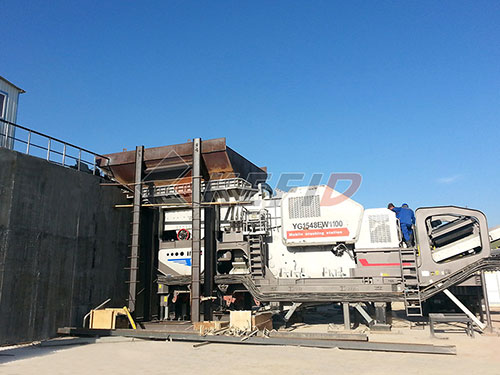
- Detailed design drawings and calculations.
- A risk assessment following EN ISO 12100 (Safety of machinery – General principles for design – Risk assessment and risk reduction).
- Instructions for installation, operation, and maintenance in all official EU languages.
- Declarations of conformity for sub-components (e.g., motors, bearings, hydraulic systems).
- Test reports for noise levels, vibration, and structural integrity.
2. Design Engineering: Structural Integrity and Process Optimization
A stone quarry crushing plant is not a single machine but an integrated system. The manufacturer’s engineering team must balance throughput, reduction ratio, energy efficiency, and structural durability. The design process begins with a thorough analysis of the feed material—hardness (e.g., granite, basalt, limestone), abrasiveness, moisture content, and maximum feed size.
Primary Crushing Stage: Typically a jaw crusher or gyratory crusher. The manufacturer must design the heavy-duty frame (usually fabricated from high-tensile steel plates) to withstand extreme impact loads. Finite Element Analysis (FEA) is used to simulate stress distribution on the crusher frame, toggle plates, and pitman. CE compliance requires that all load-bearing welds are executed by certified welders (e.g., EN 287/ISO 9606) and that non-destructive testing (NDT) such as ultrasonic or magnetic particle inspection is performed on critical welds.
Secondary and Tertiary Stages: Cone crushers, impact crushers, or vertical shaft impactors (VSI) are used to refine the aggregate shape. The manufacturer must ensure that the crushing chamber geometry is optimized for the desired product gradation. Hydraulic adjustment systems, which allow for remote setting changes, must be designed with fail-safe mechanisms to prevent accidental movement that could injure maintenance personnel.
Screening and Conveying: Vibrating screens must be dynamically balanced to minimize transmitted vibration to the supporting structure. CE compliance requires that screen decks have adequate guarding and that access platforms have anti-slip surfaces and guardrails. Conveyor systems must have emergency pull-cord switches, belt alignment sensors, and anti-rollback devices on inclined sections.
3. Safety Systems and Risk Mitigation: The Core of CE Compliance
The most critical differentiator for a CE-marked manufacturer is the depth of its safety engineering. A stone crushing plant is inherently hazardous due to high kinetic energy, heavy rotating masses, and falling rocks. The manufacturer must implement a hierarchy of controls:
- Fixed Guards: All drive belts, flywheels, and rotating shafts must be enclosed with fixed guards that require a tool for removal. These guards must be made of robust materials (e.g., perforated steel) that allow visibility but prevent access.
- Interlocking Devices: Access doors to crusher chambers, screen decks, and inspection hatches must be fitted with safety interlock switches that cut power to the system when opened. These interlocks must meet the requirements of EN 1088 (now ISO 14119) for positive-mode operation.
- Emergency Stop Systems: The plant must have strategically placed emergency stop buttons (mushroom-head, red on yellow background) that are easily accessible from all operational zones. The emergency stop circuit must be hardwired, independent of the PLC, and must remain effective even in the event of a control system failure.
- Dust and Noise Control: CE compliance also addresses environmental and occupational health. The manufacturer must integrate water spray systems or dry dust collectors at transfer points and crusher discharge. Noise levels must be measured and documented; if they exceed 80 dB(A), the manufacturer must provide hearing protection zones and signage. For enclosed control rooms, acoustic insulation is mandatory.
- Lockout/Tagout (LOTO) Provisions: The plant design must include clearly marked energy isolation points for electrical, hydraulic, and pneumatic systems. This allows maintenance crews to safely lock out energy sources before servicing.
4. Quality Assurance and Manufacturing Processes
A CE-marked manufacturer operates under a robust Quality Management System (QMS), typically aligned with ISO 9001. The manufacturing process involves several critical stages:
- Material Procurement: High-grade steel (e.g., Hardox for wear liners, S355JR for structural frames) is sourced from certified mills with mill test certificates. Bearings, seals, and hydraulic components are sourced from reputable brands (e.g., SKF, Timken, Bosch Rexroth) to ensure reliability.
- Fabrication and Machining: Large crusher frames are cut using CNC plasma or laser cutting, then welded in controlled environments to prevent distortion. Critical machining operations (e.g., bore alignment for eccentric shafts) are performed on large horizontal boring mills with tolerances within ±0.05 mm.
- Assembly and Pre-Commissioning: The entire plant is assembled at the factory on a test stand. This includes running the crusher with a dummy load (e.g., steel balls or gravel) to verify vibration levels, bearing temperatures, and oil pressure. Electrical panels are wired and tested for continuity, insulation resistance, and proper PLC logic.
- Final Inspection and Documentation: Each unit receives a CE certificate of conformity, a detailed user manual, and a spare parts list. The manufacturer must also provide a Declaration of Incorporation for partially completed machinery if the plant is to be integrated into a larger system.
5. The Role of Notified Bodies and Third-Party Testing
While some CE marking can be self-declared, for high-risk machinery like crushing plants, the involvement of a Notified Body is often required, especially for the Machinery Directive. A Notified Body (e.g., TÜV, SGS, Bureau Veritas) conducts an independent assessment of the technical file and may perform on-site inspections of the manufacturing facility. They verify that the risk assessment is comprehensive and that the safety measures are effective. For example, they may test the emergency stop response time or measure the sound pressure level at the operator’s position. The manufacturer must cooperate fully and address any non-conformities before the CE mark is affixed.
6. Customization and Modular Design for Global Projects
A professional CE-marked manufacturer does not offer a one-size-fits-all solution. Quarry conditions vary dramatically—from hard, abrasive basalt in volcanic regions to softer, moisture-laden limestone in tropical climates. The manufacturer must offer:
- Modular Crushing Plants: These are pre-engineered units that can be transported in standard containers and assembled on-site with minimal civil works. Each module is CE-certified individually, simplifying the overall certification of the complete installation.
- Mobile vs. Stationary: Mobile crushing plants (mounted on tracked or wheeled chassis) are increasingly popular for smaller quarries or temporary projects. CE compliance for mobile units includes additional requirements for road transport (e.g., braking systems, lighting, and width limits). The manufacturer must ensure that the mobile chassis is designed to withstand both crushing forces and dynamic loads during transit.
- Automation and Remote Monitoring: Modern CE-marked plants feature PLC-based control systems with human-machine interfaces (HMIs). These systems monitor crusher load, oil temperature, belt speed, and screen efficiency. CE compliance requires that the HMI is intuitive, that alarms are clearly visible, and that the system can be safely overridden in manual mode.
7. After-Sales Support and Lifecycle Compliance
The CE mark is not a one-time achievement; it represents an ongoing commitment to safety and performance. A reputable manufacturer provides:
- Installation Supervision: Engineers are dispatched to the quarry site to oversee assembly, alignment, and commissioning. They ensure that the plant is installed according to the technical file and that all safety devices are functional.
- Operator Training: Comprehensive training programs cover safe operation, routine maintenance, and emergency procedures. This training is documented and provided in the local language.
- Periodic Safety Audits: The manufacturer may offer annual inspections to ensure that the plant remains compliant with CE standards, especially after modifications or wear-related changes.
- Spare Parts and Wear Parts: Availability of genuine wear parts (jaw plates, cone liners, screen meshes) is critical. The manufacturer must maintain a global logistics network to minimize downtime.
8. Strategic Advantages of Choosing a CE-Marked Manufacturer
For international buyers, contractors, and quarry operators, selecting a CE-marked manufacturer offers several tangible benefits:
- Regulatory Compliance: The plant can be legally imported and operated in the EU and in many other countries that accept CE as a benchmark (e.g., Turkey, Middle East, parts of Africa and Asia).
- Reduced Liability: The manufacturer assumes legal responsibility for design safety. In the event of an accident, the technical file and risk assessment provide a clear defense that due diligence was exercised.
- Higher Resale Value: CE-certified equipment is easier to resell or lease in international markets.
- Insurance and Financing: Banks and insurance companies often require CE certification for heavy machinery loans and policies.
- Operational Efficiency: The rigorous design and testing process inherent in CE compliance typically results in higher reliability, lower maintenance costs, and better energy efficiency.
9. Challenges and Future Trends in CE-Compliant Crushing Plant Manufacturing
The industry is evolving rapidly. A forward-looking CE-marked manufacturer must address:
- Sustainability: Reducing carbon footprint through electric drives (instead of diesel), energy recovery systems, and the use of recycled aggregates. CE directives are increasingly focusing on eco-design (ErP Directive).
- Digitalization: Implementing IoT sensors for predictive maintenance. However, these digital systems must also comply with cybersecurity requirements under the new EU Cyber Resilience Act.
- Autonomous Operation: Semi-autonomous crushers that adjust settings based on feed size and hardness. These systems require additional safety validation to prevent unintended movement.
- Noise and Dust Reduction: Stricter local regulations are pushing manufacturers to develop fully enclosed plants with advanced filtration systems.
Conclusion
A CE-marked stone quarry crushing plant manufacturer is not merely a fabricator of steel and motors; it is a systems integrator that combines mechanical engineering, electrical safety, process optimization, and regulatory compliance into a single, cohesive product. The CE mark is a testament to a manufacturer’s engineering rigor, quality control, and commitment to protecting human life and the environment. For quarry owners and contractors, partnering with such a manufacturer ensures not only legal market access but also long-term operational reliability, lower total cost of ownership, and peace of mind. As global infrastructure demands grow, the role of these manufacturers becomes ever more critical—delivering the crushed stone that builds our roads, bridges, and cities, while upholding the highest standards of safety and compliance. Choosing a CE-marked supplier is, therefore, not an option but a strategic imperative in the modern aggregate industry.
