Bespoke Stone Crusher Machines: Cost-Effective Customization in Aggregate Processing
Introduction
In the aggregate, mining, and construction industries, stone crushing is a fundamental operation that transforms large rocks into usable sizes for applications ranging from concrete production to road base and railway ballast. While standardized, off-the-shelf crushing equipment dominates the market, a growing number of operators are turning to bespoke stone crusher machines. The term “bespoke” implies custom design and manufacture, tailored to specific feed material, output requirements, site constraints, and budget limitations. The phrase “cheap” in this context does not necessarily mean low quality; rather, it refers to cost-effective solutions that avoid unnecessary features, reduce over-engineering, and optimize the machine for the exact application. This article examines the concept of bespoke stone crusher machines from an engineering and economic perspective, exploring how customization can deliver affordable solutions without compromising core performance.
Understanding the Stone Crushing Process
Before discussing bespoke design, it is essential to understand the basic principles of stone crushing. Crushing involves reducing the size of run-of-mine or quarried rock through mechanical force: compression, impact, attrition, or shear. Different crusher types excel at different stages:
- Primary crushing: Reduces large lumps (up to 1,500 mm) to around 100–300 mm. Jaw crushers and gyratory crushers are typical.
- Secondary crushing: Further reduces to 20–100 mm. Cone crushers, impact crushers, and hammer mills are common.
- Tertiary and quaternary crushing: Produces fine aggregates (0–20 mm) and manufactured sand. Cone crushers, vertical shaft impactors (VSIs), and roller crushers are used.
Each application has unique requirements regarding feed size, moisture content, abrasiveness, throughput, product shape, and gradation. A bespoke machine is designed around these variables rather than forcing the material to fit a standard machine’s limitations.
What Makes a Stone Crusher “Bespoke”?
A bespoke stone crusher is not merely a standard model with a different paint color. It involves engineering modifications or entirely new designs based on client specifications. Key customization parameters include:
- Frame and Housing: The structural base can be reinforced or lightened depending on duty cycle. For mobile or semi-mobile applications, a bespoke frame may integrate with a specific chassis or skid.
- Crushing Chamber Geometry: The profile of the crushing chamber (e.g., in cone or jaw crushers) can be altered to match the feed size distribution and desired product curve. This is critical for achieving a cheap solution because an optimized chamber reduces energy consumption per ton.
- Material of Construction: Wear parts (liners, jaws, blow bars) can be made from different alloys—manganese steel, high-chrome iron, or ceramic composites—selected based on the rock’s abrasiveness. Using the right material avoids premature wear and costly downtime, which indirectly lowers total cost of ownership.
- Drive and Power: Motor size, pulley ratios, and transmission type can be tailored to available power supply (diesel, electric, or hybrid) and local voltage/frequency. A smaller, correctly sized motor is cheaper to purchase and operate than an oversized standard motor.
- Control Systems: From simple relay logic to PLC with touchscreen HMI, the level of automation can be scaled. A cheap bespoke machine might use manual adjustment for CSS (closed side setting) rather than hydraulic automatic control, if the operator accepts periodic manual intervention.
- Throughput and Reduction Ratio: Instead of buying a large machine that runs at 50% capacity, a bespoke unit can be designed for the exact tonnage per hour, reducing capital expenditure and energy waste.
Why “Cheap” Does Not Mean Inferior
In engineering, “cheap” often carries a negative connotation of poor quality. However, in the context of bespoke machinery, cheap can mean cost-efficient. Several factors contribute to a lower price without sacrificing reliability:
- Elimination of Redundant Features: Standard crushers often include features for the widest possible range of applications—heavy-duty frames for the hardest rock, advanced automation for variable feed, and oversized bearings for future expansion. A bespoke machine removes these redundancies, focusing only on the actual duty.
- Local Manufacturing and Sourcing: Bespoke fabrication can be done by regional workshops using locally available steel and components, reducing logistics and import tariffs. This is particularly relevant in developing markets where imported branded crushers are expensive.
- Simplified Maintenance: A simpler design with fewer proprietary parts is cheaper to maintain. For example, a bespoke jaw crusher might use standard pillow block bearings and off-the-shelf belts instead of custom-fitted sealed units.
- Right-Sizing: Over-sizing is a common mistake. A 500 t/h standard cone crusher used for a 150 t/h job wastes capital and energy. A bespoke 150 t/h unit costs less to buy and run.
- Modular Design: Some bespoke manufacturers use modular components that can be swapped or upgraded later. This allows an initial cheap configuration that can be expanded as the business grows.
Case Examples of Cost-Effective Bespoke Crushers
To illustrate, consider three real-world scenarios (based on typical industry practice):
Case 1: Small-scale recycled concrete crushing
A demolition contractor needed to process 80 t/h of concrete rubble into 0–40 mm aggregate. Off-the-shelf impact crushers were either too large (200 t/h) or too expensive. A bespoke horizontal shaft impactor was built with a 1.2 m rotor, a simplified two-bar blow bar arrangement, and a manual gap adjustment. The frame was fabricated from 20 mm mild steel plate rather than the 40 mm used in mining-duty machines. Total cost was 40% less than a comparable standard unit. The machine has operated for three years with routine maintenance.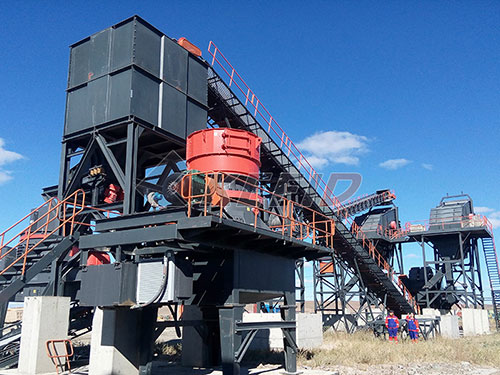
Case 2: Remote quarry with limited power
A quarry in a rural area had only a 150 kVA diesel generator. Standard cone crushers required 250 kW. A bespoke jaw crusher was designed with a 90 kW motor, a smaller eccentric throw, and a reduced speed to match the available power. Throughput was 120 t/h—sufficient for the local market. The cheap bespoke solution avoided the need for a major power upgrade.
Case 3: Manufactured sand for a specific gradation
A producer needed VSI-crushed sand with a fineness modulus of 2.8 and less than 10% passing 75 microns. Standard VSIs produced too many fines. A bespoke VSI was built with a modified rotor tip speed, a different anvil configuration, and a variable frequency drive. The cost was higher than a standard VSI but lower than importing a specialized sand plant. The cheap aspect came from avoiding the need for additional screening and washing.
Engineering Trade-offs in Bespoke Design
Designing a cheap bespoke crusher involves deliberate trade-offs. These must be clearly communicated to the client:
- Wear Life vs. Initial Cost: Using lower-cost manganese liners instead of high-chrome may reduce upfront cost but increase replacement frequency. For low-abrasion rock (e.g., limestone), this is acceptable.
- Automation vs. Labor: Manual controls reduce capital cost but require skilled operators. In regions with low labor costs, this is a valid choice.
- Throughput vs. Reduction Ratio: A single bespoke crusher can achieve a high reduction ratio, but at the expense of throughput and higher wear. Sometimes two cheaper crushers in series are more cost-effective than one complex unit.
- Portability vs. Capacity: Mobile bespoke crushers are cheaper if they use standard truck axles and tires rather than tracked undercarriages. However, tracked units offer better site access.
- Spare Parts Availability: Using non-standard parts can lower initial cost but create long-term supply risks. A balance is needed.
Economic Analysis: When Does Bespoke Become Cheap?
A cost-benefit analysis should compare bespoke versus standard over the machine’s life cycle (typically 10–20 years). Key metrics include:
- Capital Expenditure (CAPEX): Bespoke often lower by 20–50% for small to medium capacities.
- Operational Expenditure (OPEX): Energy, wear parts, labor, and maintenance. A well-designed bespoke machine can match or beat standard units in OPEX if right-sized.
- Downtime Cost: Standard machines have global spare parts networks. Bespoke machines may have longer lead times for critical spares. This must be mitigated by keeping a local stock of wear parts.
- Resale Value: Standard branded crushers hold value better. Bespoke machines may have limited resale appeal, but if the machine is used for its full life, this is less relevant.
- Financing and Leasing: Some financiers are reluctant to fund bespoke equipment. However, many small operations use cash or local credit.
In many cases, the break-even point for bespoke versus standard occurs when the required throughput is below 200 t/h and the feed material is not extremely hard or abrasive. Above 500 t/h, standard modular crushers from major manufacturers often become more economical due to economies of scale.
Design and Manufacturing Process for a Bespoke Crusher
A reputable bespoke manufacturer follows a structured process:
- Material Testing: Rock samples are tested for compressive strength, abrasiveness (e.g., Los Angeles abrasion), moisture, and particle size distribution.
- Requirement Definition: Throughput, product size, power availability, mobility, and budget are documented.
- Conceptual Design: Engineers select the crusher type (jaw, cone, impact, etc.) and sketch the general arrangement.
- Detailed Engineering: 3D CAD models, finite element analysis (FEA) for stress, and discrete element method (DEM) simulation for flow.
- Fabrication: Cutting, welding, machining, and assembly. Quality control at each stage.
- Testing: No-load run and load test with actual rock. Performance curves are generated.
- Delivery and Commissioning: On-site installation, operator training, and handover.
For a cheap bespoke machine, steps 4 and 6 may be simplified—for example, using empirical formulas instead of DEM simulation. However, skipping material testing is false economy.
Potential Risks and Mitigation
Bespoke cheap crushers carry risks:
- Under-design: The machine may fail prematurely. Mitigation: use conservative safety factors for critical components.
- Poor weld quality: Common in low-cost fabrication. Mitigation: hire certified welders and perform non-destructive testing.
- Vibration and noise: Can exceed acceptable limits. Mitigation: dynamic balancing and rubber mounts.
- Inconsistent product quality: Due to manual adjustment. Mitigation: provide clear operating procedures and a sample testing protocol.
- Regulatory compliance: CE, ISO, or local mining safety standards. Mitigation: engage a certification body early.
Market Trends and Future Outlook
The demand for bespoke stone crushers is growing, driven by several trends:
- Decentralization of aggregate production: Small quarries and recycling yards need affordable equipment.
- Rise of local fabrication shops: With CNC plasma cutters and portable welding machines, small workshops can now build reliable crushers.
- Digital design tools: Free or low-cost CAD and simulation software lowers engineering barriers.
- Circular economy: Construction and demolition waste recycling often requires custom solutions.
- Electrification: Bespoke electric crushers can be designed for renewable energy sources like solar-diesel hybrids.
However, buyers must be cautious. Not every cheap bespoke crusher is a good investment. Due diligence includes visiting the manufacturer’s workshop, checking references, and reviewing design calculations.
Conclusion
A bespoke stone crusher machine can indeed be cheap—not in the sense of being poorly made, but in being cost-effective for a specific application. By eliminating unnecessary features, right-sizing components, using local materials, and simplifying controls, a custom-built crusher can deliver the required throughput and product quality at a fraction of the cost of a standard industrial unit. The key is to work with experienced engineers who understand both crushing principles and economic constraints. For small to medium operations, especially in regions with limited access to imported equipment, bespoke cheap crushers represent a viable and often superior alternative. As with any capital investment, the lowest purchase price is not always the lowest life-cycle cost, but when designed and built correctly, a bespoke crusher can provide years of reliable service at an affordable total cost of ownership.
