
OEM Stone Quarry Crushing Plant Datasheet: A Comprehensive Technical Overview
Document Reference: OEM-SQC-DS-2025
Revision: 1.0
Prepared for: Quarry Operators, Project Engineers, and Procurement Managers
Classification: Technical Specification
An OEM (Original Equipment Manufacturer) stone quarry crushing plant datasheet is a controlled technical document that defines the performance envelope, mechanical configuration, electrical characteristics, and operational limits of a complete aggregate processing system. Unlike a generic product brochure, a datasheet issued by an OEM carries contractual weight: it specifies guaranteed throughput, product gradation, power consumption, and maintenance intervals against which acceptance testing is performed. This article provides a detailed, objective examination of the constituent sections of such a datasheet, the engineering rationale behind each parameter, and the criteria by which a plant should be evaluated prior to procurement and commissioning.
The datasheet applies to stationary, semi-mobile, and modular crushing plants designed for the reduction of blasted rock, boulders, and quarry run material into calibrated aggregates. Typical feed materials include granite, basalt, limestone, dolomite, gabbro, andesite, and certain metamorphic rocks with compressive strengths ranging from 80 MPa to 350 MPa. The document governs plants with nominal capacities between 50 t/h and 1,200 t/h, although larger custom configurations are addressed through supplementary engineering annexes.
A standard OEM crushing plant comprises four principal stages: primary crushing, secondary crushing, tertiary (and optionally quaternary) crushing, and screening with material handling. The datasheet must describe each stage unambiguously.
3.1 Primary Crushing Stage
The primary stage typically employs a jaw crusher or a gyratory crusher. For capacities below 400 t/h, a single-toggle jaw crusher is standard; above 400 t/h, a gyratory or large-format jaw crusher is specified. The datasheet states the feed opening (e.g., 1,200 × 900 mm), the maximum feed size (typically 80–85% of the feed opening), the closed-side setting (CSS) range, and the nominal throughput at a defined bulk density (usually 1.6 t/m³ for blasted granite).
3.2 Secondary Crushing Stage
Secondary reduction is normally performed by a cone crusher (standard or coarse cavity) or, in some configurations, an impact crusher. The datasheet specifies the reduction ratio, the recommended CSS, the eccentric speed, and the liner profile. For hard, abrasive rock, the datasheet should indicate the expected liner life in hours and the wear metal consumption in grams per tonne.
3.3 Tertiary and Quaternary Crushing
Where shaped aggregate (cubicity) and sand manufacture are required, a short-head cone crusher or a vertical shaft impactor (VSI) is employed. The datasheet must state the rotor speed range, the anvil or rock-on-rock configuration, and the resulting fines generation rate.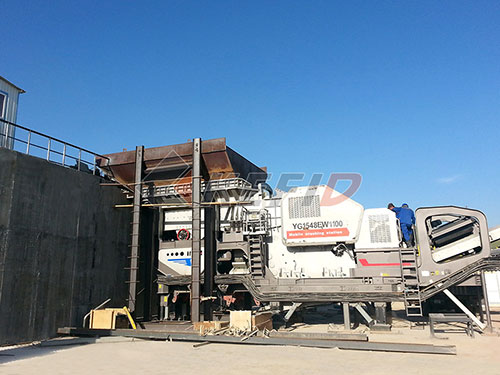
3.4 Screening and Classification
Screens are specified by type (inclined, horizontal, or banana), deck count, screening area, stroke, and speed. The datasheet includes aperture sizes for each deck and the expected screening efficiency (typically 85–95% for dry, well-graded feed).
The core of the datasheet is the specification table. A representative extract is provided below.
| Parameter | Unit | Value / Range |
|---|---|---|
| Nominal capacity | t/h | 250–300 |
| Maximum feed size | mm | 750 |
| Primary crusher type | — | Single-toggle jaw |
| Primary CSS range | mm | 90–150 |
| Secondary crusher type | — | Hydraulic cone |
| Secondary CSS range | mm | 20–45 |
| Tertiary crusher type | — | Short-head cone / VSI |
| Product sizes | mm | 0–5, 5–10, 10–20, 20–40 |
| Total installed power | kW | 620 |
| Voltage / frequency | V / Hz | 400 / 50 |
| Control system | — | PLC with SCADA |
| Dust suppression | — | Water spray + bag filter |
| Noise level at 1 m | dB(A) | ≤ 85 |
| Operating mass | t | 210 |
Each value is accompanied by a tolerance. For example, capacity is guaranteed within ±10% when the feed gradation, moisture content, and bulk density conform to the stated assumptions. The datasheet must explicitly list these assumptions; otherwise, the guarantee is unenforceable.
An OEM datasheet defines the acceptance test protocol. Typically, a 72-hour continuous run is conducted at the design CSS. During the test, the following are recorded: throughput (weighed belt scale), product gradation (sieve analysis at 30-minute intervals), power draw (kW per stage), and downtime. Acceptance is granted if the average throughput meets the guaranteed figure and the product gradation falls within the specified envelope for at least 90% of samples.
The datasheet references the structural steel grade (e.g., S355JR), the design code (Eurocode 3 or AISC), and the dynamic load factors used for foundation design. Chute liners are specified by material (e.g., Hardox 450 or ceramic-embedded rubber) and thickness. The datasheet also states the permissible ambient temperature range (−20 °C to +45 °C) and the seismic design category where applicable.
Motor ratings, starting methods (direct-on-line, soft starter, or variable frequency drive), and enclosure ratings (IP55 or IP65) are listed. The control philosophy section describes interlocks, emergency stop hierarchy, and remote diagnostics. Modern OEM datasheets include provisions for telemetry and predictive maintenance, with vibration and temperature sensors mounted on critical bearings.
The datasheet must cite applicable standards, such as EN 1009 for machinery safety, ISO 21873 for mobile crushers, and local emission regulations. Dust emission limits (e.g., 20 mg/m³ at the stack), noise limits, and guarding requirements are stated. Lockout/tagout provisions and access platform dimensions are also documented.
Recommended maintenance intervals are tabulated: daily (lubrication checks), weekly (belt tension), monthly (liner inspection), and annual (gearbox oil analysis). The datasheet lists critical spare parts with OEM part numbers and expected lead times. Wear part life is expressed in hours per tonne of processed material, differentiated by rock type.
A competent evaluation of an OEM datasheet requires verification of the following: (i) consistency between capacity, power, and CSS; (ii) traceability of guarantees to test conditions; (iii) completeness of the wear part consumption model; (iv) compatibility of the control system with existing plant infrastructure; and (v) availability of local service support. Discrepancies between the datasheet and the quotation must be resolved in writing before contract signature.
An OEM stone quarry crushing plant datasheet is not a marketing document but a binding technical instrument. Its value lies in precision: every capacity figure, power rating, and wear rate must be traceable to a defined feed condition and a measurable test method. Engineers and procurement specialists who treat the datasheet as a checklist rather than a formality reduce commissioning risk, control lifecycle cost, and ensure that the installed plant delivers the specified tonnage and gradation for the duration of its service life. Where ambiguities exist, the OEM should be required to issue a clarification addendum, which then forms part of the controlled document set.
If you have any questions about our products, please feel free to contact us. We take all inquiries and suggestions very seriously.