
Title: 250–300 TPH Stone Crushing Plant: ODM Manufacturing, Engineering Considerations, and Best-Price Sourcing
Introduction
A 250–300 tonnes-per-hour (TPH) stone crushing plant represents a mid-to-large-scale aggregate production solution widely deployed in quarrying, construction material supply, mining, and infrastructure development. For buyers seeking an ODM (Original Design Manufacturer) partner, the appeal lies in the ability to obtain a plant engineered to specific feed material characteristics, product gradation requirements, and site constraints — rather than a standardized catalogue offering. This article examines the technical configuration, ODM manufacturing dynamics, cost drivers, and procurement strategies associated with 250–300 TPH crushing plants, with attention to how buyers can identify genuinely competitive pricing without compromising engineering integrity.
1. Defining the 250–300 TPH Capacity Class
Capacity in crushing plants is not a single fixed number; it is a function of feed size, material hardness (e.g., granite versus limestone), moisture content, required reduction ratio, and product specification. A plant rated at 250–300 TPH typically processes medium-hard to hard rock with a bulk density in the range of 1.6–2.0 t/m³. Manufacturers usually quote capacity based on limestone at a defined bulk density and feed gradation; buyers should insist on capacity guarantees tied to their actual material via bond work index or hardness testing.
Typical configurations in this class include:
A representative 300 TPH three-stage layout might include: vibrating grizzly feeder (approx. 1,000 mm width), primary jaw crusher (feed opening ≥750×1060 mm), secondary standard cone (e.g., 200–250 kW), tertiary short-head cone or VSI, 3–4 deck inclined vibrating screens (typically 2,400×6,000 mm), and a network of belt conveyors with capacities rated 15–20% above nominal throughput to absorb surge loads.
2. ODM versus OEM: What the Distinction Means for Buyers
In the crushing equipment sector, ODM manufacturers design and build plants to a buyer’s specification, often allowing customization of structural steel, crusher chamber geometry, automation architecture, and branding. This differs from pure OEM arrangements, where the buyer distributes a manufacturer’s fixed product line.
The ODM model offers several practical advantages for a 250–300 TPH project:
Buyers should verify an ODM supplier’s engineering depth: in-house design capability, FEA structural analysis for chassis and frames, crusher manufacturing tolerances, and quality control protocols (e.g., dimensional inspection, weld NDT, dynamic balancing of rotors and flywheels).
3. Technical and Engineering Considerations
3.1 Feed Characterization
The single most consequential input is the feed material. Abrasiveness (silica content), compressive strength, and clay contamination determine crusher selection, wear-liner metallurgy (e.g., Mn18Cr2 versus Mn22 for high-abrasion duty), and screening media choice (polyurethane versus woven wire). A 300 TPH plant processing abrasive granite will require different liner profiles and maintenance intervals than one processing limestone.
3.2 Reduction Ratio and Circulating Load
Three-stage circuits typically achieve reduction ratios of 4:1 to 6:1 per stage. Designers must balance closed-circuit operation — where oversize from screens returns to the tertiary crusher — against open-circuit simplicity. Closed circuits improve product shape and yield but increase conveyor and screen loading; buyers should confirm the plant’s stated 250–300 TPH refers to fresh feed, not total circulating throughput.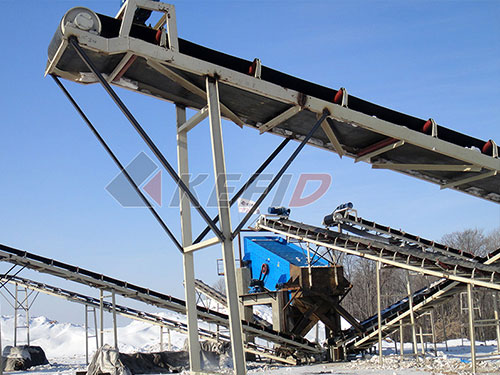
3.3 Structural and Foundation Engineering
A 300 TPH plant imposes significant dynamic loads. ODM suppliers should provide foundation drawings with static and dynamic load data, anchor bolt schedules, and vibration isolation recommendations. For modular plants, chassis steel grade (e.g., Q345B or equivalent) and bolted versus welded connections affect transport logistics and reassembly time.
3.4 Dust Control and Environmental Compliance
Modern procurement increasingly requires integrated dust suppression (water spray systems, fog cannons), enclosed transfer points, and baghouse filtration where regulations demand. These systems add 3–8% to capital cost but are often mandatory for permitting.
3.5 Automation and Safety
PLC-controlled plants with interlocking, emergency stops, and level sensors in crusher cavities reduce operator error and mechanical damage. Buyers should request automation scope definition early, as retrofitting control systems post-installation is costly.
4. Cost Structure and “Best Price” Interpretation
A 250–300 TPH plant’s price varies enormously — commonly cited ranges span roughly USD 150,000 to over USD 600,000 depending on configuration, crusher brand content, automation level, and structural scope. Key cost drivers include:
“Best price” should therefore be interpreted as lowest total cost of ownership: capital cost plus installation, energy consumption per tonne, wear cost per tonne, and availability. Buyers should request energy consumption data (kWh/t), guaranteed availability figures, and spare-parts pricing schedules for a five-year horizon.
5. Procurement Checklist for ODM Sourcing
6. Conclusion
The 250–300 TPH stone crushing plant market offers buyers substantial choice, and ODM manufacturers can deliver tailored, cost-effective solutions when engineering capability is verified rather than assumed. The most reliable path to “best price” is a disciplined procurement process: characterize the material, specify capacity and product requirements precisely, compare total cost of ownership rather than sticker price, and validate the supplier through references and factory inspection. Buyers who invest in this diligence typically secure plants that reach rated capacity quickly, operate at predictable cost per tonne, and remain supported throughout their service life — outcomes that no headline price alone can guarantee.
If you have any questions about our products, please feel free to contact us. We take all inquiries and suggestions very seriously.