
Wholesale 250-300 TPH Stone Crushing Plant Factories: A Comprehensive Industry Analysis
The global demand for construction aggregates, road base materials, and industrial minerals has driven the proliferation of medium-to-large scale stone crushing plants. Among the most sought-after configurations in the market is the 250-300 tons per hour (TPH) capacity range. This throughput level represents a critical sweet spot for mid-tier contractors, quarry operators, and infrastructure developers who require a balance between capital expenditure, operational efficiency, and production volume. This article provides a detailed, professional, and objective examination of wholesale factories specializing in 250-300 TPH stone crushing plants, covering their design principles, key components, manufacturing standards, market dynamics, and procurement considerations.
1. Understanding the 250-300 TPH Capacity Segment
A 250-300 TPH stone crushing plant is designed to process hard rock, river gravel, limestone, or recycled concrete into various aggregate sizes, typically ranging from 0-5 mm (manufactured sand) to 20-40 mm (base course). This capacity is ideal for large-scale commercial projects such as highway construction, dam building, and urban infrastructure, where consistent material supply is critical. The plant’s output is measured in metric tons per hour, and the 250-300 TPH range implies a daily production potential of 2,500 to 3,000 tons (assuming a 10-hour shift), making it suitable for projects with moderate to high aggregate demand.
Wholesale factories that produce these plants often serve as original equipment manufacturers (OEMs) or system integrators. They source components from specialized foundries, fabricate structural steel, and assemble complete crushing and screening lines. The term “wholesale” in this context refers to the direct sale of complete plants or major sub-assemblies to distributors, contractors, or mining companies, often at reduced per-unit costs due to volume purchasing and standardized production.
2. Core Components and Configuration
A standard 250-300 TPH stone crushing plant consists of several interconnected stages, each designed to reduce rock size incrementally. The typical configuration includes:
Primary Crushing Stage: A heavy-duty jaw crusher (e.g., PE-900×1200 or equivalent) with a feed opening of 900 mm × 1200 mm. This unit reduces run-of-mine rock (up to 750 mm) to 150-200 mm. The jaw crusher is chosen for its reliability and ability to handle abrasive materials.
Secondary Crushing Stage: A cone crusher (e.g., CS160 or HP300 series) or an impact crusher (for less abrasive materials). Cone crushers are preferred for hard rock due to their high reduction ratio and cubic shape output. The secondary crusher reduces material to 40-80 mm.
Tertiary Crushing and Screening: A vertical shaft impact (VSI) crusher or a high-efficiency cone crusher, paired with a multi-deck vibrating screen (e.g., 3YK-2460 or 4YK-2470). This stage produces final aggregates (0-5 mm, 5-10 mm, 10-20 mm, 20-40 mm) and ensures particle shape and gradation compliance.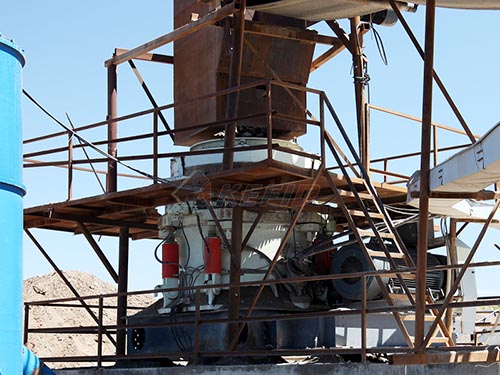
Auxiliary Equipment: Belt conveyors (with widths of 800-1200 mm), a vibrating feeder (e.g., ZSW-490×110), a control panel with PLC automation, dust suppression systems (water spray or baghouse filters), and electrical cabinets. Some factories also integrate mobile or semi-mobile chassis for relocation flexibility.
3. Manufacturing Standards and Quality Control
Wholesale factories that produce 250-300 TPH plants typically adhere to international standards such as ISO 9001 for quality management, ISO 14001 for environmental management, and OHSAS 18001 for occupational health and safety. Key manufacturing processes include:
Steel Fabrication: Heavy-duty frames, hoppers, and chutes are fabricated from Q235B or Q345B steel plates (Chinese standard) or equivalent ASTM A36. Welding is performed by certified welders using CO2 shielded arc welding, followed by stress relief heat treatment for critical components.
Crusher Casting: Jaw plates, cone liners, and blow bars are cast from high-manganese steel (Mn13Cr2 or Mn18Cr2) or high-chromium iron (Cr26) to resist wear. Factories often use sand casting or lost foam casting techniques, with hardness testing (Rockwell or Brinell) and chemical composition analysis.
Assembly and Testing: Each plant undergoes a dry run test (no load) and a load test (with material) to verify throughput, power consumption, and vibration levels. Factories typically guarantee a capacity of 250-300 TPH ±5% under standard conditions (bulk density 1.6 t/m³, feed size ≤750 mm, moisture <5%).
Electrical and Automation: Control systems use Siemens, Schneider, or Mitsubishi PLCs with touch-screen interfaces. Motors are typically IP54 rated, and cables are flame-retardant. Some factories offer remote monitoring via SCADA systems.
4. Market Dynamics and Leading Wholesale Factories
The global market for 250-300 TPH stone crushing plants is dominated by manufacturers in China, India, Turkey, and parts of Europe. Chinese factories, particularly those in Henan, Zhejiang, and Jiangsu provinces, account for a significant share due to their cost advantages, large production capacity, and established supply chains. Notable wholesale factories include:
Zhengzhou Yifan Machinery Co., Ltd.: Known for its modular design and high-efficiency cone crushers. Their 250-300 TPH plant uses a PE-900×1200 jaw crusher and a CS160 cone crusher, with a footprint of approximately 2,500 m².
Shanghai Shibang Machinery Co., Ltd. (SBM): Offers a comprehensive line of stationary and mobile plants. Their 250-300 TPH configuration often includes a C6X jaw crusher and HPT multi-cylinder hydraulic cone crusher, emphasizing energy efficiency (power consumption ~0.8-1.2 kWh per ton).
Henan Liming Heavy Industry Science & Technology Co., Ltd.: Specializes in high-capacity plants with VSI crushers for sand making. Their 250-300 TPH plant is popular in the Middle East and Africa for road construction projects.
Turkish Manufacturers (e.g., FABO, MEKA): Known for robust design and compliance with European standards (CE marking). Their plants often feature hydraulic adjustment systems and advanced dust control.
Indian Manufacturers (e.g., Propel Industries, Puzzolana): Offer cost-effective solutions with localized service networks. Their 250-300 TPH plants are widely used in domestic infrastructure projects.
5. Cost Analysis and Wholesale Pricing
The wholesale price of a 250-300 TPH stone crushing plant varies significantly based on configuration, automation level, and origin. As of 2025, typical price ranges are:
Standard stationary plant (Chinese OEM): $350,000 – $550,000 USD (FOB port). This includes jaw crusher, cone crusher, vibrating screen, conveyors, and basic electrical control.
Premium stationary plant (European or Turkish OEM): $600,000 – $900,000 USD. Features include hydraulic crusher adjustment, PLC automation, and higher-grade wear parts.
Semi-mobile or skid-mounted plant: $500,000 – $750,000 USD. These offer faster setup and relocation but have slightly lower structural rigidity.
Complete turnkey solution (including civil works, installation, and training): $800,000 – $1,200,000 USD.
Wholesale factories often offer volume discounts (e.g., 5-10% for orders of 3+ plants) and flexible payment terms (30% down payment, 70% before shipment). Buyers should factor in shipping costs (typically $15,000 – $30,000 for a 40-foot container load), import duties, and local taxes.
6. Operational Considerations and Maintenance
A 250-300 TPH plant requires a dedicated team of 5-8 operators and maintenance personnel. Key operational parameters include:
Power Requirement: 400-600 kW (depending on crusher types and conveyor lengths). A diesel generator set (500-750 kVA) is often recommended for remote sites.
Water Consumption: 50-100 m³ per day for dust suppression (if using wet systems). Dry dust collectors (baghouse) are preferred in water-scarce regions.
Wear Parts Replacement: Jaw plates every 3-6 months (depending on abrasiveness), cone liners every 6-12 months, and screen meshes every 2-4 months. Annual wear part costs can range from $30,000 to $60,000.
Lubrication and Hydraulics: Automatic grease lubrication systems are standard on premium plants. Hydraulic oil (ISO VG 46 or 68) should be changed every 2,000 hours.
7. Environmental and Regulatory Compliance
Modern wholesale factories design plants to meet stringent environmental regulations. Key features include:
Dust Control: Enclosed conveyor belts, water spray nozzles at transfer points, and baghouse filters with emission levels below 20 mg/Nm³.
Noise Reduction: Rubber liners on chutes, soundproof enclosures for crushers, and low-noise motors (below 85 dB at 1 meter).
Waste Management: Closed-loop water recycling systems for wet plants, and zero-discharge sludge handling.
Certifications: CE marking (for EU markets), GOST-R (for Russia), and SABS (for South Africa) are often required for export.
8. Procurement Strategy for Wholesale Buyers
When sourcing a 250-300 TPH stone crushing plant from wholesale factories, buyers should follow a structured approach:
Define Technical Specifications: Clearly state feed material type (e.g., granite, basalt, limestone), required product sizes, and moisture content. Request a process flow diagram and capacity guarantee.
Request Multiple Quotations: Compare at least 3-5 factories. Evaluate not only price but also delivery time (typically 45-90 days), warranty period (usually 12-18 months), and after-sales support (spare parts availability, technical hotline).
Conduct Factory Audit: If possible, visit the factory to inspect welding quality, test run the plant, and review quality control records. For remote buyers, request video inspections and third-party testing reports (e.g., SGS, Bureau Veritas).
Negotiate Terms: Include clauses for liquidated damages for delayed delivery, performance bond (5-10% of contract value), and arbitration in a neutral jurisdiction (e.g., Singapore or London).
Plan for Installation: Ensure the factory provides detailed foundation drawings, electrical schematics, and commissioning support. Some factories offer on-site supervision at $200-$400 per day plus travel expenses.
9. Future Trends and Innovations
The 250-300 TPH stone crushing plant market is evolving with technological advancements:
Automation and IoT: Smart sensors monitor crusher load, bearing temperature, and vibration in real time. Predictive maintenance algorithms reduce downtime by 15-20%.
Mobile and Hybrid Plants: Track-mounted or wheeled plants with integrated diesel-electric drives are gaining popularity for temporary projects. Hybrid systems (solar + battery) are being tested for remote sites.
Recycling Integration: Plants are being designed to process both virgin rock and recycled concrete/asphalt, with magnetic separators and air classifiers for contaminant removal.
Energy Efficiency: New generation crushers (e.g., multi-cylinder hydraulic cone crushers) reduce power consumption by 10-15% compared to older models. Variable frequency drives (VFDs) on conveyors optimize energy use.
10. Conclusion
Wholesale 250-300 TPH stone crushing plant factories represent a critical link in the global construction supply chain. They offer standardized, cost-effective solutions for medium-to-large scale aggregate production, with a wide range of configurations to suit different rock types and project requirements. Buyers must carefully evaluate technical specifications, manufacturing quality, and after-sales support to ensure a successful investment. As the industry moves toward automation, energy efficiency, and environmental compliance, these factories will continue to innovate, providing reliable equipment for the world’s growing infrastructure needs. Whether for a greenfield quarry in Africa, a road project in Southeast Asia, or a recycling plant in Europe, the 250-300 TPH stone crushing plant remains a workhorse of the mining and construction sectors.
If you have any questions about our products, please feel free to contact us. We take all inquiries and suggestions very seriously.