Slag Crusher Plant Factory Datasheet: Comprehensive Technical Overview and Operational Specifications
Introduction
A Slag Crusher Plant is a specialized industrial facility designed for the processing, crushing, and recycling of slag generated from steel manufacturing, ferroalloy production, and other metallurgical processes. Slag, a byproduct of metal smelting, consists primarily of oxides, silicates, and residual metallic content. The efficient handling and crushing of slag are critical for recovering valuable metals, producing construction aggregates, and minimizing environmental waste. This datasheet provides a detailed, professional, and objective analysis of the design, components, technical specifications, operational parameters, and performance metrics of a standard Slag Crusher Plant Factory.
1. Plant Overview and Purpose
The primary objective of a Slag Crusher Plant is to transform large, irregular slag boulders (often ranging from 300 mm to 1000 mm in size) into graded, marketable products. These products include:
- Metal Recovery: Separation of ferrous and non-ferrous metals (e.g., iron, steel, copper, nickel) from the slag matrix.
- Aggregate Production: Production of crushed slag aggregates (0-5 mm, 5-20 mm, 20-40 mm, and 40-80 mm) for use in road construction, concrete, asphalt, and railway ballast.
- Waste Minimization: Reduction of landfill volume and compliance with environmental regulations.
The plant is typically designed as a modular, semi-mobile, or stationary system, capable of handling capacities ranging from 50 tons per hour (TPH) to over 500 TPH, depending on the client’s requirements and the slag type (e.g., blast furnace slag, steel slag, ferrochrome slag).
2. Key Components and Machinery
A standard Slag Crusher Plant Factory integrates several critical subsystems, each engineered for durability and high throughput under abrasive conditions.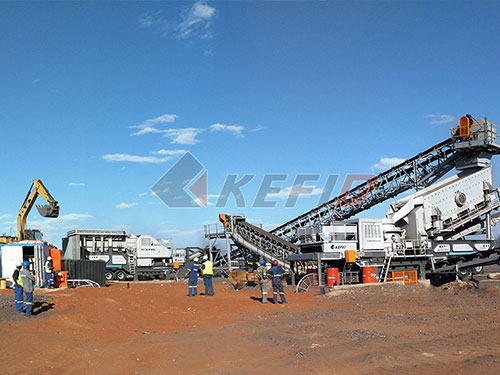
2.1 Primary Crushing Unit
- Equipment: Heavy-duty Jaw Crusher or Gyratory Crusher.
- Function: Reduces large slag boulders (up to 1000 mm) to a manageable size (150-250 mm).
- Specifications: Typically features a feed opening of 900 x 1200 mm or larger, with a manganese steel jaw plate for wear resistance. The eccentric shaft is forged from high-alloy steel to withstand shock loads.
- Drive: 75-150 kW electric motor with V-belt drive and hydraulic adjustment for closed side setting (CSS).
2.2 Secondary and Tertiary Crushing Units
- Equipment: Cone Crusher, Impact Crusher, or Roll Crusher.
- Function: Further reduces material to the desired product size (20-40 mm or finer). Cone crushers are preferred for hard, abrasive slag, while impact crushers are used for softer slag or when a cubical shape is required.
- Specifications: Cone crushers typically have a feed opening of 200-300 mm and a capacity of 50-200 TPH. The crushing chamber is lined with high-chrome or manganese steel liners.
2.3 Magnetic Separation System
- Equipment: Overband Magnetic Separator (suspended magnet) and Drum Magnetic Separator.
- Function: Removes ferrous metals (iron, steel) from the crushed slag stream. This is a critical step for both metal recovery and protecting downstream crushers from damage.
- Specifications: Magnetic strength of 900-1200 Gauss for overband separators; drum separators with 1200-2000 Gauss for fine metal recovery. Belt width matches conveyor width (e.g., 800 mm, 1000 mm, 1200 mm).
2.4 Screening System
- Equipment: Vibrating Screens (inclined or horizontal).
- Function: Classifies crushed slag into different size fractions.
- Specifications: Multi-deck screens (2-4 decks) with screen mesh sizes ranging from 5 mm to 80 mm. Screen area typically 6-15 m² per deck. Drive via eccentric shaft or vibrator motors.
2.5 Conveying System
- Equipment: Belt Conveyors.
- Function: Transports slag between crushing, screening, and stockpiling stages.
- Specifications: Belt width 600-1400 mm; belt speed 1.0-2.5 m/s; rubber belt with anti-abrasive cover (grade M or N). Idlers are heavy-duty, sealed for life.
2.6 Dust Suppression and Control System
- Equipment: Water spray nozzles, misting systems, or baghouse filters.
- Function: Controls airborne dust generated during crushing and screening.
- Specifications: Water flow rate 10-50 L/min per spray point; baghouse filter with 99.9% efficiency for particulate matter (PM10 and PM2.5).
2.7 Control and Automation System
- Equipment: Programmable Logic Controller (PLC) with Human-Machine Interface (HMI).
- Function: Centralized monitoring and control of all plant operations, including start/stop sequences, load monitoring, and alarm management.
- Specifications: Siemens, Allen-Bradley, or Mitsubishi PLC; touchscreen HMI with real-time data logging and remote access capability.
3. Technical Specifications (Typical 200 TPH Plant)
| Parameter |
Specification |
| Total Installed Power |
450-600 kW |
| Feed Material |
Blast furnace slag, steel slag, ferrochrome slag |
| Feed Size |
Up to 800 mm |
| Product Size Range |
0-5 mm, 5-20 mm, 20-40 mm, 40-80 mm |
| Capacity |
200 TPH (nominal) |
| Primary Crusher |
Jaw Crusher (900 x 1200 mm) |
| Secondary Crusher |
Cone Crusher (2200 mm head diameter) |
| Magnetic Separators |
2 units (overband + drum) |
| Screens |
2 units (3-deck, 8 m² each) |
| Conveyors |
8 units (total length approx. 150 m) |
| Dust Control |
Water misting system (50 nozzles) |
| Control System |
PLC with remote monitoring |
| Operating Voltage |
415 V / 50 Hz / 3-phase (or 480 V / 60 Hz) |
| Plant Weight |
Approx. 150-200 tons (excluding civil works) |
| Footprint |
50 m x 30 m (approximate) |
4. Operational Parameters and Performance Metrics
4.1 Crushing Efficiency
- Reduction Ratio: Typically 4:1 to 6:1 per crushing stage.
- Product Shape: Cubical shape index > 85% (for impact crushers); > 70% for cone crushers.
- Metal Recovery Rate: 90-98% for ferrous metals; 70-85% for non-ferrous metals (depending on slag composition).
4.2 Wear and Maintenance
- Liner Life: Jaw plates: 2000-4000 hours; Cone liners: 1500-3000 hours; Screen meshes: 500-1000 hours.
- Lubrication: Automatic grease lubrication system for crushers and screens.
- Downtime: Scheduled maintenance downtime of 8-12 hours per month; unscheduled downtime < 2%.
4.3 Energy Consumption
- Specific Energy: 2.5-4.0 kWh per ton of slag processed (depending on hardness and moisture content).
- Power Factor: > 0.9 (with capacitor bank).
4.4 Environmental Compliance
- Noise Level: < 85 dB(A) at 1 meter from equipment (with enclosures).
- Dust Emission: < 50 mg/Nm³ (with baghouse filter).
- Water Usage: Closed-loop water system for dust suppression; zero discharge.
5. Slag Types and Processing Considerations
The design and operation of a Slag Crusher Plant Factory must account for the specific properties of the slag being processed.
| Slag Type |
Characteristics |
Processing Challenges |
Recommended Equipment |
| Blast Furnace Slag |
Glassy, abrasive, low metal content |
High wear on crushers; requires careful cooling |
Jaw crusher + cone crusher + ball mill (for fine grinding) |
| Steel Slag |
Dense, high iron content, expansive |
Metal recovery critical; potential for volume instability |
Magnetic separators + impact crusher + aging yard |
| Ferrochrome Slag |
Very hard, high chromium content |
Extreme abrasion; high value metal recovery |
Heavy-duty jaw crusher + cone crusher + dense media separation |
| Copper Slag |
Hard, glassy, low metal content |
Abrasive; used as abrasive blasting media |
Impact crusher + screening only |
6. Factory Quality Assurance and Testing
A reputable Slag Crusher Plant Factory adheres to strict quality control protocols during manufacturing and assembly:
- Material Testing: All wear parts (manganese steel, high-chrome iron) are tested for hardness (BHN 450-550) and chemical composition.
- Welding Inspection: Non-destructive testing (NDT) such as ultrasonic and magnetic particle inspection for critical welds.
- Run-in Testing: Each crusher and screen is run-in for 4-8 hours under no-load and load conditions to verify bearing temperatures, vibration levels, and alignment.
- Performance Guarantee: The factory provides a performance guarantee for capacity, product size, and metal recovery, typically verified by a third-party inspection agency.
7. Installation and Commissioning
- Civil Works: Reinforced concrete foundations designed to absorb dynamic loads. Anchor bolts are pre-embedded with templates.
- Erection: Modular assembly using cranes (50-100 ton capacity). Alignment of crushers and conveyors within 0.5 mm tolerance.
- Commissioning: Sequential start-up of individual units, followed by integrated system testing. Load testing at 50%, 75%, and 100% capacity over 72 hours.
- Training: On-site training for operators and maintenance personnel (typically 5-7 days).
8. Safety Features
- Emergency Stops: Pull-cord emergency stop switches along all conveyors.
- Guards: All moving parts (belts, pulleys, flywheels) are fully guarded.
- Interlocks: Crusher discharge chutes are interlocked with conveyor motors to prevent blockages.
- Fire Protection: Fire extinguishers and thermal sensors in electrical panels and near crusher bearings.
- Lockout/Tagout (LOTO): Standardized LOTO procedures for all maintenance activities.
9. Conclusion
A Slag Crusher Plant Factory is a highly engineered, integrated system designed for the efficient processing of metallurgical slag. Its success depends on the correct selection of crushing and separation equipment, robust construction, and adherence to operational best practices. By recovering valuable metals and producing high-quality aggregates, these plants contribute significantly to the circular economy and sustainable industrial practices. The datasheet provided herein serves as a comprehensive reference for engineers, procurement professionals, and plant operators seeking to evaluate, design, or operate such a facility. For specific project requirements, a detailed engineering study and customized plant design are recommended.
