
OEM Impact Crushers Manufacturers: Engineering Precision, Performance, and Partnership
In the global aggregate, mining, and recycling industries, the impact crusher stands as a cornerstone of material reduction. Its ability to process medium-hard rocks, recycled concrete, and asphalt with high reduction ratios and cubical output makes it indispensable. However, behind every efficient crushing circuit lies a critical, often overlooked decision: the choice between an original equipment manufacturer (OEM) and a generic aftermarket supplier. This article provides a comprehensive, professional examination of OEM impact crusher manufacturers—their role, their engineering standards, their manufacturing processes, and the strategic value they deliver to operators worldwide.
Defining the OEM in Crushing Technology
An OEM impact crusher manufacturer is the entity that designs, engineers, tests, and produces the crusher from the ground up. Unlike aftermarket fabricators who reverse-engineer parts, OEMs hold the original intellectual property, including proprietary drawings, metallurgical specifications, and finite element analysis (FEA) data. They are the source of truth for every bolt, rotor, blow bar, and liner. The term “OEM” implies not just production, but ownership of the design lifecycle—from initial concept through continuous improvement and field validation.
Leading OEMs in this space include global names such as Metso (now Metso Outotec), Sandvik, Terex (including Powerscreen and Cedarapids), Hazemag, and Rubble Master, alongside specialized regional players like Stedman Machine Company and BHS-Sonthofen. Each brings a distinct philosophy, but all share a common commitment to structural integrity, wear life optimization, and safety compliance.
The Engineering Core: Rotor Dynamics and Crushing Chamber Geometry
The heart of any impact crusher is the rotor. OEM manufacturers invest heavily in rotor design because it dictates throughput, particle shape, and energy efficiency. A typical OEM rotor is a solid, machined steel body with keyed blow bar seats, designed to withstand extreme centrifugal forces—often exceeding 1,500 RPM in horizontal shaft impactors (HSI) and high tip speeds in vertical shaft impactors (VSI).
OEMs use advanced computational tools, including discrete element method (DEM) simulations, to model the trajectory of material inside the crushing chamber. This allows them to optimize the angle of the impact aprons, the spacing between the rotor and the breaker plates, and the shape of the wear liners. For example, a primary impact crusher from Hazemag features a hydraulically adjustable first impact apron, enabling the operator to fine-tune the gap without manual shimming—a design refinement that only the original manufacturer can guarantee because they own the tolerance stack-up data.
Furthermore, OEMs specify the exact metallurgy for each wear component. High-chrome white iron (e.g., 27% Cr) is standard for blow bars in abrasive applications, while martensitic steel with ceramic inserts is offered for recycling where impact resistance is paramount. The OEM’s metallurgical laboratory maintains strict quality control (QC) on hardness, impact toughness, and microstructure, ensuring that a replacement part matches the original’s performance curve. Generic parts often fail here, using “equivalent” alloys that may have similar hardness but lack the proper austenitic matrix, leading to premature cracking.
Manufacturing Precision: From Casting to Machining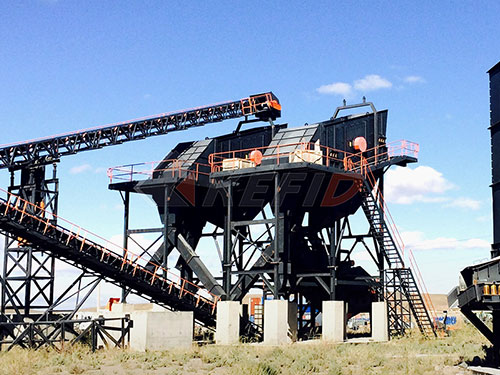
OEM impact crusher manufacturers operate vertically integrated facilities or maintain tight partnerships with certified foundries. The manufacturing process is rigorous:
Casting and Forging: The main crusher housing is typically fabricated from heavy steel plate (e.g., S355J2+N) with full penetration welds, followed by stress-relieving heat treatment. The rotor body is either cast as a single piece or machined from a solid forging, depending on size. OEMs enforce ultrasonic testing (UT) and magnetic particle inspection (MPI) on all critical welds and castings, a step rarely performed by low-cost aftermarket shops.
CNC Machining: The rotor shaft, bearing housings, and blow bar seats are machined on five-axis CNC centers with tolerances of ±0.05 mm. This precision ensures that the rotor is dynamically balanced. An OEM will perform a two-plane dynamic balancing test at operating speed, typically to ISO 1940 G2.5 grade. A poorly balanced rotor from a non-OEM source can generate vibrations that destroy bearings and shorten the life of the entire machine.
Assembly and Testing: OEMs assemble the crusher in a controlled environment, using torque-controlled hydraulic wrenches for all fasteners. Many manufacturers run a no-load test run for 4–8 hours, monitoring bearing temperatures, vibration levels, and oil flow. This “run-in” procedure is a hallmark of OEM quality, as it validates the assembly before the unit leaves the factory.
The Strategic Advantage of OEM Parts and Service
While the initial purchase price of an OEM impact crusher is higher than a generic alternative, the total cost of ownership (TCO) analysis overwhelmingly favors the OEM. Consider the following factors:
Wear Life Consistency: OEM blow bars are manufactured to a precise chemical composition and heat treatment cycle. A typical high-chrome bar from Metso, for example, offers a consistent wear profile of 8,000–12,000 hours in limestone, depending on feed size. Aftermarket bars may offer 20% lower cost but often deliver 30–40% less life, resulting in higher cost per ton.
Interchangeability and Fit: OEM parts are guaranteed to fit without modification. This eliminates downtime for grinding, shimming, or welding during installation. In a high-production quarry, a 4-hour installation delay at $500/hour in lost production easily outweighs any part price savings.
Engineering Updates: OEMs continuously improve their designs. For instance, Sandvik introduced a “triple-wedge” blow bar locking system that reduces changeout time by 50%. Only the OEM can supply this updated wedge kit, as it requires a modified rotor pocket. Generic suppliers cannot replicate these innovations because they lack the design drawings.
Safety and Compliance: OEM crushers are designed to meet CE, ANSI, and OSHA standards. The safety interlocks, hydraulic relief valves, and emergency stop systems are engineered into the machine. When you purchase OEM replacement parts, you maintain the original safety certification. Non-OEM parts may void the machine’s warranty and insurance coverage in the event of an accident.
Case Study: The OEM Advantage in Recycling Applications
Consider a concrete recycling operation using a Rubble Master RM 120GO! impact crusher. This machine processes reinforced concrete with rebar, which causes severe impact and abrasion. The OEM’s wear package includes a special “rebar-safe” blow bar with a ceramic composite insert that resists cutting from steel wires. Additionally, the OEM provides a “breaker plate with a wear lip” that is designed to deflect rebar away from the rotor. A generic supplier might offer a standard high-chrome bar that shatters upon hitting a 20mm rebar, causing catastrophic rotor damage. The OEM’s engineering data—derived from thousands of field hours—allows them to tailor the wear package to the specific application, a service no aftermarket vendor can match.
Global Supply Chain and Local Support
OEM impact crusher manufacturers operate global distribution networks. This is critical for mining operations in remote regions. For example, Metso Outotec maintains regional warehouses in Chile, Australia, and South Africa, stocking critical spares like rotor shafts, bearings, and blow bars. They also provide on-site service engineers who are factory-trained on their specific models. This logistical capability reduces lead times from weeks to days, a decisive factor when an unplanned breakdown occurs.
Moreover, OEMs offer lifecycle services, including performance audits, wear measurement using 3D scanning, and predictive maintenance via IoT sensors. These services are not available from generic part suppliers. An OEM can analyze your crusher’s wear patterns and recommend adjustments to the rotor speed or gap settings, increasing throughput by 5–10% without any capital expenditure.
Challenges and Considerations for Buyers
Despite the clear benefits, there are legitimate reasons why some operators hesitate to engage OEMs. The primary barrier is cost. OEM parts can be 50–100% more expensive than aftermarket equivalents. For small operators with low tonnage, the premium may not be justifiable. Additionally, some older crusher models are no longer supported by the OEM, forcing operators to seek third-party solutions.
However, the professional recommendation is to use OEM parts for critical, high-stress components: the rotor, blow bars, main shaft, and bearings. For non-critical items like conveyor belts, chute liners, and simple wear plates, aftermarket sources may be acceptable. This hybrid approach balances cost and risk.
The Future: OEMs and Digitalization
The leading OEM impact crusher manufacturers are now integrating digital twins and AI-driven predictive analytics. For instance, Terex’s “Smart Crusher” system monitors rotor speed, current draw, and bearing temperature in real time, sending alerts to the operator’s mobile device. The OEM’s cloud-based algorithm compares this data against thousands of similar machines to predict when a blow bar will fail, allowing proactive replacement. This level of integration is impossible with aftermarket parts, as the sensor data is calibrated to the OEM’s specific component geometry and material properties.
Conclusion: The OEM as a Long-Term Partner
Selecting an OEM impact crusher manufacturer is not merely a procurement decision; it is a strategic partnership. The OEM provides not just a machine, but a guarantee of engineering integrity, metallurgical precision, and operational support. While the upfront investment is higher, the return is measured in reduced downtime, lower cost per ton, and extended equipment lifespan. In an industry where a single hour of unplanned stoppage can cost thousands of dollars, the OEM’s value proposition is clear. For any operation that demands maximum uptime, consistent product quality, and safety compliance, the OEM remains the gold standard. The aftermarket may offer a shortcut, but the OEM offers the only reliable path to sustained crushing performance.
If you have any questions about our products, please feel free to contact us. We take all inquiries and suggestions very seriously.