Export Iron Ore Crushing Plant Vendors: A Comprehensive Analysis of Global Suppliers, Technologies, and Market Dynamics
Introduction
The global iron ore industry is a cornerstone of the steel manufacturing sector, which in turn underpins infrastructure development, automotive production, and heavy machinery manufacturing. At the heart of this industry lies the critical process of crushing—the initial stage of transforming raw, extracted iron ore into a form suitable for further beneficiation, transportation, and eventual smelting. The efficiency, reliability, and technological sophistication of iron ore crushing plants directly impact the profitability and operational continuity of mining operations. Consequently, the market for vendors who design, manufacture, and export these plants is both specialized and highly competitive. This article provides a detailed, professional, and objective examination of the key vendors in the global export market for iron ore crushing plants, analyzing their technological offerings, geographic reach, market strategies, and the evolving trends shaping this essential industrial sector.
1. The Nature of Iron Ore Crushing Plants
Before delving into the vendors, it is crucial to understand what constitutes an iron ore crushing plant. Unlike generic aggregate crushers, iron ore crushing plants are engineered to handle extremely hard, abrasive, and high-density materials. They are typically multi-stage systems designed to reduce run-of-mine (ROM) ore, which can have a top size of over 1.5 meters, to a final product size of 0-40 mm or finer, depending on the downstream beneficiation process (e.g., magnetic separation, flotation, or direct reduction).
A typical plant includes:
- Primary Crushers: Often gyratory or jaw crushers, capable of handling massive feed sizes.
- Secondary and Tertiary Crushers: Cone crushers are the industry standard for these stages due to their ability to produce a well-shaped, fine product with high reduction ratios.
- Screens: Vibrating screens for classification and closed-circuit operation.
- Conveyors and Feeders: Heavy-duty systems to transport the abrasive material.
- Control Systems: Advanced PLC and SCADA systems for automation and optimization.
The key challenges for vendors include designing for extreme wear resistance, minimizing downtime for liner changes, and ensuring energy efficiency given the high power consumption of crushing.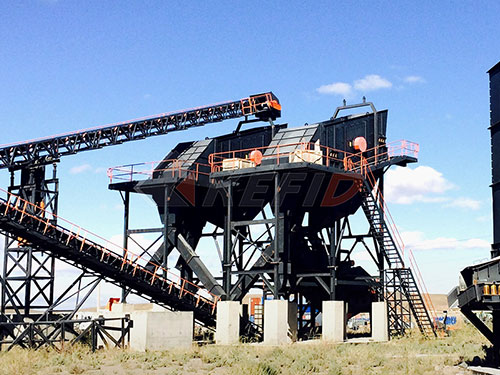
2. Major Global Vendors and Their Export Capabilities
The market for exporting iron ore crushing plants is dominated by a mix of long-established Western multinationals and rapidly growing Asian manufacturers. These vendors are distinguished by their engineering expertise, after-sales service networks, and ability to deliver turnkey solutions.
2.1. Metso Outotec (Finland/Sweden)
Metso Outotec, formed by the merger of Metso Minerals and Outotec, is arguably the most prominent global vendor. Their product portfolio is considered the gold standard in the industry.
- Key Technologies: The Nordberg® HP and MP series cone crushers are ubiquitous in iron ore applications. Their Superior™ MK-III primary gyratory crushers are designed for the highest throughput capacities. Metso Outotec also offers the innovative HRC™ high-pressure grinding rolls (HPGR), which are increasingly used for energy-efficient fine crushing in iron ore.
- Export Strategy: Metso Outotec operates a vast global network of service centers, foundries, and manufacturing facilities. They export complete plants and key components from their production hubs in Europe, India, China, and Brazil. Their strength lies in providing “life-cycle services,” including digital monitoring (Metso Metrics) and predictive maintenance, which are critical for remote mine sites.
- Market Position: They are the preferred vendor for large-scale, greenfield projects requiring the highest reliability and throughput, particularly in Australia, Brazil, and West Africa.
2.2. Sandvik Mining and Rock Solutions (Sweden)
Sandvik is another dominant player, particularly strong in the cone crusher and stationary plant segments.
- Key Technologies: The Sandvik CH800i series cone crushers are renowned for their automation and high performance. Their CS and CH series are widely used in secondary and tertiary applications. Sandvik also offers robust jaw crushers (CJ series) and gyratory crushers. A key differentiator is their “Stationary Crushing and Screening” solutions, which are highly modular and designed for rapid installation.
- Export Strategy: Sandvik exports from manufacturing sites in Sweden, India, and China. They have a strong focus on digitalization, with the “My Sandvik” digital platform providing real-time data on crusher performance. Their aftermarket parts distribution is among the fastest in the industry.
- Market Position: Sandvik is highly competitive in mid-to-large scale operations and is often chosen for projects requiring advanced automation and remote monitoring capabilities.
2.3. FLSmidth (Denmark)
FLSmidth is a major supplier of complete mineral processing solutions, including crushing.
- Key Technologies: FLSmidth offers the Raptor® cone crusher line (acquired from Excel Foundry & Machine), which is specifically designed for high-reduction, high-capacity applications in hard rock mining. They also provide Fuller-Traylor gyratory crushers, which are legendary for their durability in primary crushing.
- Export Strategy: FLSmidth focuses on providing “end-to-end” solutions, from mine to metal. Their export model involves large-scale engineering and project management, often supplying complete crushing and conveying systems for massive iron ore operations. They have a strong presence in India and South America.
- Market Position: They are a top-tier vendor for the largest, most demanding iron ore mines, particularly where integration with downstream processing (grinding, flotation) is required.
2.4. ThyssenKrupp Industrial Solutions (Germany)
ThyssenKrupp is a key player in the heavy-duty crushing segment, especially for primary and secondary applications.
- Key Technologies: They are famous for their gyratory crushers and, more recently, their innovative “Crusher for the Next Generation” concept. Their Kubria® cone crushers are also used in iron ore. ThyssenKrupp has pioneered the use of eccentric roll crushers (ERC) for primary crushing, which offer a compact design and high capacity.
- Export Strategy: ThyssenKrupp exports high-value, engineered-to-order equipment from Germany and other European facilities. They are less focused on standardized “off-the-shelf” plants and more on bespoke, high-capacity solutions.
- Market Position: They are the vendor of choice for mines requiring extremely large primary crushers or unique, customized crushing solutions.
2.5. Chinese Vendors: The Rising Export Powerhouses
The most significant shift in the export market over the past decade has been the rise of Chinese manufacturers. These vendors have moved from producing low-cost, imitative equipment to offering technologically advanced, reliable plants at highly competitive prices.
- Key Players:
- CITIC Heavy Industries: A state-owned giant that can supply complete, large-scale crushing plants. They are particularly strong in the Asian and African markets.
- Zhengzhou Yifan Machinery Co., Ltd. (YIFAN): A major exporter of mobile and stationary crushing plants. They offer a wide range of jaw, cone, and impact crushers tailored for iron ore.
- Shanghai Shibang Machinery Co., Ltd. (SBM): A well-known vendor for complete aggregate and mining processing lines. Their HPT and HST series cone crushers are designed for high efficiency.
- Henan Hongxing Mining Machinery Co., Ltd. (HXJQ): A large manufacturer offering cost-effective solutions for smaller to medium-scale iron ore operations.
- Technological Advancements: Chinese vendors have invested heavily in R&D. Many now offer crushers with advanced hydraulic systems, automatic tramp release, and intelligent control systems that rival their Western counterparts. The quality of wear parts (manganese steel liners) has also improved significantly.
- Export Strategy: Chinese vendors dominate the export market for mobile crushing plants and modular, containerized plants. Their primary advantage is price—often 30-50% lower than Western brands. They also offer flexible financing and faster delivery times. Their export focus is on developing markets in Africa, Southeast Asia, South America, and Central Asia.
- Market Position: They are the leading choice for junior miners, mid-tier companies, and projects in regions where capital expenditure is the primary constraint. They are increasingly competing with Western vendors for larger, more complex projects.
3. Emerging Trends and Technological Innovations
The export market for iron ore crushing plants is being reshaped by several key trends:
- Mobile and Semi-Mobile Plants: There is a growing demand for mobile crushing plants (e.g., Metso Lokotrack, Sandvik UJ series) that can be moved closer to the mining face. This reduces haulage costs and is ideal for smaller deposits or operations with multiple pits. Chinese vendors have been particularly aggressive in this segment.
- Automation and Digitalization: Vendors are embedding sensors and IoT capabilities into their equipment. This allows for real-time monitoring of wear, power draw, and product quality. Predictive maintenance algorithms can forecast liner changes, preventing catastrophic failures. This is a key differentiator for Western vendors.
- Energy Efficiency: Crushing is energy-intensive. Vendors are developing more efficient crushers, such as HPGRs and high-speed cone crushers, to reduce specific energy consumption (kWh/t). This is a major selling point in regions with high electricity costs.
- Modular and Containerized Plants: To reduce installation time and civil works costs, vendors are offering pre-assembled, modular plants that can be shipped in standard containers and quickly erected on site. This is a specialty of many Chinese and Indian vendors.
- Wear Life Optimization: The cost of wear parts (liners, mantles, cheek plates) is a major operational expense. Vendors are using advanced metallurgy and simulation software to design liners that last longer and provide a consistent product shape.
4. Geographic Market Dynamics
- Australia: The largest iron ore exporter. Vendors must supply plants capable of handling extremely high tonnages (often >10,000 t/h) with maximum uptime. Metso Outotec, Sandvik, and FLSmidth dominate here.
- Brazil: Another major producer. The market is dominated by Vale, which has long-standing relationships with Western vendors, though Chinese vendors are making inroads.
- India: A large domestic producer and exporter. The market is price-sensitive, leading to a strong presence of local manufacturers (e.g., Terex Finlay, Puzzolana) and Chinese vendors.
- Africa (West Africa, South Africa): A rapidly growing market with many new projects. This is a battleground between Western vendors (for large, high-quality projects) and Chinese vendors (for cost-sensitive, smaller operations).
- Russia & Central Asia: A market with a preference for robust, heavy-duty equipment. Both Western and Chinese vendors are active, though sanctions have shifted some demand toward Chinese suppliers.
5. Selection Criteria for Buyers
When evaluating export vendors for an iron ore crushing plant, buyers must consider:
- Total Cost of Ownership (TCO): Not just the purchase price, but also installation, freight, duties, power consumption, wear parts cost, and maintenance labor.
- After-Sales Support: Availability of local service engineers, spare parts warehouses, and technical support. This is a critical weakness for some Chinese vendors in remote locations.
- Proven Performance: References from similar iron ore applications (e.g., crushing magnetite vs. hematite, handling wet vs. dry ore).
- Delivery Lead Time: The time from order to commissioning. Chinese vendors often have a significant advantage here.
- Financing Options: The ability of the vendor to provide financing or partner with export credit agencies.
Conclusion
The export market for iron ore crushing plant vendors is a sophisticated, high-stakes arena. The industry is dominated by a small number of elite Western multinationals—Metso Outotec, Sandvik, FLSmidth, and ThyssenKrupp—who offer the highest levels of technology, reliability, and global support. However, the landscape is being fundamentally reshaped by the rapid ascent of Chinese manufacturers, who have closed the technology gap and now offer compelling value propositions, particularly for mobile and modular plants.
The future of the market will be defined by automation, energy efficiency, and the ability to provide integrated, life-cycle solutions. For mining companies, the choice of vendor is a strategic decision that impacts operational efficiency for decades. The most successful vendors will be those that can combine cutting-edge engineering with responsive local service and flexible commercial models, catering to the diverse needs of iron ore producers from the Pilbara to the Simandou range. As the global demand for steel continues to evolve, the role of these specialized crushing plant vendors will remain indispensable in unlocking the value of the world’s iron ore resources.
