Eco-Friendly Gold Mining Equipment Specification: Engineering a Sustainable Future for Artisanal and Industrial Extraction
Introduction: The Imperative for Ecological Transformation in Gold Mining
Gold mining, one of humanity’s oldest industries, has historically been associated with significant environmental degradation. From mercury amalgamation in artisanal and small-scale gold mining (ASGM) to cyanide heap leaching and massive earth-moving operations in industrial contexts, the extraction of a single ounce of gold can generate up to 20 tonnes of waste ore, consume thousands of liters of water, and release toxic byproducts into surrounding ecosystems. However, the global push toward the United Nations Sustainable Development Goals (SDGs), particularly SDG 6 (Clean Water), SDG 12 (Responsible Consumption), and SDG 15 (Life on Land), has catalyzed a paradigm shift. The modern gold mining sector is now demanding equipment that not only maximizes recovery but also minimizes ecological footprint. This article provides a comprehensive, technical specification for eco-friendly gold mining equipment, covering primary extraction, gravity concentration, chemical-free recovery, water management, and energy efficiency. The specifications are designed for both ASGM (1–50 tonnes per day) and small-to-medium industrial operations (50–500 tonnes per day), with an emphasis on modularity, recyclability, and zero-discharge principles.
1. Primary Crushing and Grinding: Low-Impact Comminution Systems
The first stage of any mining operation is size reduction. Traditional jaw crushers and ball mills are energy-intensive, often consuming 30–50 kWh per tonne of ore. Eco-friendly specifications mandate the following:
- High-Pressure Grinding Rolls (HPGR): Instead of conventional tumbling mills, HPGRs use two counter-rotating rollers to compress ore, reducing energy consumption by 20–40% and water usage (as dry grinding is possible). Specification: Roll diameter 1.2–2.4 m, specific grinding force 4.5–6.0 N/mm², throughput up to 250 t/h. The closed-circuit design with a dry air classifier eliminates the need for slurry, thus conserving water.
- Vertical Shaft Impact (VSI) Crushers with Variable Frequency Drives (VFD): For secondary crushing, VSI crushers with VFD allow precise control of rotor speed, reducing over-grinding and downstream energy waste. The equipment must be fitted with ceramic or tungsten carbide wear liners to extend service life beyond 8,000 hours, reducing the frequency of part replacement and associated embodied carbon.
- Dust Suppression via Dry Fog Systems: All crushers and conveyors must integrate ultrasonic dry fog nozzles (0.5–10 micron droplets) that agglomerate with dust particles without wetting the ore, achieving >95% dust capture efficiency while using less than 0.05 L/min of water per nozzle.
2. Gravity Concentration: The Cornerstone of Mercury-Free Processing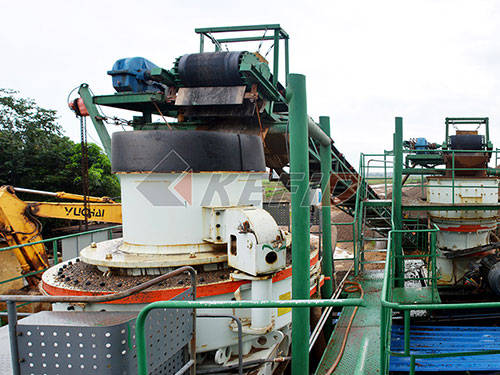
Mercury is still used by over 15 million ASGM workers globally. Eco-friendly equipment must eliminate this entirely. The specification prioritizes enhanced gravity separators that recover free gold (particle size > 10 microns) without chemicals.
- Centrifugal Concentrators (e.g., Knelson or Falcon type): Specification: Bowl speed 600–900 RPM, fluidization water pressure 0.5–1.5 bar, feed density 25–40% solids. These units achieve 90–95% recovery of free gold. The key eco-friendly feature is a closed-loop water recirculation system with a settling tank and a 5-micron cartridge filter, ensuring zero process water discharge.
- Multi-Gravity Separator (MGS): For fine gold (< 100 microns) that escapes centrifugal units, the MGS uses a rotating drum with a shaking action. Specification: Drum speed 150–250 RPM, shake amplitude 20–40 mm, wash water flow 2–4 L/min. The MGS can be operated with clarified recycled water, and its tailings are dry-stacked after a filter press.
- Inline Pressure Jigs (IPJ): For pre-concentration before grinding, IPJs reduce the mass entering downstream processes by 40–60%. Specification: Pulse frequency 60–120 cycles/min, screen aperture 3–6 mm. The jig’s water is recirculated via a hydrocyclone, achieving a water consumption of < 0.3 m³ per tonne of ore, compared to 1.5 m³ for conventional jigs.
3. Chemical-Free Gold Recovery: Advanced Flotation and Leaching Alternatives
For ores where gold is encapsulated in sulfides, cyanide is the default. Eco-friendly specifications require alternatives:
- Glycine Leaching Systems: Glycine, a non-toxic amino acid, combined with low concentrations of hydrogen peroxide (0.5–1.0 g/L) and a copper catalyst (as copper glycinate), can leach gold at pH 9–11. Specification: Leach tank volume 50–500 m³, agitation speed 50–80 RPM, retention time 24–48 hours. The system must include a resin-in-pulp (RIP) circuit using strong-base anion exchange resins to adsorb gold-glycine complexes, eliminating the need for carbon stripping and cyanide destruction. The residual glycine is biodegradable and can be recovered via nanofiltration with >98% efficiency.
- Thiosulfate Leaching with Resin Recovery: For refractory ores, thiosulfate (0.1–0.2 M) with ammonia and copper sulfate is a viable cyanide substitute. Specification: Temperature 40–60°C, pH 9.5–10.5. The pregnant solution passes through a fixed-bed resin column (styrene-divinylbenzene copolymer) with a loading capacity of 5–10 g Au/L resin. Elution uses a concentrated thiosulfate solution, and the spent resin is regenerated in-situ. This system produces no toxic effluents, and the tailings can be safely neutralized with ferric sulfate.
- Electrowinning and Electrodeposition: Instead of zinc precipitation (which produces hazardous sludge), eco-friendly electrowinning cells use stainless steel cathodes with a high surface area (e.g., 3D mesh). Specification: Current density 20–40 A/m², cell voltage 2.5–4.0 V, electrolyte flow 1–2 m³/h. The gold is recovered as a high-purity (99.9%) flake, and the spent electrolyte is recycled back to the leach circuit, achieving a closed-loop mass balance.
4. Water Management: Zero-Discharge and Closed-Loop Systems
Water is the most critical resource in mining. Eco-friendly equipment must be designed for absolute water conservation.
- High-Density Sludge (HDS) Water Treatment Plant: All process water, including tailings slurry, must pass through an HDS system. Specification: Lime dosing to pH 10.5–11.5, flocculant (anionic polyacrylamide) at 5–15 g/t, clarifier surface loading rate 0.5–1.0 m³/m²/h. The treated water must meet WHO drinking water standards for heavy metals (e.g., As < 0.01 mg/L, Pb < 0.01 mg/L) before being returned to the process. The sludge is dewatered using a membrane filter press (plate pressure 15–20 bar) to produce a filter cake with < 20% moisture, suitable for dry stacking.
- Rainwater Harvesting and Evaporation Ponds: The equipment layout must include impermeable HDPE-lined catchment areas (minimum 2 mm thickness) to collect all rainfall. The water is stored in a 10,000 m³ reservoir and used for dust suppression and ore washing, reducing freshwater extraction by 70%.
- Real-Time Water Quality Sensors: Every water recirculation line must be equipped with inline pH, turbidity, and conductivity sensors (accuracy ±0.1 pH, ±1 NTU) connected to a PLC (Programmable Logic Controller) that automatically diverts off-spec water to the HDS plant. This prevents any accidental discharge.
5. Energy Efficiency and Renewable Integration
The carbon footprint of gold mining is substantial. Eco-friendly specifications mandate:
- Solar-Powered Crushing Circuits: For ASGM operations in sun-rich regions, the primary crusher and conveyor system must be powered by a hybrid solar-diesel system. Specification: Photovoltaic array 100–500 kWp, battery storage (lithium iron phosphate) 500–2000 kWh, inverter efficiency > 97%. The diesel generator operates only as a backup, reducing fuel consumption by 60–80%.
- Regenerative Braking on Conveyors: Long-distance conveyors (over 500 m) must use variable frequency drives with regenerative braking. When the conveyor is loaded downhill, the motor acts as a generator, feeding power back into the grid or battery bank. This can recover 15–25% of the total conveyor energy.
- Heat Recovery from Grinding Mills: The thermal energy generated by HPGR and ball mills (surface temperature 60–80°C) must be captured via a closed-loop glycol heat exchanger. The recovered heat (up to 200 kW) is used to preheat leach solutions, reducing the energy required for heating by 30%.
6. Tailings Management: Dry Stacking and Backfill
Conventional tailings dams are a major ecological and safety hazard. Eco-friendly equipment must support dry stacking:
- Filter Presses with High-Capacity Plates: Specification: Filter area 500–1500 m², cycle time 15–20 minutes, cake thickness 30–40 mm. The filter press must achieve a cake moisture content of < 18% for sandy tailings and < 22% for clay-rich tailings. The filtrate is returned to the water treatment plant.
- Cemented Paste Backfill Plants: For underground operations, tailings are mixed with 3–5% cement (or alternative binders like fly ash) to create a paste with a slump of 150–200 mm. Specification: Mixer capacity 50–100 m³/h, pump pressure 50–80 bar. This eliminates surface tailings entirely and provides ground support, reducing the risk of subsidence.
- In-Situ Tailings Dewatering: For existing tailings dams, eco-friendly retrofits include electrokinetic dewatering electrodes (voltage 30–50 V DC, current density 1–2 A/m²) that accelerate consolidation and reduce water content from 40% to 25% within 60 days, allowing progressive rehabilitation of the dam surface.
7. Monitoring, Automation, and Lifecycle Assessment
- IoT-Based Environmental Monitoring: Every piece of equipment must be fitted with sensors for vibration, temperature, and acoustic emission. Data is transmitted via LoRaWAN or 5G to a central dashboard. The system must include automated alarms for any deviation from the specified ecological parameters (e.g., water pH, dust concentration, energy consumption per tonne).
- Modular and Recyclable Design: All equipment frames must be fabricated from high-strength, low-alloy steel (e.g., S355) with a corrosion-resistant coating (zinc-rich epoxy). At end-of-life, 95% of the equipment by weight must be recyclable. The design must allow for disassembly without cutting torches, using bolted connections and quick-release couplings.
- Lifecycle Carbon Footprint: The manufacturer must provide a certified Environmental Product Declaration (EPD) for each unit, showing a carbon footprint of < 0.5 kg CO₂e per tonne of ore processed over a 10-year lifespan. This includes manufacturing, transport, operation, and decommissioning.
8. Case Study: A Fully Compliant Modular Plant
To illustrate the integration of these specifications, consider a 100 t/day modular plant for a hard-rock gold deposit in West Africa. The plant comprises:
- A primary jaw crusher (150 kW) with dry fog dust suppression.
- An HPGR (2 x 250 kW) with air classification.
- A bank of four KC-MD30 centrifugal concentrators (each 30 t/h) with closed-loop water.
- A glycine leach circuit (4 x 100 m³ tanks) with resin-in-pulp.
- An electrowinning cell (50 A, 10 V) producing 2 kg gold per day.
- A filter press (800 m²) producing dry-stacked tailings.
- A 300 kWp solar array with 1 MWh battery storage.
This plant consumes 0.8 m³ of freshwater per tonne (compared to 3.5 m³ for a conventional plant), emits zero mercury or cyanide, and has an energy intensity of 18 kWh/t (compared to 35 kWh/t). The total capital cost is 15% higher than a conventional plant, but the operational cost is 25% lower due to reduced water treatment, energy, and waste disposal. Payback period is 3.2 years.
Conclusion: Specification as a Commitment, Not a Checklist
The specifications outlined above represent a feasible, economically viable, and scientifically rigorous path toward eco-friendly gold mining. They are not merely a list of components but a holistic engineering philosophy: every subsystem must interact to achieve zero toxic discharge, minimal water loss, and maximum energy recovery. The industry must move beyond greenwashing and adopt these measurable, auditable standards. Regulatory bodies, financiers, and certification schemes (e.g., Fairmined, Responsible Jewellery Council) should mandate these specifications as a baseline for licensing. Only then can gold mining transform from a source of ecological harm into a model of circular economy, where the value of the metal is matched by the integrity of the ecosystem from which it is extracted. The future of gold is not yellow; it is green.
