Custom 250-300 TPH Stone Crushing Plant Factories: Engineering, Configuration, and Global Supply Chain Dynamics
The global demand for construction aggregates, road base materials, and industrial minerals has driven the evolution of stone crushing plants from simple, single-stage crushers to complex, multi-stage systems capable of processing hundreds of tons per hour. Among the most sought-after capacities in medium-to-large scale quarrying and mining operations is the 250-300 tons per hour (TPH) range. This throughput level represents a critical inflection point where operational efficiency, capital investment, and product quality must be meticulously balanced. This article provides a comprehensive, objective analysis of custom 250-300 TPH stone crushing plant factories, covering design principles, core equipment selection, customization drivers, manufacturing standards, and the global market landscape.
1. Defining the 250-300 TPH Capacity Segment
A 250-300 TPH stone crushing plant is typically classified as a medium-to-large scale stationary or semi-mobile installation. It is designed to process raw materials such as granite, basalt, limestone, river gravel, and dolomite into multiple grades of aggregates (e.g., 0-5mm, 5-10mm, 10-20mm, 20-40mm) and manufactured sand. This capacity range is ideal for:
- Commercial aggregate quarries supplying regional infrastructure projects (highways, railways, dams).
- Contract crushing operations requiring flexible relocation.
- Mining operations processing low-abrasive ores or overburden.
- Recycling facilities handling construction and demolition waste.
The “custom” aspect implies that the plant is not a one-size-fits-all product. Instead, it is engineered to match specific raw material characteristics, final product specifications, site topography, environmental regulations, and client budget constraints.
2. Core Equipment Configuration and Process Flow
A typical 250-300 TPH plant follows a multi-stage crushing and screening process. The exact configuration varies, but the most common and robust layout includes: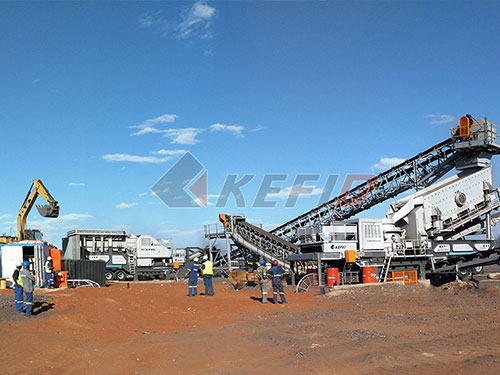
2.1 Primary Crushing Stage
- Equipment: Vibrating Grizzly Feeder + Jaw Crusher (e.g., PE-900×1200 or equivalent).
- Function: The feeder removes fines (<150mm) via a grizzly section, reducing wear on the jaw crusher. The jaw crusher reduces run-of-mine (ROM) material from up to 1000mm to 150-200mm.
- Customization: For highly abrasive materials, a heavy-duty feeder with manganese liners and a larger jaw crusher (e.g., C106 or C110 class) may be specified.
2.2 Secondary Crushing Stage
- Equipment: Cone Crusher (e.g., Symons 4.25ft, HP300, or CH440) or Impact Crusher (PF-1315 or equivalent).
- Function: The secondary crusher reduces the primary product to 40-80mm. Cone crushers are preferred for hard, abrasive rocks (granite, basalt) due to lower wear costs. Impact crushers are chosen for limestone or softer materials where higher reduction ratios and cubical shape are desired.
- Customization: For high-specification concrete aggregates, a “closed-circuit” secondary stage with a pre-screening deck may be integrated to bypass fines.
2.3 Tertiary Crushing and Screening Stage
- Equipment: Vertical Shaft Impact (VSI) Crusher (e.g., Barmac 9100 or equivalent) + Multi-deck Vibrating Screens (e.g., 3YK-2460 or 4YK-2470).
- Function: The VSI crusher is used for shaping and producing manufactured sand (0-5mm). The screens classify the material into multiple fractions. A closed-circuit loop returns oversized material to the VSI or tertiary cone crusher.
- Customization: For plants requiring high sand production (up to 30-40% of output), a dedicated sand washing module (e.g., spiral classifier or hydrocyclone) may be added.
2.4 Conveying and Control Systems
- Belt conveyors are sized for 250-300 TPH capacity (typically 800-1000mm wide) with heavy-duty idlers and impact beds at loading points.
- Electrical control is centralized via a PLC-based system with remote monitoring, motor protection relays, and soft starters for large motors (e.g., 200-400 kW crusher drives).
3. Customization Drivers in Plant Design
No two 250-300 TPH plants are identical. Factories that specialize in custom solutions consider the following variables: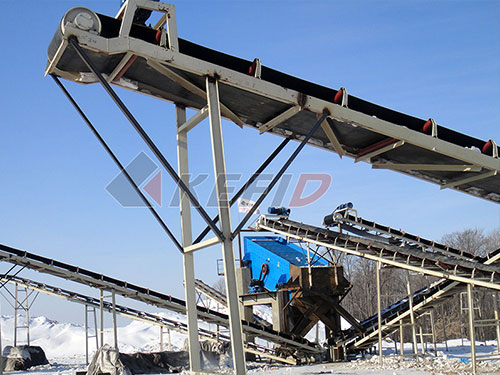
3.1 Raw Material Characteristics
- Abrasiveness: High silica content (e.g., quartzite, granite) demands wear-resistant liners (e.g., chrome-moly steel, ceramic inserts) and slower crusher speeds.
- Moisture Content: Wet materials (e.g., river gravel) require vibrating feeders with adjustable amplitude and non-clogging screen decks (e.g., polyurethane or rubber).
- Compressive Strength: Rocks above 300 MPa (e.g., basalt) may require a gyratory crusher as primary or a heavy-duty cone crusher in secondary.
3.2 Final Product Specifications
- Gradation: Strict requirements for concrete aggregates (e.g., ASTM C33) necessitate precise screen openings and multi-deck configurations.
- Shape: For high-quality asphalt aggregates, a VSI crusher with a “rock-on-rock” chamber is mandatory.
- Cubicity Index: Custom plants often include a “shaping” stage even for secondary crushers, using a cone crusher with a fine chamber setting.
3.3 Site Constraints
- Footprint: In confined quarries, a compact layout with a “tower-type” structure (vertical arrangement of crushers and screens) reduces land use.
- Mobility: Semi-mobile plants with hydraulic legs and wheel-mounted chassis allow relocation within the quarry.
- Altitude and Climate: High-altitude sites require derated motors and specialized lubrication systems. Cold climates need heated screens and insulated control rooms.
3.4 Environmental and Regulatory Compliance
- Dust Control: Custom plants integrate baghouse filters, water spray systems at transfer points, and enclosed conveyor galleries.
- Noise Reduction: Acoustic enclosures for crushers and screens, plus rubber liners in chutes.
- Wastewater Management: Closed-loop water systems for wet processing plants.
4. Manufacturing Standards and Quality Assurance
Reputable custom 250-300 TPH plant factories adhere to international standards:
- ISO 9001:2015 for quality management systems.
- CE Certification for European markets (machinery directive 2006/42/EC).
- ASME or GB/T standards for structural steel fabrication (e.g., main frame, hoppers, chutes).
- API or DIN standards for conveyor components (idlers, pulleys, belts).
Key quality indicators in factory production include:
- Welding: Full penetration welds on crusher frames, non-destructive testing (NDT) for critical joints.
- Machining: CNC-machined crusher eccentric shafts and bearing housings with tolerances within 0.02mm.
- Assembly: Pre-assembly and trial run of the entire plant at the factory (for stationary units) or modular assembly for containerized shipping.
- Wear Parts: Use of high-manganese steel (Mn13Cr2 or Mn18Cr2) for jaw plates and cone liners, with hardness testing (e.g., 180-220 HB).
5. Global Supply Chain and Factory Locations
The market for custom 250-300 TPH stone crushing plants is dominated by factories in:
- China: The largest producer, with clusters in Henan (Zhengzhou), Jiangsu (Shanghai), and Hebei. Chinese factories offer competitive pricing (typically $300,000–$800,000 for a complete plant) and fast delivery (8–12 weeks). Leading brands include Sandvik (via Chinese subsidiaries), Metso Outotec (licensed manufacturing), and domestic giants like Liming Heavy Industry, Shibang, and Zhengzhou Yifan.
- India: Factories in Gujarat, Maharashtra, and Tamil Nadu produce cost-effective plants (20–30% cheaper than European equivalents) with robust designs for local conditions. Brands like Puzzolana, Propel, and Mewar Hitech are prominent.
- Europe: German (Kleemann, Wirtgen), Austrian (SBM), and Finnish (Metso) factories focus on premium, high-efficiency plants with advanced automation and lower energy consumption. Prices range from $1.2 million to $2.5 million.
- Turkey: Factories in Ankara and Izmir offer a balance of quality and price, with strong export networks to the Middle East, Africa, and Central Asia.
6. Economic Considerations and ROI
A 250-300 TPH plant represents a significant capital investment. Typical cost breakdown:
- Equipment: 60–70% (crushers, screens, feeders, conveyors).
- Installation and Civil Works: 15–20% (foundations, steel structures, electrical).
- Engineering and Project Management: 5–10%.
- Spare Parts and First Fill: 5–10%.
Operational costs (per ton of production) include:
- Power: 0.8–1.2 kWh/ton (depending on material hardness).
- Wear Parts: $0.10–$0.30/ton (for cone crushers) to $0.05–$0.15/ton (for impact crushers).
- Labor: 3–5 operators per shift.
- Maintenance: 2–5% of equipment cost annually.
At a selling price of $10–$15 per ton for aggregates, a 250-300 TPH plant operating at 70% utilization (approx. 1,500 hours/year) can generate annual revenue of $3.75–$6.75 million, with payback periods of 2–4 years under favorable conditions.
7. Future Trends in Custom Plant Design
- Digitalization: Factories now offer IoT-enabled crushers with real-time monitoring of bearing temperature, oil pressure, and power draw. Predictive maintenance algorithms reduce downtime.
- Modularization: Containerized plants that can be shipped in standard 40ft containers and assembled within 2–3 weeks are gaining popularity in remote regions.
- Energy Efficiency: Hybrid plants combining electric motors with diesel generators for peak shaving, or fully electric plants with regenerative braking on conveyors.
- Sustainability: Use of recycled steel in plant fabrication, solar-powered lighting, and water recycling systems.
Conclusion
Custom 250-300 TPH stone crushing plant factories represent a sophisticated intersection of mechanical engineering, material science, and project management. The optimal plant is not merely a collection of crushers and screens but a tailored solution that balances throughput, product quality, operational cost, and environmental compliance. As global infrastructure spending continues to rise, the demand for such medium-capacity plants will remain robust, driving innovation in factory design, automation, and aftermarket support. For buyers, selecting the right factory requires a thorough evaluation of raw material properties, site conditions, and long-term service capabilities—not just the initial price tag.
