
The global construction and mining industries are the bedrock of modern infrastructure development, and at the heart of these sectors lies the essential process of stone crushing. Within this domain, the term “Shanghai Crusher” has become a prominent descriptor, not for a single machine, but for a comprehensive ecosystem of crushing machinery and complete production lines originating from Shanghai-based heavy equipment manufacturers. A “Shanghai Crusher Stone Crushing Line” represents a sophisticated, integrated system engineered to transform large, raw rock into specific, graded aggregates essential for countless applications. This article provides a detailed exploration of these production lines, examining their core components, operational principles, technological advancements, diverse applications, and their significant role in the international market.
A stone crushing line is not a single unit but a coordinated circuit of machines working in sequence. A typical Shanghai-designed crushing line is meticulously planned to optimize efficiency, output quality, and operational cost. The primary stages can be broken down as follows:
a) Feeding System: The process begins with a vibrating feeder. This equipment is responsible for consistently and evenly transporting raw materials (such as limestone, granite, basalt, or river stone) from the hopper to the primary crusher. Shanghai manufacturers often equip these feeders with grizzly sections—a set of parallel steel bars—that pre-screen finer materials, bypassing the primary crusher to enhance overall efficiency and reduce wear.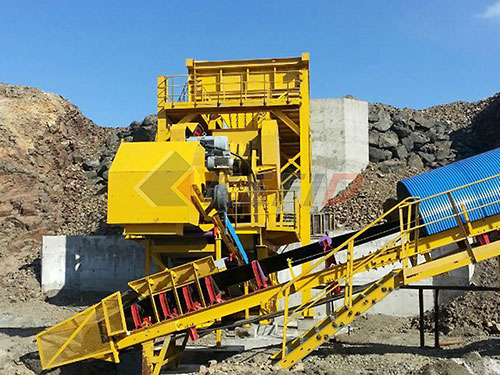
b) Primary Crushing Station: This is the first and most robust stage of size reduction. Large rocks, sometimes measuring over a meter in diameter, are fed into the primary crusher. Shanghai crusher lines frequently employ Jaw Crushers for this duty. The working principle involves a fixed and a movable jaw plate creating a “V” cavity. The movable jaw exerts immense mechanical pressure through an elliptical motion, crushing the rock against the stationary jaw. The ruggedness and relatively simple design of jaw crushers make them ideal for handling the initial impact and high abrasion of uncrushed material.
c) Secondary Crushing Station: The output from the primary crusher (typically 150-300mm) is still too coarse for most construction purposes. It is then conveyed to secondary crushers for further refinement. At this stage, Cone Crushers are the predominant choice from Shanghai suppliers. Operating on a gyratory principle inside a concave hopper, cone crushers provide continuous compression crushing. They are exceptionally well-suited for hard and abrasive materials, producing a more uniform, cubical product compared to jaw crushers. For softer materials like limestone, Impact Crushers might be used; they utilize high-speed rotors and hammers/anvils to shatter rock through impact forces, offering excellent shaping capabilities.
d) Tertiary and Quaternary Crushing: For applications requiring very specific, fine aggregates (e.g., for asphalt chips or manufactured sand), additional crushing stages may be incorporated. Here, finer cone crushers or specialized Vertical Shaft Impact (VSI) Crushers are deployed. VSI crushers use a high-velocity rotor to throw rock against a surrounding anvil ring or rock shelf, resulting in intense attrition that produces excellently shaped, cubicle aggregates and high-quality artificial sand.
e) Screening System: Integral to the entire process is the vibrating screen. This machine separates the crushed material into various predefined size fractions (e.g., 0-5mm, 5-10mm, 10-20mm). Screens feature multiple decks with different-sized meshes. Oversized material from the screens is typically sent back via conveyor belts to the appropriate crusher for further processing in a closed-circuit loop—a critical feature for maximizing yield and product consistency.
f) Conveying System: A network of belt conveyors acts as the circulatory system of the crushing line, seamlessly transporting material between feeders, crushers, screens, and final product stockpiles.
The prominence of Shanghai-based manufacturers like Sandvik (a Swedish company with significant presence), SBM (Shibang Industry & Technology Group), and several other renowned Chinese firms stems from decades of focused R&D and adaptation to global demands.
The aggregate produced by these lines forms the literal foundation of modern society.Its applications are vast:
Shanghai-based crushing equipment manufacturers have achieved adominant positionin both domestic Chineseand international markets.They successfully caterto abroad spectrumof customers,rangingfrom state-owned mining conglomeratesto small-scale quarry operatorsin developing nations.This successis built on acost-performance ratio thatis highly competitivecomparedto traditional Europeanand North American counterparts,coupledwith rapidly closing gapsin qualityreliability,and technological sophistication.Their global distributionand service networksensurethat spare partsand technical supportare accessible worldwide,further solidifyingtheir statusas key enablersof global infrastructuredevelopment.In essence,aShanghaiCrusherStoneCrushingLineis morethan justacollectionof machines;it representsacomprehensive,turnkey solutionengineeredto meetthe rigorousdemands ofthe modernaggregateindustry,withmodelsto suitvirtually anymaterial,budget,and outputrequirement.
In conclusion,the “ShanghaiCrusherStoneCrushingLine”is amicrocosmofglobalindustrialprogress.It embodiesdecadesofmechanicalengineeringrefinement,theintegrationofsmartautomationtechnologies,andaresponsiveadaptationto evolvingenvironmentaland economicneeds.Whetherproducingaggregatesfor amegaprojectlike adamor anew highwayor facilitatingurbanrenewalthroughwasterecycling,theselinesstandasatestamenttothecritical,yet oftenoverlooked,sectorthatbuildsandrebuildsourworld.As technologycontinuesto evolvewith trendstowardsgreaterconnectivity(Industry4 .0),electrification,andautonomousoperation,S hanghai’scrushingsectoris poisedtoremainattheforefront,supplyingtheessentialbuildingblocksforthefuture
Lorem ipsum dolor sit amet, consectetur adipisicing elit. Consectetur sequi saepe ut sunt eveniet perferendis excepturi, iste obcaecati. Qui tempore hic sed quia soluta obcaecati vel.