Optimizing Rock Crusher Equipment for Mining and Quarrying Operations in Georgia
The state of Georgia, with its rich and diverse geological foundation, is a significant hub for mining and quarrying in the Southeastern United States. From the hard, crystalline rocks of the Piedmont province to the extensive limestone deposits and valuable granite formations, the extraction of aggregates and dimension stone is a cornerstone of the state’s industrial and construction sectors. The efficiency, productivity, and environmental compliance of these operations are intrinsically linked to one critical component: rock crusher equipment. The selection, configuration, and operation of this machinery are not merely a matter of breaking rock; it is a sophisticated science tailored to Georgia’s specific geological characteristics, market demands, and regulatory landscape.
The Geological Context: What Georgia’s Quarries are Crushing
To understand crusher selection, one must first appreciate the raw material. Georgia’s geology presents three primary resource categories for quarrying:
- Granite and Other Igneous/Metamorphic Rocks: Found predominantly in the Piedmont region, notably around Elberton, the “Granite Capital of the World.” This rock is exceptionally hard, abrasive, and dense. It is quarried both for dimension stone (large blocks for monuments and building facades) and for aggregate (crushed stone). Processing this material demands equipment with high wear resistance and substantial power.
- Limestone: Extensive deposits exist in the Valley and Ridge province and other areas. Limestone is somewhat less abrasive than granite but can vary in hardness and silica content. It is a primary source for construction aggregate, agricultural lime, and cement manufacturing.
- Sandstone and Other Sedimentary Rocks: Used primarily for construction aggregate and fill material.
The physical properties of these materials—including compressive strength, abrasiveness, stickiness (in some weathered materials), and natural fracture lines—directly dictate the type of crushing technology required.
The Crushing Circuit: A Multi-Stage Process
No single machine can efficiently reduce a massive quarry-run boulder to the finely graded aggregates required for asphalt or concrete. Therefore, rock crushing is performed in a staged process within a well-designed circuit.
1. Primary Crushing: The First Reduction
The primary crusher is the workhorse stationed at the face of the quarry or in-pit. Its role is to accept the large feed material from haul trucks (which can be several feet in diameter) and perform the initial size reduction.
- Jaw Crushers: These are the most common choice for primary crushing in Georgia quarries. They function like a giant V-shaped vise, with one stationary “jaw” and one moving jaw that compresses rock against the stationary one until it fractures. Their robust design is ideal for handling large, hard rocks like granite. Their simplicity offers high reliability and relatively low maintenance.
- Gyratory Crushers: For very high-capacity operations (often seen in larger limestone quarries or mines), gyratory crushers may be employed. They consist of a long spindle with a crushing head that gyrates within a concave hopper. They offer higher throughput than jaw crushers but are more complex and have a higher initial cost.
2. Secondary Crushing: Refining the Product
The output from the primary crusher (typically 6 to 10 inches) is conveyed to secondary crushers for further reduction.
- Cone Crushers: This is arguably the most critical piece of equipment for producing high-quality aggregate from hard Georgia granite. Cone crushers operate by compressing rock between a gyrating mantle and a stationary concave liner (bowl liner). Modern cone crushers feature advanced hydraulics that allow for precise adjustment of the closed-side setting (CSS) during operation to control product size consistently.
- Impact Crushers: These are excellent for processing softer, less abrasive materials like limestone. They use high-speed impact forces from hammers or blow bars thrown against liners (anvils) to shatter the rock. While they can produce a well-shaped cubical product ideal for concrete aggregate without excessive fines generation in soft rock applications they would experience catastrophic wear if used on Georgia granite.
3. Tertiary/Quaternary Crushing: Precision Sizing
For applications requiring very specific particle shapes or sizes—such as manufactured sand (M-Sand) or specialized filter media—a third or even fourth stage of crushing may be implemented using finer-setting cone crushers or specialized Vertical Shaft Impactors (VSIs).
- Vertical Shaft Impactors (VSIs): VSIs are paramount for producing high-quality cubical aggregates and manufactured sand by accelerating rock into a stationary anvil ring or by rock-on-rock action (“rock shelf”). This process fractures the rock along its natural cleavage planes, creating optimally shaped particles that enhance workability in concrete mixes.
Key Considerations for Equipment Selection in Georgia
Beyond basic functionality, several localized factors influence equipment choice: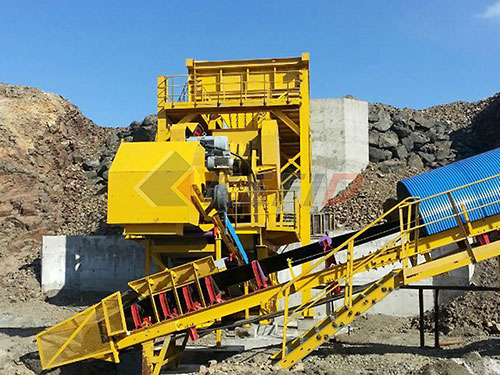
- Material Abrasiveness: For granite operations near Elberton or other Piedmont quarries,the dominant factor is wear.The manganese steel liners(jaws,mantles,bowl liners)in jawand cone crushers will wear rapidly.Crusher selection must prioritize models designed foreasy liner replacement,and operations must budgetfor significant wear parts inventory.In contrast,a limestone quarry might prioritize different liner metallurgiesand consider impact crushersfor their superior product shape.
- Product Versatility & Market Demand: A successful quarry must be able to pivot its production mix based on market demand.Should there be high demandfor asphalt chipsone monthand concrete stonethe next,the crushing circuitmust be flexible.Modern cone crushers with automated setting regulation allow quick changes.Crushing plantsare often designedwith multiple screening decksand conveyor cross-overs tomaximize product flexibility.
- Regulatory Compliance & Environmental Stewardship: Georgiaindustriesoperate under strict environmental regulationsfromtheGeorgia Environmental Protection Division(EPD).Dust suppressionis paramount.Crusher enclosures,tightly sealed transfer points,and comprehensive water spray systemsare mandatory investments.Noise controlis another critical considerationespeciallyfor quarriesnear residential areas.Crusher foundationsmayrequire special damping,and equipment selection often favors modelswith lower decibel output.
- Energy Efficiency & Operational Costs: The costof poweris amajor operational expense.Jawcrusherstendto be energy-efficienton aper-tonbasisforprimary crushingbut maynot produceideal shape.Modern conecrushersthroughadvanced hydraulicsandcrushing chamber designsare continuouslyimprovingtheirefficiencymeasuredin tonsperhourperkilowatt(tph/kW).Operatorsmust weighhigher capitalcostof more efficient machineryagainstlong-termoperational savings.
Technological Advancements Shaping Modern Quarries
The modern Georgian quarryis increasingly automatedand data-driven.Key advancementsinclude:
- Automation & Process Control Systems: Sophisticated PLCs(Programmable Logic Controllers)can monitorcrusher loadpowerhydraulic pressureandother parametersautomatically adjustingfeed ratesorclosed-side settingsto optimize throughputand protectthe machineryfrom overloads.This ensuresconsistentproduct qualitywith minimal human intervention.
- Telematics & Remote Monitoring: Equipment manufacturersnow embed sensorsthat transmit operational datavia cellularor satellite networks.This allows foreal-time monitoringof equipment healthpredictive maintenancealertsand remote diagnosticsreducingdowntime whichis criticalfor maintainingprofitability.
- Wear Part Innovation: Researchinto newalloysceramic compositesand improvedliner profilesextends thereplacement cyclesfor wear partsdirectly loweringcost-per-tonfigures.Thisis particularly impactfulin highly abrasivegranitecrushingapplications.
Conclusion
In conclusion,the selectionand operationofrockcrusherequipmentinGeorgia’sminingandquarryingsectorisa complexdisciplinerequiringadeepunderstandingoflocalgeologymarketdynamicsandenvironmentalregulations.Thereisnoonesizefitsallsolution.Aprimaryjawcrusherfeedingintosecondaryconecrushersremainsthebackboneforprocessingthestate’shardrockgranitedepositswhileimpactcrushersmayfindtheirplaceinsofterlimestoneoperations.TheintegrationofthefinalstageVSIiscrucialformodernsandspecifications.UltimatelysuccesshingesonmatchingtherighttechnologytotherockbeingprocessedwhileembracingautomationandefficiencyadvancementstoensurethatGeorgia’squarriesremainproductivecompetitiveandenvironmentallyresponsiblecontributorstothestate’seconomyformanyyearstocome
