Quarry Ballast Crushing Equipment Importer Specification: A Comprehensive Guide
For importers in the construction and railway infrastructure sectors, procuring the right quarry ballast crushing equipment is a critical capital investment. Ballast, the uniformly graded, coarse aggregate placed beneath railway tracks, is fundamental for drainage, load distribution, and track stability. Its production demands robust, efficient, and precise machinery. This specification guide serves as a professional framework for importers to define their requirements, evaluate suppliers, and ensure the delivered equipment meets operational, economic, and regulatory standards.
1. Defining the Core Objective: Ballast Specification Compliance
Before specifying equipment, the end-product must be defined. Ballast aggregates must conform to strict national or international standards (e.g., AREMA Chapter 4 in North America, EN 13450 in Europe, local railway authority specs). Key product parameters include:
- Particle Size Distribution: Typically 25-65mm or 30-50mm ranges with strict limits on fines (e.g., <1% passing a 0.075mm sieve).
- Particle Shape: High percentage of cubical particles (Flakiness Index <30%) for optimal interlock; minimal elongated or flaky pieces.
- Abrasion & Strength: High resistance to degradation (Los Angeles Abrasion <25%, Micro-Deval <10%).
- Cleanliness: Free from clay coatings, organic material, and deleterious substances.
Implication for Equipment Specification: The plant design must prioritize shaping and fines control over simple size reduction. This inherently favors multi-stage crushing circuits with specific crusher types.
2. Detailed Equipment Specifications & Plant Configuration
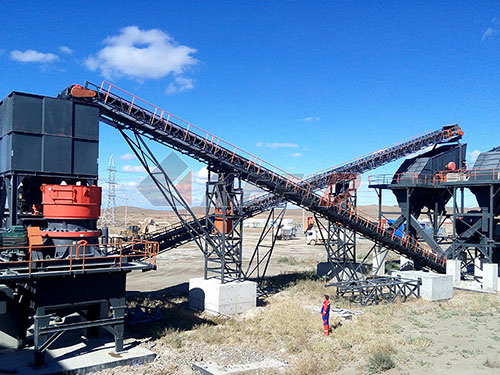
A typical ballast crushing circuit involves three to four stages. Importers must specify each component.
A. Primary Crushing Station:
- Type: Jaw Crusher (preferred) or Gyratory Crusher for high-capacity (>500 t/h) operations.
- Key Specifications:
- Feed opening dimensions to accommodate maximum feed size from quarry blast.
- Closed Side Setting (CSS) adjustment range.
- Drive power (kW) and flywheel mass for shock load absorption.
- Frame construction: Welded steel plate of defined yield strength.
- Jaw plates: Manganese steel grade (e.g., 14% Mn), thickness, and expected wear life in tonnage.
- Safety devices: Shear-pin or hydraulic toggle release system for tramp iron.
B. Secondary & Tertiary Crushing Stages:
This is where shaping occurs. A classic circuit is Jaw Crusher + Cone Crusher(s).
- Cone Crusher Specifications:
- Type: Hydraulic adjustment and clamping modern cone crushers are mandatory for consistent product quality.
- Chamber design: Options for coarse/medium/fine ballast profiles.
- Power rating and eccentric throw.
- Automation System: Must include automatic setting regulation (ASRi or equivalent) to maintain CSS despite liner wear.
- Tramp release and clearing system: Fully hydraulic.
- Liner material specification and predicted wear cost per tonne.
C. Screening & Fines Removal:
Critical for achieving grading and cleanliness specs.
- Screen Type: Multi-deck vibrating screens (typically 2 or 3 decks).
- Deck inclination, stroke, and frequency specifications based on material flow.
- Screen media: Defined aperture sizes per deck (punch plate, rubber panels, wire mesh). Specify material grade (e.g., HARDOX for plates).
- Drive mechanism: Vibration exciter type with bearing specifications.
- Fines Removal System: Sand screw classifier or hydrocyclone plant may be required if washing is specified to remove clay/silt.
D. Conveying System:
- Belt Width, Speed, and Capacity with at least 25% design margin over crusher output.
- Idler type (impact/return), spacing, sealing class against dust ingress.
- Drive pulley lagging specification.
E. Power Generation & Control:
- Prime mover options: Electric motors (specify voltage/frequency tolerance) or diesel-hydraulic drives for remote sites.
- Control Panel: PLC-based with touchscreen HMI for full plant sequencing start/stop; individual equipment interlocks; production data logging; fault diagnostics.
3. Importer-Centric Commercial & Logistical Specifications
Beyond technical details, these clauses protect the importer’s interests:
A. Supplier Qualification Requirements:
- Minimum years of experience in designing ballast plants.
- List of reference installations with similar capacity/output spec.
- Certification of quality management system (ISO 9001).
B. Scope of Supply & Delivery Terms (Incoterms):
Define explicitly:
- Full itemized list of supplied equipment (EXW, FOB, CIF, etc.).
- C. Technical Documentation Package:
Mandatory delivery with shipment:
- General Arrangement drawings for layout approval.
- Foundation drawings with dynamic load data.
- Electrical schematics and pneumatic/hydraulic diagrams.
- Comprehensive parts manual with OEM part numbers for all components (bearings, motors).
- Detailed operation & maintenance manual in English.
D. Performance Guarantees & Warranty:
- Throughput Guarantee: e.g., “The plant shall process [X] tonnes per hour of quarry run material with a bulk density of [Y] t/m³ to produce compliant ballast.”
- Product Shape Guarantee: e.g., “The output aggregate shall have a Flakiness Index not exceeding [Z]%.”
- Warranty Period: Minimum 12 months from commissioning or 18 months from shipment for structural parts; specific warranty on wear parts excluded unless defective in material/workmanship.
E. After-Sales Support:
- Availability of spare parts stockholding commitment by supplier/distributor within the importer’s region/ country .
Conclusion
Specifying quarry ballast crushing equipment as an importer requires a holistic approach that balances product quality mandates with total lifecycle costs . A meticulous technical specification forms the backbone , but it must be reinforced by robust commercial terms covering performance , support , logistics , compliance . By issuing a tender document structured around these pillars , importers move from being mere purchasers of machinery to informed project owners . This discipline minimizes project risk , ensures long-term plant reliability , secures return on investment through consistent production of high-specification railway ballast – ultimately contributing to safer more durable rail infrastructure .
