
Title: Private Label Gyratory Crusher: An In-Depth Analysis of OEM/ODM Manufacturing, Market Dynamics, and Operational Advantages
Introduction
In the heavy machinery and mineral processing industries, the gyratory crusher stands as a cornerstone of primary crushing operations. Known for its ability to handle high throughput and large feed sizes, this equipment is indispensable in mining, quarrying, and aggregate production. However, a significant trend has emerged over the past decade: the rise of the private label gyratory crusher. This business model, where an original equipment manufacturer (OEM) produces crushers that are branded and sold by another company, has reshaped supply chains, reduced capital barriers, and introduced new levels of competition. This article provides a comprehensive, professional, and objective examination of private label gyratory crushers, covering their technical foundations, manufacturing processes, quality control, market advantages, and strategic considerations for buyers.
1. Understanding the Gyratory Crusher: Technical Fundamentals
Before delving into the private label aspect, it is essential to understand the core technology. A gyratory crusher consists of a concave surface (the fixed bowl liner) and a conical head (the mantle) that gyrates eccentrically. The crushing action is continuous, unlike the intermittent action of a jaw crusher. This design allows for a higher capacity per unit of power, typically ranging from 1,000 to 10,000 tons per hour, depending on the model.
Key technical parameters include:
Gyratory crushers are preferred over jaw crushers when high capacity and a consistent product shape are required, especially in hard rock mining (e.g., copper, gold, iron ore). Their robust design, however, comes with high initial cost and complex maintenance requirements.
2. The Private Label Model: Definition and Mechanics
A private label gyratory crusher is a machine manufactured by one company (the OEM) but sold under the brand name of another company (the reseller or distributor). This is distinct from white-label products, where the manufacturer’s identity is completely hidden. In private labeling, the reseller often specifies design modifications, performance targets, and aftermarket support requirements.
The typical private label arrangement involves:
3. Manufacturing Process and Quality Control
Private label gyratory crushers are not inferior to branded counterparts if the manufacturing process adheres to rigorous standards. The production involves several critical stages:
3.1. Casting and Forging
The main frame, bowl, and mantle are typically cast from high-manganese steel (e.g., ASTM A128 Grade B-2) or alloy steel. The eccentric assembly and main shaft are forged from high-strength alloy steel. Private label manufacturers must ensure that foundries use certified materials and follow heat treatment protocols to achieve the required hardness and toughness.
3.2. Machining and Assembly
Precision machining of the eccentric bushing, pinion shaft, and bearing housings is critical. Tolerances are typically within ±0.05 mm for rotating parts. Assembly must be performed in a clean, controlled environment to prevent contamination. Many private label OEMs use CNC machining centers and coordinate measuring machines (CMM) to verify dimensions.
3.3. Quality Assurance
Reputable private label manufacturers implement ISO 9001 quality management systems. Key tests include:
3.4. Component Sourcing
A major advantage of private label production is the ability to source components from specialized suppliers. For example, bearings from SKF or FAG, hydraulic cylinders from Parker or Rexroth, and electric motors from Siemens or ABB. The reseller can specify these brands to ensure reliability, even if the crusher itself is not a “name brand.”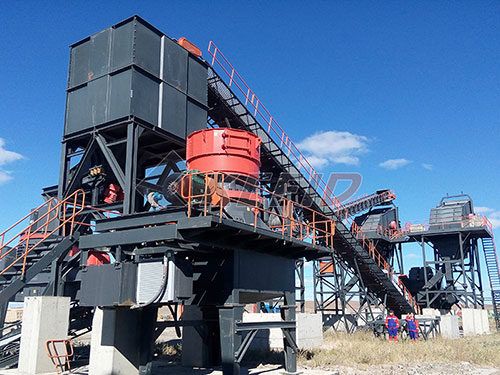
4. Advantages of Private Label Gyratory Crushers
4.1. Cost Efficiency
Private label crushers typically cost 20–40% less than established global brands (e.g., Metso, Sandvik, Thyssenkrupp). This is due to lower overhead costs, reduced marketing expenses, and competitive labor rates in manufacturing hubs. For mining companies with tight capital budgets, this can be a decisive factor.
4.2. Customization and Flexibility
Resellers can request modifications that standard OEMs may not offer. For example, a private label crusher can be designed with a specific feed opening to match an existing mine layout, or with a modified eccentric throw to optimize for a particular ore type. This flexibility is particularly valuable for brownfield expansions.
4.3. Supply Chain Control
By owning the brand, the reseller can manage spare parts availability and aftermarket service directly. This reduces dependency on a single global supplier and can lead to faster response times for critical repairs. Some mining companies have even established their own private label brands to bypass traditional OEM markups.
4.4. Market Entry for New Players
Private labeling allows smaller equipment distributors to enter the primary crusher market without investing in R&D and manufacturing infrastructure. They can leverage the technical expertise of established OEMs while building their own brand reputation.
5. Risks and Challenges
5.1. Quality Variability
Not all private label manufacturers maintain consistent quality. The reseller must conduct thorough audits of the OEM’s facilities, review past production records, and insist on third-party inspections. A poorly manufactured gyratory crusher can lead to catastrophic failures, production downtime, and safety hazards.
5.2. Intellectual Property and Liability
If the private label crusher infringes on existing patents (e.g., for hydraulic adjustment systems or concave locking mechanisms), the reseller may face legal action. Additionally, liability for accidents or equipment failure rests with the brand owner, not the OEM. Comprehensive insurance and indemnity clauses are essential.
5.3. Aftermarket Support
While the reseller controls the brand, they must also build a robust aftermarket network. This includes stocking spare parts (mantles, concaves, bushings, seals), providing technical documentation, and training maintenance crews. Without this, the crusher’s total cost of ownership (TCO) can skyrocket.
5.4. Long-Term Reliability
Gyratory crushers are designed for decades of service. Private label models may use lower-grade materials or simplified designs to reduce cost, which can compromise long-term reliability. The reseller must balance initial price with expected lifespan and maintenance intervals.
6. Market Trends and Future Outlook
6.1. Regionalization of Supply
The private label market is growing in regions like Africa, Southeast Asia, and South America, where local mining companies seek to reduce reliance on European or North American suppliers. Chinese manufacturers, in particular, have become dominant in private label production due to their scale and cost advantages.
6.2. Digitalization and IoT
Some private label crushers now incorporate smart sensors for monitoring oil temperature, vibration, and wear. Resellers can offer remote diagnostics as a value-added service. However, this requires integration with the OEM’s control systems, which can be a technical challenge.
6.3. Sustainability and Circular Economy
There is increasing demand for crushers that are easier to refurbish and recycle. Private label manufacturers are exploring modular designs that allow for component replacement rather than full machine replacement. This aligns with mining companies’ ESG (Environmental, Social, Governance) goals.
6.4. Consolidation and Partnerships
As the market matures, we may see more strategic alliances between private label resellers and OEMs. For example, a reseller might invest in the OEM’s production capacity in exchange for exclusive rights to a specific model. This vertical integration can improve quality control and reduce lead times.
7. Strategic Recommendations for Buyers
For mining companies or contractors considering a private label gyratory crusher, the following steps are critical:
Conclusion
The private label gyratory crusher represents a pragmatic evolution in the heavy equipment industry. It offers a viable alternative to established global brands, particularly for cost-conscious buyers in emerging markets. However, success depends on rigorous due diligence, transparent partnerships, and a commitment to quality from both the OEM and the reseller. As mining operations become more complex and capital-intensive, the private label model will likely continue to grow, provided it can deliver on the fundamental promise of reliability, performance, and value. For those who navigate the risks effectively, the private label gyratory crusher can be a powerful tool for optimizing crushing operations and improving project economics.
If you have any questions about our products, please feel free to contact us. We take all inquiries and suggestions very seriously.