OEM Impact Crushers: The Unseen Engine of Modern Aggregate Processing
In the vast and intricate ecosystem of industrial machinery, few components are as critical yet as understated as the Original Equipment Manufacturer (OEM) impact crusher. Far more than a simple commodity, an OEM impact crusher represents the pinnacle of integrated engineering, material science, and application-specific design. It is the core kinetic engine within crushing plants worldwide, transforming raw quarry rock, recycled concrete, and industrial minerals into the precise, specification-grade aggregates that build our infrastructure. This article delves into the multifaceted world of OEM impact crushers, exploring their technological essence, advantages over aftermarket alternatives, key selection criteria, and their evolving role in a sustainability-focused industry.
Defining the OEM Distinction: More Than a Brand Name
An OEM impact crusher is manufactured by the same company that designs and markets the complete crushing system or plant. This includes industry leaders like Metso Outotec, Sandvik, Terex MPS, Kleemann (Wirtz Group), and Hazemag (part of Schmidt-Kranz). The term “OEM” signifies a holistic origin: every rotor assembly, blow bar, impact apron, housing, and control system is conceived, engineered, tested, and produced as part of a unified system.
This contrasts sharply with aftermarket or “generic” crushers and parts. The OEM advantage is rooted in system synergy. The crusher is not an isolated unit but the calculated centerpiece of a material flow process. Its feed opening dimensions correlate precisely with upstream feeder capacities; its rotor inertia and speed are optimized for expected feed sizes from a primary crusher; and its product gradation is designed to work in harmony with downstream screening decks. This intrinsic compatibility ensures maximum plant-wide efficiency, minimizing bottlenecks and power consumption spikes.
Core Technological Principles and Design Evolution
Impact crushing operates on the principle of accelerated kinetic energy. Material is fed into a rapidly rotating rotor equipped with blow bars (hammers). The rotor flings the material against stationary impact aprons (breaker plates) or into other pieces of rock within the crushing chamber (rock-on-rock action). This violent collision causes fractures along natural grain boundaries, producing a characteristically cubical product shape—a highly prized attribute for high-strength concrete and asphalt where flaky or elongated particles are detrimental.
OEMs continuously refine this principle through advanced design:
- Rotor Dynamics: Modern rotors are no longer simple steel discs. They are heavy-duty, computer-balanced assemblies designed for specific applications. “Solid” rotors offer maximum inertia for hard rock, while “open” or “sledger” rotors provide better throughput for recycling and softer materials.
- Hydraulic Adjustment & Assistance: Nearly all premium OEM impactors feature hydraulic systems to adjust the gap between rotor and aprons for precise product size control without manual labor. More critically, hydraulic cylinders allow the entire rear frame to open for safe and rapid maintenance access to the interior chamber—a stark contrast to arduous manual disassembly.
- Intelligent Control Integration: Modern OEM crushers are sensor-rich machines. Bearing temperature monitors, vibration sensors on the rotor frame, and wear indicators on liners feed data directly into the plant’s PLC or cloud-based monitoring platform (e.g., Metso Metrics™ or Sandvik My Fleet). This enables predictive maintenance, preventing catastrophic failures.
- Material Science in Wear Parts: The battle against wear is fought with advanced metallurgy. OEMs develop proprietary alloys and ceramic composites for blow bars and apron liners tailored to specific abrasiveness levels. A blow bar for granite crushing differs materially from one designed for asphalt recycling.
The Compelling Value Proposition: Why Choose OEM?
The initial capital outlay for an OEM impact crusher is often higher than for a non-OED alternative. However, a Total Cost of Ownership (TCO) analysis invariably reveals its superior long-term value.
- Guaranteed Performance: An OEM crusher comes with factory-derived performance curves—verified throughput (tph), power draw (kW), and product gradation under defined conditions. This eliminates guesswork in plant design.
- Optimized Wear Life & Cost-Per-Ton: Genuine OEM wear parts are engineered to work in perfect concert with the crusher’s geometry. A non-OEM blow bar may have different weight or profile, causing imbalance on the rotor leading to premature bearing failure or suboptimal particle throw. While cheaper per piece, their shorter life and potential collateral damage result in a higher cost-per-ton of crushed material.
- Unmatched Reliability & Uptime: Built to exacting standards with premium-grade bearings, castings,and seals,OEM crushers are designed for relentless operation.Higher availability directly translates to greater production volumesand revenue.
- Integrated Safety & Ease of Service: Safety features like mechanical lock-out devices on adjustment mechanismsand tool-less access designs are inherent to OEM engineering.Service manualsare precise,and technical support teams possess deep,institutional knowledge ofthe machine’s DNA.
- Warranty & Support Ecosystem: Purchasing anOEM unit includes comprehensive warranty coveragefor both partsand labor.Furthermore,OEMs provide global service networks,a steady supply chainfor spare parts,and expert field service technicians.
Selecting an OEMA Impact Crusher: Key Application-Driven Considerations
Choosingthe right OEMA impactor requiresa detailed analysisofthe application:
- Primary vs.Secondary/Tertiary Crushing: Primary horizontalshaft impactors(HSI)are robust machineswith massive rotorsfor processing large feed(up to ~1m).Secondary/tertiaryHSIor Vertical Shaft Impactors(VSI)arefinesse toolsfor shapingand final sizing.VSIs excelat producing manufactured sandwith ideal particle shape.
- Feed Material Characteristics: Abrasiveness(e.g.,granite vs.limestone),silica content,density,and moisture levelare paramount.Hard ,abrasive rock demandsasolid rotorand high-chrome martensitic blow bars.Recycled concretewith rebar requiresan open rotorwith replaceable wear tilesand possiblyan overband magnet integratedinto the design.
- Desired End Product: The needfor cubicity,fines generation(e.g.,for asphalt filler),or specific top sizewill guide selectionbetween HSI(typically better reduction ratios)and VSI(superior shape).
- Mobility Needs: For quarryand permanent installations,a stationary modular plantis ideal.For contractors needingto move between sites,OEMs offertrack-mounted(Tracked Mobile Impact Crusher)or wheel-mounted mobile unitswith fully integrated feeders,screens,and conveyors.
The Future Trajectory: Digitalization,Sustainability,and Circularity
The futureof OEMA impact crushingis being shapedby macro-industrial trends: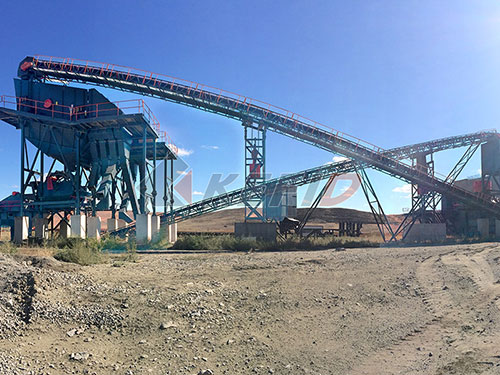
- Digital Twins & Advanced Automation: Crushers will existas digital twins,virtual modelsusedto simulate performanceunder different conditions.Automatic setting adjustmentbasedon real-time feedbackfrom camerasor laser-basedproduct analysiswill optimize gradation autonomously.
- Energy Efficiency Mandates: New designsfocuson reducing specific energy consumption(kWh/ton).This involvesoptimizingcrushing chamber geometry,motor efficiency,and drive systems.Lower power drawis bothan economicandan environmental imperative.
- Embracingthe Circular Economy: Impactcrushersare alreadythe workhorsesof Construction& Demolition(C&D)waste recycling.Future modelswill feature enhanced protection against uncrushables,moredust suppression integration,and designs tailoredfor heterogeneous feed streams.OEMs are positioningtheir machinesas essential toolsin urban mining.
- Alternative Drives: While fully electric drivesare commonin stationary plants,the explorationof hybrid drivesfor mobile unitsis underwayto reduce fuel consumptionand emissionsat site.
Conclusion
The OEMA impactcrusher standsasa testamentto sophisticated mechanical engineeringin serviceof foundational industries.It transcendsits basic functionof sizereductionto becomea strategic assetthat determinesplant profitability,end-product quality,and operational reliability.Inan erawhere efficiency,sustainability,and data-driven decision-makingare paramount,the choiceof an OEMA solutionis not merelya purchasing decisionbuta long-term operational philosophy.The deep integrationof design,materials,and intelligenceensures that these unseen enginescontinue todrive progressfromthe groundup,turning raw resourcesinto the building blocksof civilization.With relentless innovationfocusedon digital integrationand environmental stewardship,OEMA impactcrushersare poisedto remainindispensableforthe infrastructurechallengesofthe21st centuryand beyond
