
Abstract
This document provides a detailed, objective, and professional specification framework for Original Design Manufacturing (ODM) quarry ballast crushing equipment. Ballast, the graded aggregate placed beneath railway tracks, demands stringent physical and geometrical properties to ensure track stability, drainage, and longevity. Consequently, the machinery designed for its production must adhere to exacting standards. This article delineates the critical specifications, design principles, component requirements, and performance metrics essential for ODM suppliers and quarry operators in the engineering and procurement of optimal ballast crushing systems.
Railway ballast is not merely crushed stone; it is a key engineered component of the track structure. Its primary functions include distributing dynamic loads from sleepers (ties) to the subgrade, providing lateral and longitudinal track resistance, facilitating drainage, and inhibiting vegetation growth. To fulfill these roles, ballast must possess high strength (Los Angeles Abrasion < 25%), durability (Micro-Deval < 17%), a specific angular shape for interlocking, and a tightly controlled particle size distribution (typically 25-65mm as per AREMA or EN 13450 standards).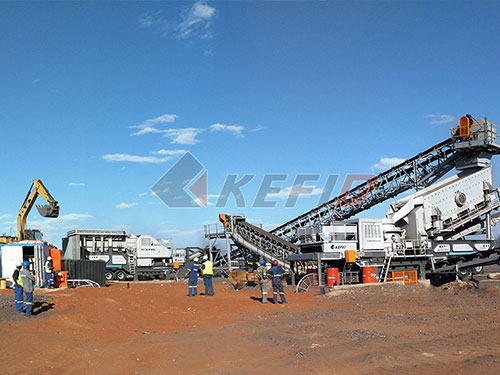
ODM crushing equipment for this application is designed from the ground up to transform blasted quarry run material into this premium product. Unlike standard aggregate crushers, ballast crushers are optimized for yield—maximizing the proportion of in-spec product while minimizing fines (particles <25mm) and oversize. This necessitates an integrated system approach with precise specification at every stage.
2.1 Overall Plant Design Philosophy
An ODM ballast crushing plant is a fixed or semi-mobile system engineered for high-volume, consistent output. The design philosophy centers on:
2.2 Primary Crushing Stage: Jaw Crusher Specifications
The primary crusher accepts feed directly from the quarry face.
2.3 Secondary & Tertiary Crushing Stages: Cone Crusher Specifications
This is the heart of shape generation. Secondary crushing reduces primary output to -80mm, while tertiary (and sometimes quaternary) stages refine shape and final sizing.
2.4 Screening Stage Specifications
Screening is as crucial as crushing for yield control.
3.1 Feed System
3.2 Conveying System
3.3 Power & Drive System
3.4 Dust Suppression & Control
A mandatory specification due to environmental compliance:
ODM equipment must be contractually guaranteed against measurable performance criteria:
1 . Product Yield : Minimum % of total plant feed meeting specified ballast gradation e.g., >70% yield of +25 -65 mm fraction .
2 . Particle Shape Index : Measured by Flakiness Index per EN / ASTM standards ; target FI <20%.
3 . Aggregate Strength : While dependent on parent rock , final product must pass LA Abrasion tests ; plant design should not induce internal cracking .
4 . Production Capacity : Sustained throughput over an extended period e.g., average TPH over consecutive shifts .
5 . Operational Availability : Percentage uptime excluding planned maintenance .
6 . Specific Wear Cost : Cost per ton crushed attributable directly wear parts liners , screen panels etc .
Specifying ODM quarry ballast crushing equipment requires moving beyond generic capacity figures towards holistic engineering focused on end-product quality metrics particularly yield cubicity durability The ideal system integrates rugged primary reduction precision shaping via automated cone crushers intelligent screening into closed circuit loops all governed by robust PLC controls For project owners issuing tenders these specifications form basis technical evaluation For ODM manufacturers they represent commitment delivering not just machinery but complete process solution integral modern rail infrastructure development As demands rail efficiency safety grow so too will sophistication these purpose built industrial workhorses driving bedrock global transportation networks
Lorem ipsum dolor sit amet, consectetur adipisicing elit. Consectetur sequi saepe ut sunt eveniet perferendis excepturi, iste obcaecati. Qui tempore hic sed quia soluta obcaecati vel.