ODM JC5000 Jaw Crusher: A Comprehensive Analysis of a High-Capacity Primary Crusher
In the demanding world of aggregate production, mining, and heavy-duty recycling, the primary crushing stage sets the fundamental tone for operational efficiency, product quality, and overall profitability. At this critical juncture, jaw crushers remain the undisputed workhorses, prized for their simplicity, robustness, and ability to handle the toughest feed materials. Among the various offerings in the market, the ODM JC5000 Jaw Crusher emerges as a significant contender in the high-capacity primary crushing segment. This article provides a detailed, objective analysis of this machine, examining its design philosophy, technical specifications, potential applications, and its position within the broader industrial context.
Understanding the “ODM” Designation and Market Position
Firstly, it is crucial to decode the “ODM” prefix. ODM stands for Original Design Manufacturer. This signifies that the JC5000 is not merely a generic copy but a crusher designed and engineered by its manufacturer to meet specific performance benchmarks and market needs. The vendor producing the JC5000 has invested in its proprietary design, which may then be sold under its own brand or potentially white-labeled for other distributors. This contrasts with OEM (Original Equipment Manufacturer) parts designed for a specific brand or pure reverse-engineered replicas. An ODM product like the JC5000 typically aims to offer a compelling balance of performance, durability, and cost-effectiveness, positioning itself as a viable alternative to established global brands.
Technical Specifications and Design Philosophy
The “5000” in JC5000 generally denotes a key dimension—the feed opening. A jaw crusher model number often references the width and length of the feed opening in millimeters. In this case, a 5000 mm dimension (approximately 197 inches) would indicate an exceptionally large crusher. However, it is more common for such numbers to represent width; thus a 1300mm x 1000mm (51″ x 40″) or similar large format is plausible for a “5000” class machine. For accurate analysis, we will assume the JC5000 is designed as a high-tonnage primary crusher.
1. Core Structural Design:
- Frame: Expect a heavily reinforced, single-piece or modular welded steel frame to withstand immense cyclical stresses. The integrity of the frame is paramount for longevity and maintaining alignment of crushing components.
- Crushing Chamber: The chamber geometry is optimized for high reduction ratios and throughput. A deep,symmetrical crushing chamber with no dead zones promotes continuous material flow and minimizes clogging.
- Jaw Dies: Utilizes massive manganese steel jaw plates (fixed and movable). The profile of these dies (e.g., corrugated or quasi-curved) is engineered to enhance nip angle (the angle between the jaws), improve grip on slabby material,and promote inter-particle crushing for better particle shape.
2. Drive System & Kinematics:
- The heart of its performance lies in its kinematics—the motion of the movable jaw. The JC5000 likely employs an aggressive elliptical motion at the discharge end combined with a powerful stroke.
- This action ensures:
- High Throughput: Rapid cycling of material through the chamber.
- Effective Reduction: Powerful compression at every cycle.
- Self-Cleaning Tendency: The elliptical motion helps eject crushed material downward efficiently.
- It is driven by a high-inertia flywheel connected to a large electric motor via V-belts or direct drive.The flywheel stores energy during the non-crushing half of the cycle,smoothing out power demand and delivering massive force during compression.
3. Adjustment & Safety Systems:
- Discharge Setting Adjustment: A critical feature is how quickly and safely CSS (Closed Side Setting) can be changed.Typical systems involve hydraulic shims or tandem hydraulic cylinders that allow remote adjustment under load or when empty.This minimizes downtime for product size changes.
- Overload Protection: To protect against uncrushable material (e.g., tramp metal),a robust safety system is essential.This could be:
- Toggle Plate System: A mechanically sacrificial toggle plate that breaks under extreme pressure.
- Hydraulic Toggle System: More advanced;uses hydraulic cylinders to allow temporary release of pressure before automatically resetting.This offers superior protection without requiring manual replacement parts.
4. Key Performance Metrics (Estimated):
- Feed Opening: ~1500mm x 1300mm (59″ x 51″)
- Max Feed Size: Up to ~1200mm (47″) lump size
- Capacity Range: Highly dependent on material density,friability,and CSS,but likely in the range of 750 – 1500 metric tons per hour in standard applications.
- Power Rating: Likely equipped with a 300-400 kW (400-550 HP) electric motor.
- Total Weight: A machine of this scale would weigh between 80-120 tonnes,making foundation design critical.
Target Applications and Operational Suitability
The ODM JC5000 is engineered for capital-intensive projects where high-volume primary reduction is non-negotiable.
- Large-Scale Hard Rock Mining & Quarrying: Its primary domain.Ideal for primary crushing of granite,basalt,and iron ore directly from blast run-of-mine (ROM) feed.It serves as an anchor machine feeding secondary cone crushers or large SAG mill circuits.
- Major Aggregate Production Plants: In sand-and-gravel operations processing tough abrasives,the JC5000 can serve as an efficient first stage,promising consistent output for further processing into construction aggregates.
- Industrial Minerals Processing: Suitable for processing limestone,dolomite,and other industrial minerals at scale where high throughput trumps ultra-fine shaping requirements.
- (Potential) Heavy-Duty Recycling/Demolition Waste Processing: With proper configuration(e.g.,integrated pre-screening,a reinforced frame,and specialized wear protection),it could handle large concrete slabs,rubble,and construction waste.Note that recycling applications demand specific features like tramp metal handling which may require additional options.
Comparative Analysis: Strengths & Considerations
When evaluating an ODM product like the JC5000 against established international brands(CAT,Terex,Mesto,Sandvik),a nuanced perspective is required.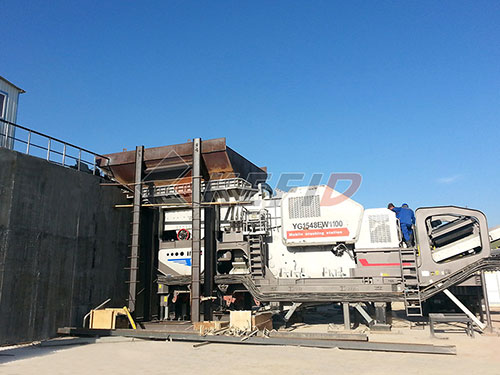
Potential Strengths:
- Cost Competitiveness: Often,the most significant advantage.An ODM vendor typically has lower overheads related to global branding,massive R&D amortization,and extensive dealer networks.This can translate into substantial capital expenditure savings upfront.
- Performance-to-Price Ratio: For operations focused on raw throughput tonnage over decades-long lifecycle nuances,the JC5000 may offer excellent initial productivity per dollar invested.
- Design Focus on Core Functionality: Freed from legacy platform constraints,the design can be optimized around key performance metrics like capacity,cost-effective serviceability,and robust core components without over-engineering ancillary systems.
Key Considerations:
- After-Sales Support & Parts Availability: This is arguably the most critical factor.The value proposition hinges entirely on reliable access to genuine wear parts(jaw dies,bearings,toggles)and timely technical service.The buyer must rigorously assess:
Does this vendor have proven global logistics?
What are lead times on major components?
Is there local engineering support?
A breakdown on such large equipment costs thousands per hour in lost production.*
- (Potential) Resale Value & Brand Recognition:
Resale value tends to be lower than top-tier brands.Financing may also be structured differently.Brand recognition can affect contractor specifications on certain projects.
Long-term reliability data may be less extensive compared to models with decades-long field histories.
A thorough review of case studies from similar applications under comparable conditions becomes essential.
Conclusion: A Strategic Tool for Informed Buyers
The ODM JC5000 Jaw Crusher represents more than just machinery;it embodies strategic choice.It caters specifically to operators who prioritize maximizing initial capital efficiency while accepting calculated risks regarding long-term support logistics.It fills an important niche in markets where operational budgets are tightly constrained yet demands are high.For mega-projects governed by strict OEM specifications,the path might still lead toward traditional brands.But for independent quarry owners,major contractors running dedicated long-term projects,and operators in regions with strong local support from such vendors,the JC5000 presents itself as powerful tool worthy serious consideration.Ultimately,a successful deployment depends not only on impressive paper specifications but also on conducting exhaustive due diligence regarding supply chain resilience,vendor financial stability,and securing verifiable references from existing users operating under similar conditions.Informed procurement decisions transform powerful machines like these into reliable assets driving profitability at industry’s most demanding front line—the primary crush
