The Jc5000 Jaw Crusher: A Comprehensive Technical Specification and Operational Analysis
The Jc5000 Jaw Crusher represents a significant class of heavy-duty, high-capacity primary crushing equipment, engineered for the most demanding mining, quarrying, and industrial applications. Designed to process large feed sizes with exceptional throughput and reliability, it stands as a critical piece of infrastructure in aggregate production and mineral processing circuits. This detailed specification and analysis will dissect the machine’s design philosophy, core technical parameters, operational features, and typical application spectrum.
1. Design Philosophy and Core Construction
The overarching design principle behind the Jc5000 is robustness and serviceability. It is built not merely to crush hard, abrasive materials like granite, basalt, and iron ore but to do so continuously under severe operating conditions with minimal unplanned downtime.
- Frame: The crusher features a heavy-duty, stress-relieved steel frame, often constructed from welded plate or cast steel components. This monolithic structure provides the foundational rigidity necessary to withstand the immense cyclic forces generated during the crushing process. The design avoids high-stress concentrations through generous radii and strategic ribbing.
- Jaw Design: The heart of the machine is its jaw assembly. The fixed jaw (stationary die) is securely bolted to the crusher frame. The moving jaw (swing die) is mounted on a robust eccentric shaft supported by large-diameter, anti-friction bearings housed in precision-machined bearing seats. These bearings are typically spherical roller bearings chosen for their ability to handle both radial and axial loads.
- Crushing Chamber: The chamber geometry is optimized for high reduction ratios—often in the range of 6:1 to 8:1—meaning the feed material can be reduced to one-sixth or one-eighth of its original size in a single pass. The liner profiles (jaw plates) are designed to be deep and aggressive, promoting efficient nip-angle capture of large feed material (up to approximately 1300mm/51″ in some configurations) and ensuring consistent product gradation.
2. Detailed Technical Specifications
While exact figures can vary slightly between manufacturers or specific model iterations, the Jc5000 class typically conforms to the following performance envelope: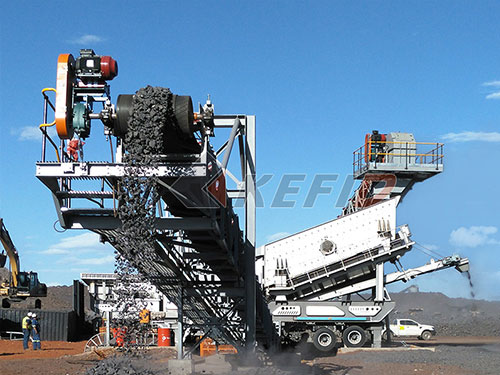
- Feed Opening: Approximately 1500mm x 2000mm (59″ x 79″). This vast opening allows for the processing of large run-of-mine rock or blasted quarry stone with minimal pre-scalping.
- Max Feed Size: Up to ~1200mm (47″) edge length, depending on material characteristics and chamber configuration.
- Capacity: Throughput is highly material-dependent (density, hardness, friability). For standard crushed stone (bulk density ~1.6 t/m³), capacities can range from 750 to 1500 metric tonnes per hour. For denser ores, throughput in weight will be higher.
- Power Rating: Driven by high-torque electric motors typically rated between 200 kW to 375 kW (270 HP to 500 HP). The drive system usually incorporates V-belts or direct drive with fluid couplings/soft starters to manage start-up inertia and absorb shock loads.
- Eccentric Shaft Speed: Operates at a relatively low speed, often between 220 to 280 rpm. This low speed maximizes torque at the jaw tip, facilitating effective breakage of massive rock pieces rather than simply grinding them.
- Discharge Setting Range: Adjustable via hydraulic or mechanical shim systems over a wide range, commonly from 150mm to 300mm (6″ to 12″) CSS (Closed Side Setting). This adjustability allows operators to fine-tune product size for downstream processes.
- Weight: As a complete unit (including drive motor and base frame), the crusher can weigh upwards of 85,000 kg, indicative of its substantial construction.
3. Key Operational Features & Advanced Systems
Modern iterations of such heavy-duty jaw crushers incorporate sophisticated features that enhance performance, safety, and ease of maintenance.
- Hydraulic Toggle System: A defining feature replacing traditional mechanical toggle plates. This system serves multiple critical functions:
- Overload Protection: It acts as a release mechanism if uncrushable material (e.g., tramp metal) enters the chamber. Pressure builds and releases hydraulically, allowing the moving jaw to retract before resetting automatically—preventing catastrophic damage.
- CSS Adjustment: Enables quick and precise setting changes at the push of a button from a remote location, significantly reducing downtime compared to manual shim adjustment.
- Unblocking/Clearing: Allows operators to open the discharge point wider than the set CSS to clear a choked chamber safely.
- Wedge Lock Liner Fastening System: Jaw liner replacement is simplified via a mechanically locked wedge system that eliminates backing material complexities associated with resin pouring. This design drastically reduces liner change-out time.
- Integrated Dust Suppression: Points are provided for connecting water spray systems at feed entry points or enclosures are designed for connection to dry dust extraction systems, ensuring compliance with environmental health standards.
- Automated Lubrication: Centralized automatic greasing systems ensure consistent lubrication of all critical bearings—including those on the eccentric shaft and toggle mechanism—extending component life and reducing manual intervention risks.
4. Application Spectrum
The Jc5000’s capabilities dictate its placement in material flow circuits:
- Primary Crushing in Large-Scale Quarries & Mines: It is quintessentially a primary crusher, often fed directly by haul trucks or wheel loaders from the blast face. Its role is initial size reduction before secondary cone crushers or further processing.
- High-Abrasion Environments: Its robust construction makes it suitable for processing highly abrasive materials where wear life on liners is a primary economic consideration.
- (Less Commonly) Stationary vs. Mobile Setups: While its immense weight typically makes it part of a stationary plant foundation on concrete plinths for vibration isolation), it could theoretically be mounted on an ultra-heavy-duty modular skid-frame for semi-permanent relocation.
5. Maintenance & Total Cost of Ownership Considerations
Operating equipment of this scale necessitates a disciplined maintenance philosophy focused on predictive rather than reactive measures.
- Wear Parts: Primary wear parts include manganese steel jaw liners (~25-35% manganese content), cheek plates,and toggle seats/plates.Liner life varies dramatically based on abrasiveness; monitoring wear profiles regularly is crucial for maintaining optimal capacityand product shape.Reversalor rotationof symmetrical liners can extend service intervals
.
Lubrication Schedule: Adherence tomandatory lubrication schedulesfor bearingsis non-negotiable.Oil analysisfor gear drivesand bearing grease condition monitoringcan provide early warning signs offailure
.
Foundation & Alignment: Proper installationon reinforced concrete foundationsdesignedto absorb dynamic loadsiscritical.Misalignmentbetween motor drive sheaveand crusher sheavecan cause premature belt failure.Vibration monitoring sensorsare increasingly usedas condition-monitoring tools
.*
Total Cost Analysis: While capital expenditureis significant,the true cost liesin cost per ton crushedoverthe crusher’s lifespan.This metricencompasses power consumption( kWh/ton ),wear part replacement costs,labor formaintenance,and availability( uptime percentage ).The Jc5000’s designaimsto optimizeall these factors throughdurabilityandreliableperformance
In conclusion,the Jc5000 Jaw Crusher embodiesengineering prioritizationof brute strengthover finesse.Itisa workhorse designednotfor subtletybutfor transformingmassivefeedinto manageableproductwithunwaveringreliability.Its specificationsreveala machinebuiltarounda heavy-dutychamber,a powerfullow-speeddrive,and intelligentprotection systemslikehydraulic overload relief.For any operationrequiringhigh-tonnageprimarysize reductionof hardrockorores,theJc5000classpresentsa proven,solution-orientedplatformwhereuptimeandlong-termcost-per-tonaretheultimateperformancemetrics.Itscontinuedevolutionliesin integratingdigitalmonitoringtoolsfordata-drivenmaintenance,furtherrefiningliner metallurgyfor extendedlife,andenhancingenergyefficiencywithoutcompromisingitscorestrength
