
The iron ore crushing plant is a critical, high-capacity hub in the mineral processing chain, serving as the primary interface between mining and beneficiation. Its fundamental purpose is to reduce the size of run-of-mine (ROM) iron ore, which can be massive blocks measuring over 1.5 meters, into a finely crushed product typically smaller than 30 millimeters, and often as fine as 6 mm, suitable for subsequent processing stages. The efficiency, reliability, and configuration of this plant directly influence the throughput, energy consumption, and final quality of the iron ore concentrate, making it a cornerstone of any integrated steel production enterprise. This article delves into the components, processes, circuit configurations, and technological advancements that define a modern iron ore crushing plant.
The necessity for crushing iron ore is driven by several fundamental principles of mineral processing:
A crushing plant is a synchronized system of several key pieces of equipment working in sequence.
A. Primary Crusher
The primary crusher is the first and most robust unit, designed to handle the largest feed material directly from the mine. Its duty is to perform heavy-duty crushing with a high reduction ratio (the ratio of feed size to product size). The two most common types used for iron ore are:
B. Secondary Crusher
Following primary crushing, the material—now reduced to around 200-300 mm—proceeds to the secondary stage. The goal here is further size reduction and preparation for tertiary crushing. The workhorse of secondary crushing for iron ore is almost exclusively the Cone Crusher. Cone crushers operate on a similar principle to gyratory crushers but are smaller, have a faster eccentric speed, and are designed for finer products. They crush rock between a rotating mantle and a stationary concave liner.
C. Tertiary Crusher
For many flowsheets producing fine feed for grinding mills like Ball Mills or High-Pressure Grinding Rolls (HPGR), tertiary crushing becomes essential to achieve product sizes below 30 mm or even 20 mm at high throughputs.
D. Screening Units
Screening is inseparable from crushing; they form an integrated “crushing and screening circuit.” Vibrating screens are used to separate the crushed material by size.
E. Auxiliary Equipment
A fully functional plant relies on extensive support infrastructure:
The arrangement of crushers and screens defines the circuit’s efficiency.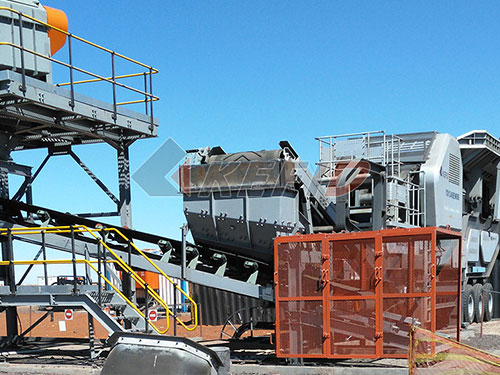
Open Circuit: Material passes through the crusher only once without any screening or recirculation of oversize material.
Closed Circuit: The output from each crusher stage is screened; oversized particles are returned (“recirculated”) back to be crushed again until they pass through screen apertures.
A typical flowsheet might look like: ROM Ore → Scalping Screen → Primary Crusher → Secondary Screen → Secondary Crusher → Tertiary Screen → Tertiary Crusher(s) → Final Product Stockpile.
Modern iron ore crushing plants leverage technology beyond mechanical hardware improvements:
They can adjust feeder speeds
and crusher settings
in real-time
for maximum throughput
This level
of automation also enables remote monitoring
and operation
reducing personnel exposure
to hazardous areas
improving safety standards significantly
Furthermore,
data analytics platforms now collect operational data enabling predictive maintenance strategies where potential failures can be anticipated before they cause unplanned downtime thus increasing overall plant availability
Another significant advancement lies within equipment design itself particularly wear parts Liners made from advanced manganese steel alloys with optimized designs last longer maintain consistent product gradation throughout their life cycle reducing change-out frequency maintenance costs Similarly bearing designs lubrication systems have seen substantial improvements contributing higher reliability operational uptime
Finally environmental considerations have become paramount Modern dust suppression systems use fog cannons chemical surfactants effectively control particulate emissions without saturating material causing handling issues Water recycling closed-loop systems minimize freshwater consumption critical consideration arid mining regions Noise abatement measures enclosures acoustic barriers protect surrounding environment workforce
In conclusion an Iron Ore Crushing Plant represents far more than just brute force reduction It embodies sophisticated engineering integrating robust mechanical equipment precise separation via screening intelligent process control This integrated system transforms heterogeneous run-of-mine ore into consistent controlled feedstock essential efficient downstream beneficiation As global demand steel continues evolve so too will technologies practices surrounding these vital facilities driving ever-greater levels efficiency sustainability within global mining steelmaking industries
Lorem ipsum dolor sit amet, consectetur adipisicing elit. Consectetur sequi saepe ut sunt eveniet perferendis excepturi, iste obcaecati. Qui tempore hic sed quia soluta obcaecati vel.