Industrial Stone Crusher Machines: A Comprehensive Technical Overview
1. Introduction
Industrial stone crusher machines are the workhorses of the mining, quarrying, and aggregate industries. These powerful, robust pieces of equipment are engineered to reduce large rocks, boulders, and blasted quarry stone into smaller, more manageable sizes for use in construction, road building, and various industrial applications. The fundamental principle behind their operation is the application of mechanical force—through compression, impact, shear, or attrition—to overcome the internal cohesive forces of the rock material. The selection of an appropriate crusher is a critical decision that directly impacts operational efficiency, product quality, and overall profitability. This datasheet provides a comprehensive technical overview of industrial stone crushers, covering their types, working principles, key components, performance metrics, and selection criteria.
2. Classification and Working Principles
Industrial crushers are primarily categorized by the method in which they apply force to break the rock. The main types are Jaw Crushers, Gyratory Crushers, Cone Crushers, Impact Crushers (Horizontal Shaft Impactor and Vertical Shaft Impactor), and Roll Crushers.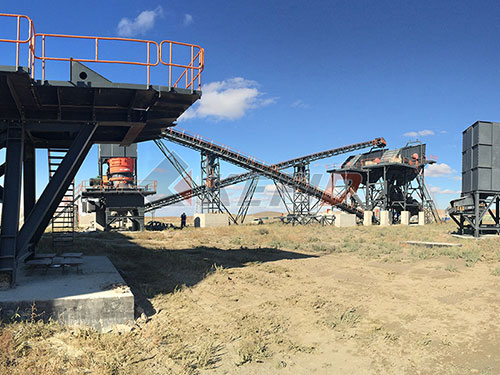
2.1 Jaw Crushers
A Jaw Crusher is a compression-type crusher, typically used as a primary crusher in a crushing circuit.
- Working Principle: It comprises two vertical jaws—one fixed (stationary jaw) and one movable (swing jaw). The rock is fed into the top of the machine and is crushed as the movable jaw moves cyclically towards the fixed jaw, applying immense compressive force. The crushed product exits at the bottom through an adjustable gap known as the closed-side setting (CSS), which determines the final product size.
- Key Characteristics: Known for their simplicity, reliability, and high reduction ratio. They are excellent for hard and abrasive materials but produce a more elongated flaky product compared to other crushers.
2.2 Gyratory Crushers
Similar to jaw crushers in function but different in design, gyratory crushers are also used for primary crushing.
- Working Principle: It consists of a long spindle with a hard steel head (mantle) that gyrates within a concave hopper. As the mantle gyrates eccentrically, it alternately moves toward and away from the concave liner, crushing the rock that enters from the top.
- Key Characteristics: Gyratories have a higher capacity than jaw crushers of the same gape and are more continuous in action due to their 360-degree crushing chamber. They are ideal for high-tonnage applications but have a higher initial cost and are more complex to maintain.
2.3 Cone Crushers
Cone crushers are secondary or tertiary stage crushers that operate on a similar principle to gyratory crushers but on a smaller scale.
- Working Principle: A rotating mantle within a concave bowl liner compresses the rock against the liners. The key difference is the supporting structure; cone crushers are supported by a spherical bearing whereas gyratories are suspended from above.
- Key Characteristics: They produce a well-shaped cubic product with fewer fines than jaw crushers. Modern cone crushers often feature hydraulic adjustment systems for quick CSS changes and advanced control systems for optimizing performance.
2.4 Impact Crushers
Impact crushers utilize impact force rather than pressure to break rock.
- Horizontal Shaft Impactor (HSI): Rock is fed into a chamber containing a fast-rotating rotor with hammers or blow bars. The material is shattered upon impact with the hammers and thrown against breaker plates lining the chamber walls.
- Vertical Shaft Impactor (VSI): Material is fed into the center of a rotor which accelerates it outward at high speed to impact an outer anvil ring or other particles in a rock-on-rock crushing action.
- Key Characteristics: Impactors excel at producing highly cubical products with excellent shape characteristics. They are highly efficient for softer, non-abrasive materials like limestone but experience higher wear rates when processing abrasive stones.
2.5 Roll Crushers
These are compression-type machines used for secondary or tertiary crushing of minerals with low to medium hardness.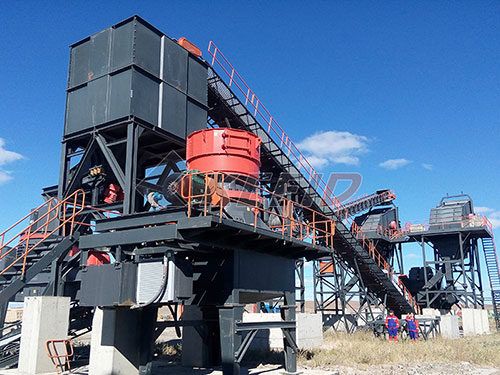
- Working Principle: Material is crushed between two counter-rotating cylindrical rolls. The gap between the rolls determines the product size.
- Key Characteristics: Roll crushers offer precise control over product size with minimal fines generation but have low capacity and are not suitable for hard or abrasive materials.
3. Key Components & Specifications
An industrial stone crusher’s performance is defined by its core components:
- Frame & Structure: A heavy-duty steel frame provides structural integrity to withstand immense cyclical loads and vibrations.
- Crushing Chamber & Liners: The chamber’s geometry dictates capacity and product shape. Liners (mantles/concaves in cones; jaws in jaw crusers; blow bars/aprons in impactors) are made from high-manganese steel or other advanced alloys to resist wear; they are consumable parts requiring regular replacement.
- Drive System: Typically consists of high-torque electric motors connected via V-belts or direct drives to pulleys or couplings that power rotors or eccentrics.
- Eccentric Mechanism / Rotor Assembly: This is what creates motion—an eccentric bushing in cone/gyratory crushers or high-inertia rotors in impactors deliver kinetic energy required for crushing.
- Adjustment System: Hydraulic cylinders or mechanical shims allow operators to adjust CSS during operation or maintenance quickly.
- Lubrication System: An automated circulation system with filters and coolers ensures critical bearings operate at optimal temperatures without contamination.
Critical Performance Specifications:
| Specification | Description | Typical Units |
| :— | :— | :— |
| Feed Opening / Gape | Maximum size of rock that can be accepted by the crusher inlet | mm / inches |
| Capacity / Throughput | Volume of material processed per unit time | Tonnes per hour (tph) |
| Closed-Side Setting (CSS) | Minimum gap between crushing members at their closest point; primary determinant of product size | mm / inches |
| Power Rating | Installed motor power required to drive the machine effectively | Kilowatts (kW) / Horsepower (HP) |
| Rotor Speed / RPM | Rotational speed of impeller/rotor; affects particle velocity & product shape | Revolutions per Minute (RPM) |
4. Performance Metrics & Operational Parameters
Evaluating an industrial stone crusher involves analyzing several key metrics:
- Reduction Ratio: The ratio of feed size to product size (
Df/Dp). Primary crushers have ratios around 8:1 while tertiary units can exceed 10:1.
- Product Shape & Gradation: A well-performing circuit produces aggregate with optimal particle size distribution (“gradation curve”) meeting project specifications (e.g., ASTM C33). Cubicity index measures how close particles resemble perfect cubes versus elongated/flaky shapes—a critical factor for asphalt concrete strength.
- Wear Cost ($/ton): Total cost associated with replacing wear parts divided by total tons processed over their lifetime—a primary measure impacting operational expenditure (OPEX).
- Energy Consumption (kWh/ton): Power consumed per ton produced indicates overall efficiency influenced by material hardness feed gradation CSS settings etcetera
5 . Availability Uptime percentage accounting scheduled unplanned downtime maintenance requirements
5 Material Considerations
The choice selection process heavily depends upon characteristics raw feed material:
- Abrasiveness Highly abrasive materials granite trap rock necessitate robust liners manganese steel potentially ceramic composites minimize wear costs
- Hardness Compressive strength measured MPa determines whether compression impact crushing suitable Very hard rocks often better suited compression type machines
- Moisture Content Sticky clay-laden feeds prone causing clogging buildup chambers requiring specialized designs pre-screening scalping
- Feed Size Distribution Properly sized consistent feed crucial achieving rated capacity preventing choke-feed starvation conditions
6 Selection Criteria Application Guidelines
Choosing correct machine requires holistic analysis entire process flow:
Primary Crushing Stage Objective reduce run-of-mine/quarry shot rock manageable sizes downstream processing Typically involves large heavy-duty units capable handling variable-sized feeds Jaw Gyratory represent dominant choices here based required throughput initial investment preferences
Secondary Tertiary Stages Focus shifts refining intermediate products specific sizes shapes Cone widely favored producing quality aggregates ballast railway track chip seal roads HSI VSI excellent generating cubical products asphalt concrete mixes where particle interlock paramount importance
Portable vs Stationary Configurations Portable plants mounted chassis wheels offer mobility ideal multiple site projects temporary contracts Stationary plants fixed locations designed maximum longevity efficiency integrated complex systems conveyors screens dust collectors
Conclusion
Industrial stonecrusher represents sophisticated engineered system rather simple mechanical device Understanding fundamental principles operational characteristics different types enables operators plant managers make informed decisions optimize production minimize costs ensure final aggregate meets stringent quality demands modern infrastructure projects Continuous advancements automation liner metallurgy control systems promise further improvements reliability efficiency sustainability vital industry
