Gyratory Crusher ODM Manufacturer Testing: A Critical Pillar of Reliability and Performance
In the demanding world of mineral processing, mining, and aggregate production, the gyratory crusher stands as a primary workhorse, tasked with the monumental job of reducing run-of-mine ore or large quarry stone into manageable sizes. For Original Design Manufacturer (ODM) specialists in this field, the journey from a design concept to a robust, field-proven machine is paved with one non-negotiable phase: comprehensive testing. Far more than a final checkbox, testing at an ODM manufacturer is a rigorous, multi-stage philosophy embedded throughout the design and manufacturing process. It is the definitive bridge between theoretical engineering and operational excellence, ensuring that each crusher delivers on its promises of capacity, reliability, longevity, and total cost of ownership.
The ODM Context: Why Testing is Paramount
Unlike a standard OEM (Original Equipment Manufacturer) selling catalog models, an ODM partner engages in a deeper collaborative relationship. They design and engineer crushers often to meet specific client requirements, unique material characteristics (e.g., high abrasivity, stickiness, or moisture), or space constraints. This bespoke approach elevates the importance of testing from generic validation to targeted verification. The client is not just buying a machine; they are investing in a performance-guaranteed solution for their unique application. For the ODM manufacturer, their reputation hinges on the crusher performing flawlessly from startup. Therefore, their testing protocols are typically more extensive, transparent, and data-driven than standard factory acceptance tests.
The Testing Spectrum: From Component to System Integration
A professional gyratory crusher ODM manufacturer employs a tiered testing strategy that scrutinizes every aspect of the machine.
1. Material & Metallurgical Testing:
The foundation of crusher durability lies in its materials. Long before assembly begins:
- Wear Liner Analysis: Mantle and concave alloy steels are subjected to spectrographic analysis to verify chemical composition (e.g., levels of manganese, chromium, molybdenum). Hardness tests (Brinell, Rockwell) are conducted across multiple points to ensure uniformity and specified hardness for optimal wear resistance without brittleness.
- Component Integrity Testing: Critical cast or forged components like the main shaft, head center, and eccentric sleeves undergo non-destructive testing (NDT). This includes ultrasonic testing for internal flaws, magnetic particle or dye penetrant inspection for surface cracks.
- Fatigue Testing: Samples of key materials may undergo cyclic load testing to simulate years of operation and validate fatigue strength calculations.
2. Subsystem & Component Functional Testing:
Each major assembly is tested in isolation before integration.
- Hydraulic System Testing: The all-important hydraulic system for setting adjustment and overload protection is tested on a separate bench. Engineers verify pressure settings, valve response times, cylinder synchronization (for multi-cylinder models), and leak integrity under pressures exceeding normal operating limits.
- Lubrication System Testing: The heart of gyratory crusher health—its lubrication system—is rigorously validated. Flow rates through each bearing circuit (eccentric bushing, step bearing, spider bushings) are measured against design specifications. Cooler efficiency is tested under simulated load conditions.
- Drive Train Verification: The motor(s), couplings/shear pins/fluid couplings/V-belts are aligned and run-in where applicable.
3. Full Machine Assembly & Dry Run Testing:
Once assembled at the factory floor:
- Dimensional & Alignment Verification: Laser alignment tools ensure perfect concentricity between the main shaft assembly and the crushing chamber.
- Clearance Checks: Critical internal clearances between wearing parts are meticulously measured and recorded as baseline data.
- Dry Run / No-Load Test: The crusher is operated empty for an extended period (often 4-8 hours). Key objectives include:
- Monitoring bearing temperatures until they stabilize within safe limits.
- Checking for unusual vibrations using tri-axial accelerometers mounted on key locations like the top shell and main frame.
- Verifying oil flow rates at all sight glasses/flow meters.
- Ensuring smooth operation of all ancillary systems: dust sealing rings function correctly; lubrication system interlocks work properly; hydraulic adjustment cycles smoothly.
4. Load / Crushing Performance Testing (The Ultimate Validation):
This is the most critical phase for performance verification.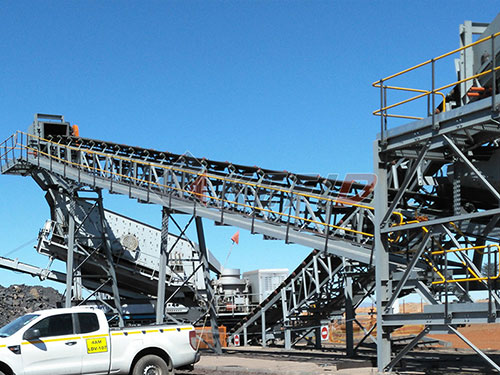
- Test Material Preparation: Ideally conducted with representative material from the client’s site or carefully selected standard aggregates/ore matching specified density and hardness indices (e.g., Bond Work Index).
- Instrumentation & Data Acquisition: The crusher becomes a flying laboratory:
- Power draw on main motor(s) is continuously monitored via power analyzers.
- Hydraulic pressure sensors track real-time crushing forces.
- Vibration analysis continues under load to detect any anomalous harmonics indicating mechanical issues.
- Temperature sensors monitor all critical bearings continuously under full load conditions
- Performance Parameter Verification:
- Capacity Throughput: Measured by weighing crushed product over timed intervals at various settings
- Product Size Distribution (% passing): Achieved gradation curves are plotted against predicted models from simulation software
- Power Consumption vs Tonnage Ratio: Validating energy efficiency predictions
- CSS Verification Under Load: Confirming that dynamic CSS matches set values
- Overload Protection Test: Simulating tramp iron events to ensure hydraulic/pneumatic accumulators release pressure correctly
Advanced Tools & Digital Twins
Leading ODMs now integrate advanced technologies into their testing regimes:
- Strain Gauge Analysis: Temporary strain gauges applied to frames or components during load tests provide empirical data to validate Finite Element Analysis (FEA) models used in design phase
- Predictive Maintenance Baseline Creation: Vibration frequency spectra captured during flawless factory load tests become baseline fingerprints used later by clients for condition monitoring
- Digital Twin Correlation: Data from physical tests feeds back into digital twin models refining their predictive accuracy regarding wear life throughput changes over time
Documentation & Transparency: Delivering Confidence
A hallmark of professional ODM testing lies not just in execution but also documentation Each test phase generates formal reports including raw data charts photographs/videos NDT certificates material test reports vibration analysis summaries performance curves These documents form part technical handover package providing client unparalleled transparency build confidence serve invaluable reference future maintenance troubleshooting
Conclusion
For discerning buyer partnering with gyratory crusher ODM manufacturer depth rigor their testing program directly correlates risk reduction project success Factory testing not merely procedure it comprehensive validation engineering integrity manufacturing quality functional capability By subjecting machine controlled exhaustive battery tests before it ever leaves factory floor premier ODM manufacturers mitigate operational risks unplanned downtime ensuring primary investment begins its lifecycle with proven foundation reliability maximum productivity Ultimately sophisticated testing culture what transforms heavy piece machinery into guaranteed production asset cornerstone profitable mineral processing operation
