Gold Ore Crushing Equipment: A Comprehensive Guide for Maximizing Recovery and Operational Efficiency

The pursuit of gold, a symbol of enduring value and a cornerstone of global finance, begins not in the vault but at the mine face with raw, unrefined ore. The critical bridge between the mineral-bearing rock and the recoverable precious metal is a sophisticated array of crushing equipment. For mining companies, selecting the right crushing machinery is not merely a procurement decision; it is a fundamental strategic choice that dictates plant throughput, operational costs, recovery rates, and ultimately, project profitability. This brochure serves as a detailed guide to the world of gold ore crushing equipment, exploring the technologies, configurations, and considerations essential for modern mining operations.

1. Understanding Gold Ore Characteristics: The Foundation of Equipment Selection

Gold ore is notoriously heterogeneous. Its hardness, abrasiveness, moisture content, and gold particle liberation size vary dramatically based on deposit type (e.g., free-milling oxide ores vs. refractory sulfide ores). This variability demands a tailored approach to comminution.

  • Hardness & Abrasiveness: Measured by Bond Work Index (Wi) and Abrasion Index (Ai). Harder ores require robust crushers with high pressure capabilities (like gyratory or cone crushers), while abrasive ores demand wear materials like manganese steel or specialized alloys.
  • Moisture & Clay Content: “Sticky” ores with high clay content pose significant challenges, causing clogging in crushers and screens. Selection may lean towards jaw crushers or impactors with specific cavity designs and perhaps the inclusion of scalping screens or feeders to bypass fines.
  • Gold Particle Size & Liberation: The primary objective is to break the ore to a size where gold particles are liberated from the gangue (waste rock). Over-crushing is wasteful and increases energy and liner costs; under-crushing reduces recovery. Understanding liberation size through metallurgical testing is paramount.

2. The Crushing Circuit: A Multi-Stage Symphony

Rarely is a single machine sufficient. Gold ore processing typically employs a multi-stage crushing circuit to achieve target particle size efficiently.

A. Primary Crushing: The First Reduction
This stage handles run-of-mine (ROM) ore directly from the pit, reducing large boulders (up to 1.5m) to manageable sizes (~150-250mm).

  • Jaw Crushers: The workhorse of primary crushing. Robust and reliable with a simple design. Ideal for hard, abrasive ores. Modern versions feature hydraulic adjustment systems for quick setting changes and reverse crushing action to minimize clogging.
  • Gyratory Crushers: Suited for high-capacity operations (>1,000 tph). They offer continuous crushing action with higher efficiency than jaw crushers at full capacity but have higher capital costs and are less portable.
  • Selection Criteria: Throughput requirements, feed size top dimension, ore hardness, and mobility needs (semi-mobile vs. fixed plant).

B. Secondary Crushing: Further Size Reduction
Accepts product from primary crushers for further reduction (~30-100mm).

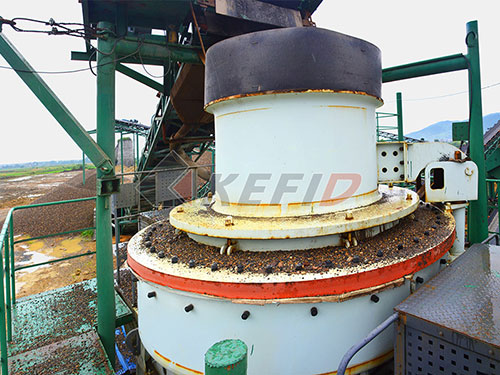
  • Cone Crushers: The dominant choice for secondary duty. They compress rock between a gyrating mantle and concave liners. Key advantages include precise control over product size via hydraulic CSS (Closed Side Setting) adjustment and high reduction ratios.
    • Standard Head Cone: For general secondary crushing.
    • Short Head Cone: For finer tertiary/quaternary duties.
  • High-Pressure Grinding Rolls (HPGR): An increasingly popular alternative or supplement in gold circuits. HPGRs compress the feed material between two counter-rotating rolls under extreme pressure (50-350 MPa), creating micro-cracks within particles that significantly improve downstream grinding efficiency and can enhance gold liberation in certain ore types.

C. Tertiary & Quaternary Crushing: Fine Reduction
For circuits requiring very fine feed for grinding mills (<30mm), additional crushing stages are employed using cone crushers in closed circuit with vibrating screens.

3. Specialized Equipment & Emerging Technologies

  • Vertical Shaft Impactors (VSI): Excellent for less abrasive ores where shaping or producing finely crushed sand is beneficial. Their rock-on-rock attrition action can be energy-efficient for specific applications.
  • Semi-Autogenous Grinding (SAG) Mill Feed Preparation: In many modern gold plants, primary crushed ore feeds directly into SAG mills. Here, the focus shifts to producing optimal SAG mill feed (-150mm) that includes enough competent media (steel balls) while ensuring consistent sizing to maximize mill throughput.
  • Modular & Mobile Crushing Plants: For smaller deposits, satellite pits, or regions with challenging infrastructure, fully mobile or modular jaw/cone/ screen plants offer flexibility and rapid deployment with lower initial capital outlay.

4. Beyond the Machine: Critical Supporting Systems

A crusher does not operate in isolation; its performance hinges on an integrated system:Gold Ore Crushing Equipment Makers Brochure
  • Feeders (Apron, Vibrating Grizzly): Ensure steady material flow at controlled rates into the primary crusher.
  • Vibrating Screens: Essential for closed-circuit operations where oversize material is recirculated back to the crusher (“closed side”). Efficient screening maximizes circuit capacity.
  • Dust Suppression & Containment: Gold value can be lost in airborne dust particles—a critical economic as well as health/safety concern—making effective spray systems or baghouses non-negotiable.
  • Automation & Control Systems: Modern crushers are equipped with advanced sensors monitoring power draw,
    CSS,
    cavity level,
    and pressure.
    Integrated with PLC/SCADA systems,
    they enable:

    • Real-time optimization for throughput or product size.
    • Predictive maintenance alerts based on bearing temperature
      or vibration analysis,
      preventing catastrophic failures.
    • Remote monitoring,
      reducing personnel exposure in hazardous areas.

*5.* Key Selection Criteria for Mining Operators

When evaluating equipment makers
and models,
consider these factors:

1.Total Cost of Ownership (TCO):
Move beyond initial capex
to evaluate energy consumption per ton crushed,
wear liner life/cost,
maintenance labor requirements,
and parts availability/price.

2.Operational Flexibility & Control:
Can CSS be adjusted under load?
How quickly can wear liners be changed?
Does it handle fluctuations in feed characteristics?Gold Ore Crushing Equipment Makers Brochure

3.Manufacturer Support & Expertise:
Partner with makers offering strong technical service
crushing circuit simulation capabilities
comprehensive spare parts networks
and process engineering support

4.Safety Features:
Automatic tramp release systems
non-intrusive liner wear monitoring
ergonomic design for maintenance access

5.Sustainability Profile:
Energy efficiency directly reduces carbon footprint
Water usage in dust suppression systems
Noise abatement technologies

*6.* Future Trends in Gold Ore Crushing

The industry continues evolving toward greater efficiency intelligence sustainability:

Integration with Pre-Concentration
Crushing stages are being optimized to produce sized fractions amenable to early waste rejection via sensor-based sorting technologies drastically reducing tonnage reporting downstream saving energy water

Advanced Process Control AI
Machine learning algorithms analyzing vast operational datasets will predict optimal crusher settings screen configurations real-time adapting changing ore properties maximizing overall plant recovery

Hybrid Electric Power Solutions
Especially mobile units leveraging battery storage renewable sources reduce diesel dependency lower operating costs emissions remote locations

Wear Life Innovation
Development next-generation composite materials ceramic-metal hybrids promise exponentially longer liner life reducing downtime waste

Conclusion

Selecting optimal gold ore crushing equipment requires deep understanding one’s specific mineralogy clear definition process goals rigorous analysis TCO Leading equipment makers today offer far more than machinery they provide integrated comminution solutions backed simulation tools automation platforms lifecycle support services By investing time upfront designing robust efficient flexible crushing circuit miners lay indispensable foundation profitable resilient operation ensuring every tonne processed yields maximum possible value from this timeless precious metal

Lorem ipsum dolor sit amet, consectetur adipisicing elit. Consectetur sequi saepe ut sunt eveniet perferendis excepturi, iste obcaecati. Qui tempore hic sed quia soluta obcaecati vel.