Technical Datasheet & Analysis: The Next Generation of Eco-Friendly Gyratory Crushers
Abstract
The gyratory crusher, a cornerstone of hard-rock mineral processing and aggregate production for over a century, is undergoing a significant technological evolution. Historically associated with high energy consumption, significant dust and noise emissions, and substantial physical footprints, the modern gyratory crusher is being re-engineered from first principles to align with global sustainability mandates. This document provides a detailed technical analysis of the “Eco-Friendly Gyratory Crusher,” examining the specific design innovations, operational methodologies, and integrated systems that collectively reduce its environmental impact while enhancing profitability and operational safety.
1.0 Introduction: Redefining Primary Crushing
A gyratory crusher is a primary compression crusher consisting of a concave surface (fixed outer shell) and a conical head (mantle) gyrating within it. The crushing action is caused by the closing of the gap between the mantle and the concave as the mantle gyrates, progressively reducing large run-of-mine (ROM) ore or quarry stone to a smaller, manageable size.
The conventional crusher’s primary objective was throughput and reduction ratio, often at any cost. The eco-friendly model reframes this objective to maximize throughput per unit of energy consumed, while systematically minimizing ancillary environmental impacts such as dust, noise, water usage, and waste. This is not merely an add-on solution but a holistic re-imagining of the machine’s entire lifecycle—from material selection and design to operation and end-of-life recycling.
2.0 Core Design Innovations for Sustainability
The ecological profile of an eco-friendly gyratory crusher is fundamentally shaped by advancements in its core mechanical and structural design.
2.1 High-Efficiency Drive Systems
- Variable Frequency Drives (VFDs): The single most impactful innovation. Traditional fixed-speed motors run at constant high power regardless of feed conditions. VFDs allow the motor speed and torque to be precisely matched to the actual load within the crushing chamber.
- Energy Savings: Reduces energy consumption by 15-30% by eliminating no-load and partial-load inefficiencies.
- Soft Starting: Eliminates the high inrush current during startup, reducing stress on the electrical grid and mechanical components, thereby extending equipment life.
- Optimized Crushing Rhythm: Allows operators to fine-tune gyrating speed for optimal particle-on-particle crushing in certain conditions, further improving efficiency.
2.2 Advanced Chamber Design & Liner Technology
- Intelligent Chamber Profiles: Computational Fluid Dynamics (CFD) and Discrete Element Modeling (DEM) are used to design concave and mantle profiles that maximize the compression crushing action while minimizing wasteful friction and “sliding” motion.
- Benefit: Achieves a higher reduction ratio per gyration or allows for a finer product size without requiring additional crushing stages.
- Longer-Lasting, Lightweight Composite Liners: Utilizing advanced manganese steel alloys with micro-alloying elements (e.g., Titanium, Boron) or composite liners with ceramic inserts significantly increases wear life.
- Environmental Impact: Longer liner life means fewer change-outs, reducing the transportation carbon footprint associated with delivering heavy new liners and disposing of old ones. Lighter composite materials also reduce the embedded energy of the parts themselves.
2.3 Sealing & Dust Suppression Integration
A primary source of environmental contamination is fugitive dust. Eco-friendly models feature multi-stage sealing systems far superior to traditional labyrinth seals.
- Positive Pressure Air Sealing Systems: A controlled stream of clean, filtered air is injected into the dust seal region, creating a barrier that prevents dust from escaping the crushing chamber.
- Integrated Dust Suppression Nozzles: Spray systems are strategically designed into the feed hopper and internal housing, using minimal water with atomizing nozzles to effectively coalesce dust particles at the source without saturating the material.
3.0 Operational & Control Systems for Minimal Impact
The “brain” of an eco-friendly gyrus crusher is its advanced automation system.
3.1 Smart Automation & Adaptive Control
- Automated Setting Regulation: Hydraulic or hybrid hydraulic-mechanical systems allow for real-time adjustment of the Closed Side Setting (CSS). This ensures consistent product size without manual intervention, optimizing downstream process efficiency.
- Load & Condition Monitoring: A network of sensors continuously monitors power draw, pressure, temperature, and vibration.
- Application: The system can automatically regulate feed rate via communication with upstream equipment (e.g., apron feeders) to prevent plugging or running empty—both major sources of energy waste.
- Predictive Maintenance: By analyzing vibration and temperature trends, these systems can predict component failures (e.g., bearings), allowing for planned maintenance that prevents catastrophic failures which generate significant waste and unplanned downtime.
3.2 Noise Abatement Technologies
Gyratory crushers are significant noise sources due to metal-on-metal impact and vibration.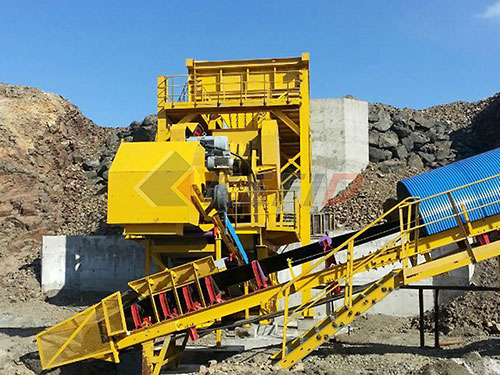
- Acoustic Enclosures & Damping Materials: The entire crusher or its key noise-emitting areas are housed within custom-designed enclosures lined with sound-absorbing materials.
- Vibration Isolation Mounts: Advanced elastomeric or spring mounts decouple the crusher’s massive vibrations from its foundation and surrounding structure, reducing structure-borne noise.
3.3 Water-Free or Reduced-Water Crushing
In water-scarce regions or where wet tailings are problematic:
- Dry Fog Systems: An alternative to traditional water sprays; these systems use compressed air and very little water to create a micron-sized fog that suppresses dust without adding measurable moisture to the product.
- Complete Enclosure & Filtration: For fully dry processing plants, robust sealing combined with connecting the crusher directly to a high-capacity baghouse filtration system can eliminate water use entirely for dust control at this stage.
4.0 Lifecycle Considerations & Circular Economy
An eco-friendly design extends beyond operation to encompass manufacturing and end-of-life.
- Design for Disassembly & Recycling: Major components are designed with bolted connections rather than permanent welds where possible, facilitating repair instead of replacement. Materials are selected not only for performance but also for their recyclability at end-of-life.
- Remanufacturing Programs: Leading manufacturers offer certified remanufacturing services for major components like main shafts and frames. This process consumes far less energy than forging new components from raw materials.
5.0 Comparative Analysis: Quantifying The Benefits
| Feature |
Conventional Gyratory Crusher |
Eco-Friendly Gyratory Crusher |
Key Environmental Benefit |
| Drive System |
Fixed Speed Direct Drive |
VFD-Controlled Drive |
15-30% Reduction in Energy Consumption |
| Dust Control |
External Water Sprays / Basic Seals |
Integrated Positive Air Seal + Atomized Sprays |
Near-Zero Fugitive Dust; Up to 80% Less Water Used |
| Liner Life |
Standard Manganese Steel |
Advanced Alloys / Composite Liners |
20-50% Longer Life; Reduced Waste & Transport Emissions |
| Process Control |
Manual / Basic PLC |
Adaptive Automation with AI/ML Logic |
Optimized Throughput per kWh; Prevents Wasteful Operation |
| Noise Emission |
Typically > 105 dBA |
Enclosed < 85 dBA |
Significant Reduction in Noise Pollution |
6.0 Economic Justification: Beyond Environmental Compliance
While driven by sustainability goals,the eco-friendly gyratory crusher presents a compelling economic case:
- Lower Operational Expenditure (OPEX): Significant reductions in electricity costs formthe largest OPEX saving.
- Reduced Water & Consumable Costs: Lower water usageand longer-lasting liners directly reduce operating costs.
- Enhanced Uptime & Reliability: Predictive maintenanceand robust designs minimize unplanned downtime,a critical cost factor in miningand aggregate production.
- Social License to Operate: Demonstratinga commitmentto reduced environmental footprintis increasingly crucialfor obtainingand maintaining permitsand community supportfor newand existing operations.
7.0 Conclusion
The eco-friendly gyrus crusher representsa paradigm shiftin comminution technology.It moves beyondthe singular pursuitof throughputto embracea holistic modelof resource efficiency.Thisis achievednot througha single breakthrough,but throughthe synergistic integrationof advanced drive systems,intelligent chamberdesigns,sophisticated sealing,and smart automation.The resultis amachinethat delivers therequired performancewhile dramatically reducingits energy,intensity,waste generation,and overall environmental footprint.As regulatory pressuresmountand themineral industryplaces greater emphasison ESG(Environmental Social,and Governance) performance,the adoptionof these next-generation primarycrushers will transitionfroma competitive advantageto an operational necessity,pavingthe wayfor amore sustainablefuturein resource extractionand processing
