
The global construction industry is a cornerstone of modern development, yet it faces mounting pressure to mitigate its environmental footprint. Aggregate production, the process of crushing stone into various sizes for use in concrete, asphalt, and road bases, is traditionally associated with high energy consumption, dust emissions, noise pollution, and landscape degradation. In this context, the design and assembly of an Eco-Friendly 250-300tph Stone Crushing Plant represent a sophisticated engineering response. It balances robust production capacity—capable of processing 250 to 300 tonnes per hour—with a comprehensive suite of technologies and methodologies aimed at minimizing ecological impact. This detailed exploration covers the core components, assembly philosophy, integrated eco-technologies, and operational protocols that define such a facility.
A 250-300tph plant is a medium-to-large-scale installation designed for sustained, high-volume output. Its assembly follows a logical material flow, segmented into primary crushing, secondary/tertiary crushing, screening, and material handling systems.
Primary Crushing Station: The process begins with a robust primary crusher, typically a jaw crusher or gyratory crusher. For this capacity range, a heavy-duty jaw crusher (e.g., 1200x1500mm) is common. Its assembly on a massive reinforced concrete foundation is critical to absorb dynamic loads. The feeder preceding it—an apron or vibrating grizzly feeder—regulates material flow from the dump hopper and removes fine material bypassing the primary crush, enhancing efficiency.
Secondary & Tertiary Crushing Stages: Primary crushed material is conveyed to secondary reduction units. Cone crushers are the standard here for their ability to produce well-shaped aggregates. An eco-friendly design often employs hydraulic cone crushers with advanced crushing chambers (like constant cavity design) for better product gradation and lower power draw per tonne. For further refinement (tertiary/quaternary crushing), vertical shaft impactors (VSIs) may be integrated. VSIs are excellent for producing premium-shaped sand (manufactured sand) from surplus stone chips, promoting resource efficiency.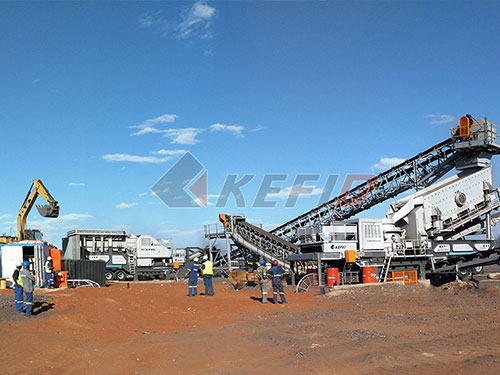
Screening & Classification System: Multiple-deck vibrating screens are strategically placed in open- or closed-circuit layouts. Precise screening separates aggregates into specified size fractions (e.g., 0-5mm sand, 5-10mm chips). Modern plants use modular polyurethane or rubber screen media instead of traditional steel wire mesh; they last longer, reduce noise significantly (by up to 15 dBA), and offer better screening efficiency with less blinding.
Material Handling Network: The entire plant is interconnected by belt conveyors enclosed in galleries or fitted with windbreaks to prevent fugitive dust emissions during transfer points.
The “eco-friendly” designation transcends mere equipment selection; it is an integrated philosophy embedded in every assembly decision.
A. Dust Suppression & Containment Systems:
Dust is the most visible pollutant from crushing plants.
B. Noise Abatement Engineering:
Noise pollution affects both workers and surrounding communities.
C. Water Management & Recycling:
Water used for dust suppression must be managed responsibly.
D. Energy Efficiency & Electrification:
Energy consumption directly correlates with carbon footprint.
E. Landscape Integration & Biodiversity Considerations
Assembly includes post-construction rehabilitation plans:
Assembling such a plant requires meticulous planning:
The eco-friendly nature must be maintained through operation:
While capital costs exceed conventional plants by ~15-25%, operational savings accrue through:
Next-generation eco-crushing plants will likely incorporate:
An Eco-Friendly 250-300tph Stone Crushing Plant Assembly represents far more than an industrial facility; it embodies the evolution of extractive industries toward sustainable coexistence with environmental imperatives through intelligent engineering integration rather than trade-offs between productivity/ecology – proving large-scale industrial operations can align with planetary boundaries when designed holistically from inception through decommissioning phases
Lorem ipsum dolor sit amet, consectetur adipisicing elit. Consectetur sequi saepe ut sunt eveniet perferendis excepturi, iste obcaecati. Qui tempore hic sed quia soluta obcaecati vel.