Custom Quarry Ballast Crushing Equipment: Engineering the Bedrock of Rail Infrastructure
The global rail network, a testament to human engineering and a cornerstone of modern logistics and transportation, relies on a deceptively simple yet critically important component: railway ballast. This layer of crushed stone beneath the tracks performs the vital functions of distributing load, providing drainage, and inhibiting vegetation growth. The quality, gradation, and physical properties of this ballast are non-negotiable for safety and longevity. Consequently, the machinery used to produce it—custom quarry ballast crushing equipment—represents a highly specialized sector within mineral processing technology. This article provides a comprehensive examination of the engineering principles, plant configurations, key equipment, and economic considerations involved in creating an effective system for producing high-quality railway ballast.
1. The Uncompromising Specifications of Railway Ballast
Before delving into the machinery, it is crucial to understand the product specifications it must achieve. Railway authorities worldwide (such as Network Rail in the UK, AREMA in North America, and others) enforce strict standards. These typically dictate:
- Particle Size and Gradation (Grading): Ballast must consist of coarse aggregates within a specific size range, commonly between 20mm and 63mm (or ¾” to 2½” in imperial units). A well-graded blend ensures interlocking particles that create a stable, void-resistant matrix.
- Particle Shape: The ideal ballast particle is cubical or equidimensional. Flaky (flat) or elongated particles are highly undesirable as they break down more easily under dynamic loading, leading to settlement and reduced stability. The “Shape Index” is a key quality parameter.
- Cleanliness and Durability: The material must be free from fine dust, clay, and organic matter that can clog drainage paths. It must also possess high resistance to abrasion and weathering, measured by tests like the Los Angeles Abrasion (LAA) value and Micro-Deval attrition test.
- Strength and Toughness: The parent rock must have high compressive strength to withstand the immense pressures from trains.
These specifications directly dictate every aspect of the crushing plant’s design.
2. Core Components of a Custom Ballast Crushing Plant
A custom ballast production plant is more than just crushers; it is an integrated system designed for efficiency and quality control.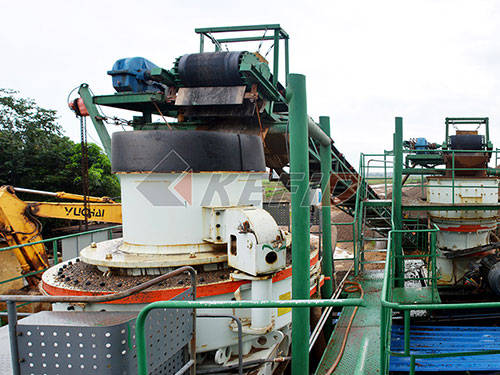
A. Primary Crushing Station: The First Reduction
The primary crusher is the workhorse that accepts large feed material directly from the quarry face, typically up to 1-meter cubes. The choice here is pivotal.
- Jaw Crushers: These are the most common choice for primary crushing in ballast production. A robust jaw crusher applies compressive force to break large rocks. Its design produces a consistent, blocky output that serves as an excellent feed for secondary crushers. Modern jaw crushers often feature steep toggle angles and aggressive crushing actions optimized for hard rock.
- Gyratory Crushers: For very high-capacity quarries (e.g., over 1,000 tons per hour), gyratory crushers may be preferred. They offer higher throughput and are more efficient in continuous operation but come with a higher initial capital cost and are less portable.
B. Secondary Crushing Station: Shaping the Product
This stage is where the critical task of shaping occurs. The goal is to reduce the primary-crushed material further while maximizing the production of cubical particles.
- Cone Crushers: These are unequivocally the industry standard for secondary crushing in ballast applications. Cone crushers compress rock between a gyrating mantle and a stationary concave liner. Modern cone crushers offer advanced features like hydraulic adjustment systems (ASRi – Automatic Setting Regulation) that maintain a consistent closed-side setting (CSS) for uniform product size, even as liners wear.
- Impact Crushers: While capable of producing very cubical products, impact crushers are less common for hard rock ballast due to higher wear costs on blow bars and liners. They may be considered for softer rock types but require careful economic analysis regarding maintenance.
C. Tertiary Crushing Station: Precision Sizing
Not all plants require tertiary crushing; its inclusion depends on raw material properties and final product specifications.
- Cone Crushers (Fine/Short-head): If further refinement is needed or if producing multiple products (e.g., sub-ballast), fine-cone or short-head cone crushers are used in a tertiary role.
- Vertical Shaft Impactors (VSI): For achieving ultimate particle shape optimization when dealing with problematic flaky feed from earlier stages, a VSI can be employed as a “shape-correction” tool using its rock-on-rock or rock-on-anvil crushing principle.
D.Screening System: The Quality Gate
Screening is arguably as important as crushing itself in producing specification ballast.
- Deck Configuration: A typical setup involves multiple decks of screens (e.g., two or three). The top deck removes oversized material (“scalping”), which is sent back to a crusher via closed-circuit recirculation (closed-circuit crushing). The middle decks separate the finished ballast fraction(s), while the bottom deck removes undersize fines (“ballast fines”) which are considered waste or sold as a by-product.
- Screen Media: Heavy-duty wire mesh or rubber/polyurethane panels are used based on abrasion resistance needs.
E.Auxiliary Systems: Ensuring Efficiency
A custom plant integrates several supporting systems:
- Feed System: Apron feeders regulate material flow from the surge pile to the primary crusher.
- Conveying System: A network of robust belt conveyors transports material between stages.
- Washing Plant: In some cases where clay contamination is present or strict dust control is mandated by environmental regulations, log washers or scrubbers may be integrated to clean the aggregate before final screening.
3.The “Custom” Element: Tailoring Technology to Task
The term “custom” signifies that no two plants are identical; they are engineered based on specific variables:
- Parent Rock Geology: A plant processing hard granite will differ significantly from one processing limestone or basalt. Hardness (measured by Los Angeles value), abrasiveness (SiO2 content), and natural fracture patterns influence crusher selection, liner metallurgy (e.g., manganese steel vs. chrome iron), and overall plant throughput.
- Required Production Capacity: A small regional railway maintenance project may only need a portable plant producing 150 tph with minimal automation required by one operator whereas supplying ballasts continuously for constructing new high-speed rail lines demands stationary plants exceeding thousands tph with sophisticated process control systems requiring minimal human intervention
3.Final Product Specifications: Different rail authorities have slightly different gradation requirements which dictate screen sizes & number & type(s)of final product screens
4.Site Constraints & Mobility: Is this temporary project requiring frequent relocation? Then modular/track-mounted portable plants become essential versus permanent stationary installations designed around long-term quarry development plans
4.Economic Considerations & Technological Trends
Investing in custom quarry ballasts equipment involves significant capital expenditure(CAPEX) balanced against operational expenditure(OPEX).
- Automation & Process Control Systems : Modern plants increasingly incorporate Programmable Logic Controllers(PLC) & SCADA systems automating start-up sequences monitoring power draw CSS adjustments ensuring optimal performance reducing human error minimizing downtime
- Wear Part Optimization : Advanced metallurgy designs self-sharpening chamber profiles help extend service life reduce frequency costly liner changes directly impacting OPEX
- Energy Efficiency : Crusher manufacturers focus designing energy-efficient drives Variable Frequency Drives(VFDs) optimize motor speed reducing electricity consumption especially under partial load conditions
- Environmental Compliance : Dust suppression systems water recycling noise abatement measures integral part modern custom design meeting stringent regulatory standards
5.Conclusion
Custom quarry ballasts crushing equipment represents sophisticated intersection mechanical engineering process control materials science Far from being simple rock-breaking machines these integrated systems meticulously engineered transform raw quarried stone into precisely graded durable cubical aggregate forms literal foundation upon which safe reliable rail travel depends Success lies not just selecting individual pieces machinery but holistic system design where each component—from primary jaw tertiary cone screening deck—works synergistic harmony deliver product meets uncompromising standards global rail industry As demands rail infrastructure grow evolve so too will technology behind production its most fundamental component
