Custom Gold Ore Crushing Equipment & Processing Plant: A Tailored Approach to Maximizing Recovery and Profitability
The pursuit of gold, one of the most coveted metals on Earth, has evolved from simple panning to highly sophisticated, industrial-scale operations. At the heart of any successful modern gold mining venture lies the processing plant, and its most critical component: the crushing circuit. A Custom Gold Ore Crushing Equipment Processing Plant is not a luxury but a fundamental necessity for economic viability. It represents a holistic engineering philosophy that moves beyond off-the-shelf solutions to design a system intricately synchronized with the unique geological fingerprint of the ore body, operational constraints, and financial objectives. This detailed exploration covers the rationale, design considerations, key equipment choices, and integrated process flow that define a truly custom plant.
The Imperative for Customization: Why “One-Size-Fits-All” Fails
Gold ores are remarkably diverse. They can be free-milling, where gold is liberated at coarse sizes, or refractory, where gold is locked within sulfide minerals like pyrite or arsenopyrite. The host rock can be hard and abrasive (e.g., quartzite), soft and clayey (e.g., oxidized saprolite), or a complex mixture. Key ore characteristics dictating customization include:
- Ore Competence (Hardness & Abrasiveness): Measured by Bond Work Index and abrasion indices, this determines the type of crushers needed (e.g., high-pressure grinding rolls for competent ores vs. impact crushers for softer materials).
- Gold Grade and Mineralogy: The size and nature of gold particles (free, associated, or refractory) dictate the required liberation size from crushing/grinding and influence downstream processes.
- Moisture and Clay Content: High clay content can cause severe handling, screening, and crushing challenges like plugging and packing, necessitating specialized feeders, screens, and possibly washing stages.
- Sulfide Content: Presence of sulfides affects chemical consumption in leaching circuits and may require pre-aeration or ultrafine grinding for liberation.
- Plant Location & Scale: Remote sites with limited power favor energy-efficient circuits. Small-scale operations might prioritize simplicity over ultimate recovery.
A custom plant is engineered to optimize the cost-recovery curve specific to these parameters. An oversized or overly complex circuit erodes profit through excessive capital expenditure (CAPEX) and operating costs (OPEX). An undersized or poorly matched circuit leaves valuable gold in the tailings.
Phases of Custom Plant Design
1. Geometallurgical Modeling & Testwork:
This is the cornerstone of customization. Extensive drilling provides samples for comprehensive testwork: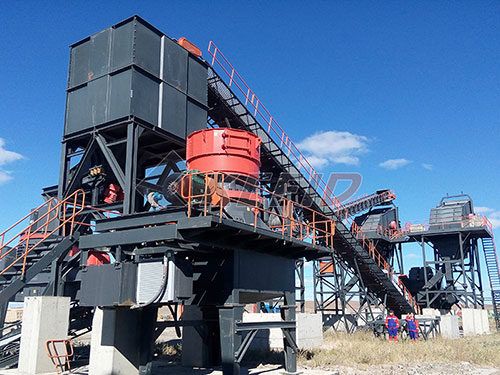
- Comminution Testing: Determines crushing energy requirements.
- Gravity Recoverable Gold (GRG) Testwork: Identifies the portion of coarse free gold recoverable by gravity before leaching—a major economic driver.
- Leach Kinetics & Cyanide Consumption Tests: Define optimal grind size and reagent needs.
The goal is to build a model that predicts how different ore types from various mine plan zones will behave through every process stage.
2. Flowsheet Development:
Based on testwork results, engineers develop a tailored flowsheet:
- Primary Crushing: Often involves a robust jaw crusher or gyratory crusher located close to the mine for run-of-mine (ROM) ore reduction to 150-250mm.
- Secondary & Tertiary Crushing: Cone crushers are standard here for further size reduction in closed circuit with screens to produce a product typically -25mm to -50mm.
- Quaternary Crushing/Coarse Grinding: For ores requiring fine liberation but with significant GRG, an innovative custom solution may involve a Vertical Shaft Impactor (VSI) or HPGR to generate a finer product while still producing gravity-recoverable gold particles.
- Gravity Concentration Circuit: A critical custom element. If GRG testwork is positive, dedicated units like centrifugal concentrators (Knelson/Falcon) are placed strategically—often after secondary crushing and/or within the grinding mill cyclone underflow—to capture free gold immediately.
- Milling & Classification: The ball mill/cyclone package is sized based on target grind size (e.g., 75 microns). For refractory ores requiring ultra-fine grind (<30 microns), SAG/ball mill circuits or stirred mills may be selected.
3. Layout & Integration:
Custom design extends to physical layout for maintainability, dust control, noise abatement, and future expansion potential.
Core Equipment in a Custom Crushing Circuit
- Jaw Crushers: For primary duty; selection based on feed size top opening capacity.
- Gyratory Crushers: For very high-tonnage primary crushing; more expensive but more efficient at high capacities.
- Cone Crushers: The workhorse of secondary/tertiary stages; chosen based on head diameter cavity profile (for product shape), power installed horsepower).
- High-Pressure Grinding Rolls (HPGRs): An increasingly popular custom choice for energy-efficient comminution particularly suitable for competent ores; they produce micro-cracks in particles enhancing downstream leach recovery.
- Vertical Shaft Impactors (VSIs): Used for shaping or fine crushing in quaternary stages especially where natural sand production is needed for leach pads.
