
In the foundational sectors of modern civilization—construction, mining, and infrastructure development—the transformation of raw, extracted materials into usable aggregate is a fundamental process. At the heart of this transformation lies the crushing and screening plant, a sophisticated and highly engineered system designed to reduce large rocks, ore, and demolition debris into precisely sized and shaped products. These plants are not merely collections of machinery; they are the linchpins of material processing, determining the efficiency, cost-effectiveness, and quality of the final product. This article provides a comprehensive overview of crushing and screening plants, delving into their core components, operational processes, various configurations, and the critical role they play in industry.
A crushing and screening plant is an interconnected system of several key pieces of equipment, each with a specific function in the size-reduction and classification workflow.
1. The Primary Crusher: The First Line of Attack
The primary crusher is responsible for the initial reduction of run-of-quarry (ROQ) or run-of-mine (ROM) material. These machines are built to handle the largest feed sizes and possess high capacity and durability. The two most common types are:
2. The Secondary Crusher: Refining the Product
Material discharged from the primary crusher is often still too large for final use. Secondary crushers take this output and reduce it further. Their focus shifts from raw size reduction to shaping the aggregate and producing more consistent particle sizes.
3. The Tertiary/Quaternary Crusher: Achieving Precision
For applications requiring very specific particle shapes or ultra-fine materials, tertiary or even quaternary crushing stages may be employed. These stages often use cone crushers configured for finer settings or specialized vertical shaft impactors (VSI). VSIs use a high-velocity rotor to fling material against anvils or other particles in a rock-on-rock action, providing unparalleled control over particle shape (cubicity) and fines generation.
4. Screening Equipment: The Sorting Mechanism
Screening is the process of separating crushed material into various size fractions. This is arguably as critical as the crushing itself.
5. Conveyors: The Circulatory System
A network of belt conveyors acts as the circulatory system of the plant, transporting material between crushers, screens, and stockpiles. Their design—including belt width, speed, and incline—is crucial for maintaining consistent flow throughout the entire operation.
The operation of a crushing and screening plant is a continuous cycle of breaking and sorting:
Crushing plants can be broadly categorized based on their mobility:
Stationary Plants: These are permanent installations typically found in quarries or large mines where long-term reserves justify significant capital investment in foundations,, infrastructure,, electrical supply,, dust suppression systems,, etc.. They offer high capacity,, reliability,, optimized layout,, low operating costs per ton,, but lack flexibility once installed,.
Mobile & Portable Plants: Mounted on tracks or wheels,, mobile plants offer unparalleled flexibility,. Track-mounted plants can be moved around site under their own power,, while wheel-mounted portable plants require trucking between locations but can be set up relatively quickly,. Mobile configurations include:
Their key advantage lies in their abilityto reduce haulage costs by processingmaterial directly at source—beita quarry face,a demolition site,a road construction project,.This makes them idealfor short-term projectscontractcrushing,.
Moderncrushingandscreeningplantsarefarfromsimplemechanicalsystems.Theyareincreasinglyintelligentandautomated.Keyadvancementsinclude:
Automation Systems: Sophisticated PLC-based control systems allow operators monitorandadjustcrushersettings,screenconfigurations,andconveyorspeedsfromacentralcontrolroom.Automationensurestheplantoperatesatpeak efficiencyconsistentlywhile reducing manpower requirements,.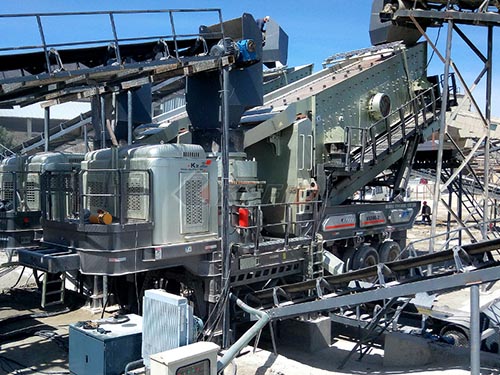
Crusher Optimization: Technologies like ASRi(AutomaticSettingRegulation)forconecrushersautomaticallycompensateforlinercrusherajusttheclosedsidesetting(CSS)tomaintainaconsistentproductandoptimalcrushingforce,.
Telematics & Remote Monitoring: Equipmenthealthdata—suchaspowerdraw,bearingtemperature,vibrationlevels—canbetransmittedremotelytoamanufacturerordepotfordiagnosticanalysis,predictivemaintenance,andearlyfaultdetectionminimizingunscheduleddowntime,.
Crushingandscreeningplantsareindispensableassetsintheglobalmaterialsprocessingindustry.Theirpreciselyengineeredcomponentsworkinginharmonyturnraw,naturalresourcesintothebuildingblocksofmodernsociety.Fromthefoundationsofourroadsandbuildingstotheballastbeneathrailwaytracks,thequalityandefficiencyoftheseplantsdirectlyimpactthesafetydurabilityandeconomicviabilityofcountlessprojects.Continuedinnovationinplantdesignautomationandsustainabilityensuresthatthesecomplexsystemswillremainatthecoreofinfrastructuraldevelopmentformanyyearstocome
Lorem ipsum dolor sit amet, consectetur adipisicing elit. Consectetur sequi saepe ut sunt eveniet perferendis excepturi, iste obcaecati. Qui tempore hic sed quia soluta obcaecati vel.