
In the demanding world of aggregate processing and mineral comminution, the cone crusher stands as a pinnacle of engineering efficiency, capable of reducing hard, abrasive rock into precisely sized fractions. While much attention is rightly paid to its robust mantle, concave liners, hydraulic adjustment systems, and drive mechanisms, there exists a component of equal, if not more fundamental, importance that often remains out of sight: the concrete foundation slab. This monolithic structure is not merely a platform upon which the crusher sits; it is the very bedrock of its operational integrity, safety, and long-term economic viability. A poorly designed or constructed slab can lead to catastrophic failure, while a properly engineered one ensures decades of reliable service.
This article delves into the multifaceted engineering considerations, design principles, construction methodologies, and critical consequences associated with the concrete slab for a cone crusher.
A cone crusher operates on the principle of eccentric compression. A gyrating mantle within a stationary concave crushes rock through a combination of impact and compression. This process generates immense forces that are anything but static. The dynamic loading comprises:
A standard industrial floor slab is utterly inadequate to handle these demands. The purpose-built concrete slab for a cone crusher must therefore fulfill several critical functions:
The design of a cone crusher foundation is a specialized task typically performed by a geotechnical and structural engineer in close consultation with the crusher manufacturer.
A. Subgrade Assessment and Preparation
The entire system’s stability begins with the ground below. A comprehensive geotechnical investigation is mandatory to determine:
Preparation often involves excavating unsuitable material (e.g., soft clay or organic topsoil) and replacing it with layers of engineered fill—typically well-graded granular material like crushed rock or gravel—compacted in controlled lifts to achieve a uniform, high-stiffness platform.
B. Slab Design Parameters
The structural design of the slab itself involves meticulous calculation based on data from both geotechnical reports and crusher manufacturers.
Mass and Dimensions: The rule of thumb is that the mass of the concrete foundation should be 2 to 3 times the mass of the operating crusher assembly (including feed hopper and drive motor). This mass ratio provides sufficient inertia to dampen vibrations effectively. The plan dimensions are determined by soil bearing capacity; weaker soils require larger footprints to distribute the load.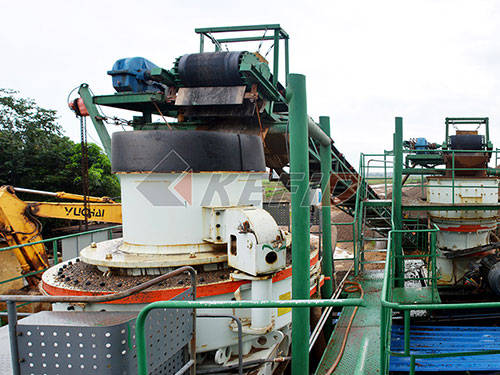
Reinforcement Design: The concrete slab is not just plain concrete; it is heavily reinforced steel-reinforced concrete (RCC). Two primary layers of rebar are used:
Dynamic Considerations: For very large crushers or sites with specific vibration sensitivities engineers may perform dynamic analysis This modeling ensures that resonant frequencies natural frequency modes vibration amplitude do not coincide with operational frequencies leading destructive resonance
Anchor Bolt Design: These are critical load path elements They are typically high strength steel L shaped J-bolts headed bolts embedded deep within rebar cage embedment length calculated develop full tensile capacity Grouting after installation ensures uniform load transfer between baseplate
The construction phase demands rigorous quality control even minor deviations design compromise entire structure
A. Excavation Subbase Preparation site excavated specified depth subgrade proof rolled compacted verify uniformity layer crushed stone often installed as capillary break drainage layer
B. Formwork Rebar Cage Erection forms built contain concrete complex shape rebar cage fabricated place strict adherence design drawings clear cover maintained between rebar future concrete surfaces crucial prevent corrosion
C. Concrete Placement Curing highest priority use high strength structural concrete mix design typically compressive strength 4000 psi minimum low water cement ratio ensure durability workability often achieved superplasticizers placement must continuous avoid cold joints proper vibration essential eliminate air pockets honeycombing which create weaknesses After placement curing process begins immediately slabs kept moist covered curing compounds least seven days achieve design strength prevent plastic shrinkage cracking full strength typically reached 28 days before commissioning
Ignoring importance proper foundation leads severe operational financial consequences
concrete slab cone crusher epitome form following function seemingly simple block represents culmination careful geotechnical analysis structural engineering precision construction serves silent partner crushers performance absorbing punishing forces providing stable unwavering platform upon which profitability reliability built investment robust well engineered foundation not optional expense but fundamental prerequisite any successful efficient crushing operation true cost cutting this critical area false economy inevitably paid many times over through unplanned downtime accelerated wear compromised safety
Lorem ipsum dolor sit amet, consectetur adipisicing elit. Consectetur sequi saepe ut sunt eveniet perferendis excepturi, iste obcaecati. Qui tempore hic sed quia soluta obcaecati vel.