
Commercial 250–300 TPH Stone Crushing Plant: Research & Development Perspectives
Abstract
The commercial stone crushing industry forms the backbone of infrastructure development, supplying aggregates for road construction, concrete batching, and dam projects. Within this sector, the 250–300 tons per hour (TPH) capacity range represents a strategic sweet spot—large enough to serve mid-to-major contractors, yet flexible enough for modular deployment. This article provides a professional, objective examination of the research and development (R&D) landscape for commercial 250–300 TPH stone crushing plants, covering process architecture, key equipment innovations, automation trends, energy efficiency, environmental compliance, and future development directions.
1. Introduction: Defining the 250–300 TPH Segment
A 250–300 TPH crushing plant typically processes hard rock (granite, basalt, diorite) or softer limestone, producing graded aggregates (0–5 mm, 5–10 mm, 10–20 mm, 20–40 mm) and manufactured sand. This capacity range is widely adopted for commercial aggregate supply because it balances capital expenditure (CAPEX) against operational throughput. For context, a 250 TPH plant can produce approximately 1.5 million tonnes per year at 70% utilization—sufficient for two to three medium-sized highway projects simultaneously.
R&D in this segment focuses not on scaling up (as in 500+ TPH mega-plants) but on optimizing the balance between reduction ratio, product shape, wear life, and energy consumption per tonne. The commercial viability demands high uptime (>90%), low maintenance downtime, and adaptability to varying feed materials.
2. Process Flow and R&D-Driven Configuration
The conventional flow for a 250–300 TPH plant includes:
R&D efforts have shifted from fixed, single-flow designs to reconfigurable modular plants. For instance, a skid-mounted primary unit can be relocated with minimal civil works, reducing site preparation time by 40%. Research on closed-circuit configurations—where oversize material from the tertiary screen returns to the VSI—has demonstrated a 15–20% improvement in fines control and product consistency.
3. Key Equipment Innovations in R&D
3.1 Crusher Chamber Geometry
Modern cone crushers for this capacity range employ hydroset or hydraulic adjustment systems that allow real-time CSS (closed side setting) changes under load. R&D has focused on chamber profile optimization using discrete element method (DEM) simulations. For example, a 250 TPH plant using a CH440-equivalent cone crusher with an optimized long-throw eccentric achieves a 12% higher throughput at the same power draw compared to older designs. Research data from crushing test labs indicates that the inter-particle breakage mechanism in multi-layered chambers reduces flakiness index from 18% to below 10%, meeting stringent European aggregate standards.
3.2 Wear Parts Metallurgy
Wear life directly affects operating cost, which for a 250 TPH plant can be $0.15–$0.25 per tonne. R&D in manganese steel (12–14% Mn) with chromium additions has improved work-hardening rates. More recently, ceramic composite inserts in VSI rotors have extended rotor life from 300 hours to over 600 hours when crushing basalt. For jaw crushers, research on toothed plates with variable thickness has reduced premature cracking by distributing stress more evenly.
3.3 Screening Efficiency
In a 250–300 TPH plant, screening inefficiency causes recirculation loads of 30–50%, wasting energy. R&D has introduced elliptical stroke screens that combine linear and circular motion, improving stratification. A case study from a commercial plant in India showed that replacing conventional circular screens with high-frequency elliptical screens increased effective screening area utilization by 22%, allowing a reduction in screen count from three to two units for the same output.
4. Automation and Digital R&D
4.1 PLC-Based Control Systems
Modern 250–300 TPH plants are equipped with programmable logic controllers (PLCs) that monitor crusher power draw, bearing temperature, and belt speed. R&D has moved toward model predictive control (MPC) algorithms that automatically adjust feed rate and crusher CSS to maintain a target product tonnage. Field trials indicate that MPC reduces energy consumption per tonne by 8–10% compared to manual operation, because the system prevents overloading and subsequent power spikes.
4.2 Remote Monitoring and Predictive Maintenance
The integration of IoT sensors (vibration, acoustic emission, oil particle counters) allows cloud-based condition monitoring. For a commercial plant operating 20 hours/day, unscheduled downtime costs approximately $2,500–$4,000 per hour in lost revenue. R&D on machine learning-based failure prediction has achieved 85% accuracy in forecasting bearing failure 72 hours in advance, enabling planned maintenance during off-peak hours. This is a significant advancement over reactive maintenance, which accounts for 60% of total maintenance costs in older plants.
4.3 Digital Twin Simulation
A digital twin of the entire crushing circuit—including crusher power curves, screen efficiency matrices, and conveyor transfer points—allows engineers to simulate changes in feed size distribution or moisture content before physical adjustments. This R&D tool has proven valuable for optimizing the blending of multiple stockpiles to meet specific aggregate grading envelopes required by asphalt or concrete specifications.
5. Energy Efficiency and Sustainability R&D
5.1 Specific Energy Consumption
The theoretical minimum energy for rock breakage is approximately 0.1–0.3 kWh/t, but real plants consume 1.5–2.5 kWh/t due to inefficiencies. R&D targets in the 250–300 TPH segment include:
5.2 Water and Dust Management
Commercial plants face strict environmental regulations. R&D has developed dry fog dust suppression systems that use ultrasonic atomizers to generate 10–50 micron droplets, achieving 90% dust capture efficiency at water consumption rates of only 0.05 L/t. For wet processing, closed-loop water recycling with thickeners and filter presses reduces fresh water intake from 3 m³/t to 0.2 m³/t. A 300 TPH plant processing river gravel can thus operate with zero liquid discharge, a critical factor for permits in water-scarce regions.
5.3 Circular Economy in Waste Fines
The 0–5 mm fraction often exceeds market demand. R&D has explored dry classification with air sifters to separate ultra-fines (<75 microns) for use in cement kilns or soil stabilization. Alternatively, briquetting of crusher dust with a binder produces artificial aggregates for backfill, converting a waste stream into a revenue source. Pilot studies show that up to 8% of total plant output can be valorized this way.
6. Structural and Mechanical R&D
6.1 Modular Frame Design
Traditional plants use welded steel structures that require heavy cranes for assembly. R&D has introduced bolted modular frames with standardized connection points, reducing erection time from 30 days to 12 days for a 250 TPH plant. Finite element analysis (FEA) ensures that bolted joints withstand dynamic loads from crusher vibration without fatigue failure over a 10-year design life.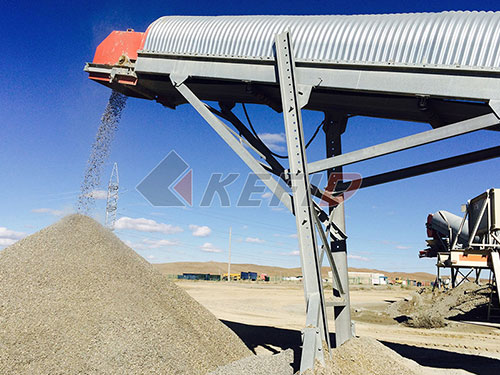
6.2 Conveyor Transfer Point Optimization
Chute design using discrete element modeling (DEM) has reduced material buildup and belt wear. A well-designed transfer chute with a curved hood and spoon minimizes impact force, reducing belt damage and dust generation. For a 300 TPH plant, optimized chutes can extend belt life from 18 months to 30 months, saving $15,000–$25,000 annually in replacement costs.
7. Safety and Ergonomics in R&D
Commercial plants operate with high personnel turnover. R&D has focused on automated sampling systems that extract aggregate samples from the main conveyor without requiring manual access to moving parts. Additionally, remote-controlled rock breakers for oversize material at the primary crusher reduce the risk of worker injury. Guarding designs now follow ISO 14120 standards, with interlocked access doors that shut down the entire circuit if opened during operation.
8. Economic Analysis and R&D Payback
A typical 250–300 TPH plant has a CAPEX of $2.5–$4.5 million (excluding civil works) and an annual operating cost of $1.2–$1.8 million. R&D investments in automation and wear parts yield a payback period of 12–18 months. For example, installing a predictive maintenance system costing $80,000 reduces unplanned downtime by 30 hours/year, which at $3,000/hour lost profit equals $90,000 savings—a payback of under one year. Similarly, upgrading to high-chrome blow bars for an impact crusher costs $15,000 more but extends wear life by 40%, saving $22,000 in replacement labor and parts annually.
9. Challenges and Future R&D Directions 
9.1 Variable Feed Quality
Commercial quarries often blend materials from multiple faces. R&D is exploring real-time ore sorting using X-ray fluorescence (XRF) or near-infrared (NIR) sensors on the feed conveyor to reject deleterious materials (e.g., clay, chert) before crushing. This reduces wear and improves product quality but requires robust algorithms for high-speed classification at 300 TPH.
9.2 Electrification and Hybrid Power
Diesel-electric hybrid drives for mobile and semi-mobile plants are under research. A 250 TPH plant using a 500 kVA diesel generator consumes ~150 L/h of fuel. R&D on grid-connected with energy storage (battery banks) allows peak shaving, reducing energy costs by 15% in regions with time-of-use tariffs. Full electric plants with regenerative braking on downhill conveyors are also being prototyped.
9.3 Artificial Intelligence for Product Quality
Current quality control relies on manual sieve analysis every 2–4 hours. R&D is testing online particle size analyzers using laser diffraction or camera-based image analysis on the discharge belt. Combined with AI, these systems can predict the need for CSS adjustment 10 minutes before product deviation occurs, maintaining a 95% compliance rate with strict grading specifications.
9.4 Carbon Footprint Reduction
The crushing industry contributes ~1–2 kg CO₂ per tonne of aggregate (including blasting and transport). R&D into low-carbon concrete aggregates—where the crushing plant is co-located with a carbon capture unit using waste heat—is in early stages. More immediately, optimizing blasting patterns to produce finer feed reduces crushing energy by 10%, directly lowering Scope 2 emissions.
10. Conclusion
The commercial 250–300 TPH stone crushing plant is not a static machine set but a dynamic system undergoing continuous R&D refinement. Current research priorities—automation, predictive maintenance, energy efficiency, and modularity—are driven by economic pressures and environmental regulations. The next decade will see these plants evolve into semi-autonomous, sensor-rich operations capable of self-optimizing for variable feed conditions. For engineering firms and quarry operators, investing in R&D for this capacity range is not optional but a competitive necessity, as margins tighten and aggregate quality demands escalate. The successful plant of 2030 will not merely crush rock; it will process data, manage energy flows, and adapt in real time—all while delivering 250–300 tonnes of high-quality aggregate every hour, with minimal human intervention and maximum profitability.
If you have any questions about our products, please feel free to contact us. We take all inquiries and suggestions very seriously.