Comprehensive Guide to Chinese Stone Crusher Plant Inspection: Ensuring Safety, Efficiency, and Compliance
The stone crushing industry is a cornerstone of global infrastructure development, providing the essential aggregates for construction, roads, and concrete. China, as the world’s largest producer and consumer of construction materials, hosts a vast and technologically diverse array of stone crusher plants. From small, semi-mobile units to fully automated mega-plants integrated with artificial intelligence (AI) and the Internet of Things (IoT), the landscape is complex. A professional inspection of these facilities is therefore not merely a regulatory formality but a critical process to ensure operational safety, maximize productivity, guarantee product quality, and enforce environmental stewardship. This detailed guide outlines the key components and methodologies of a thorough Chinese stone crusher plant inspection.
1. Pre-Inspection Preparation & Documentation Review
A professional inspection begins long before setting foot on site.
- Regulatory Framework: Inspectors must be versed in China’s relevant laws and standards, including:
- Work Safety Law: Mandating safety management systems.
- Environmental Protection Law: Governing dust, noise, and water pollution.
- Occupational Disease Prevention Law: Covering dust (silicosis) and noise exposure.
- GB Standards: Specific technical standards for machinery safety (e.g., GB 18452), dust emission limits (e.g., GB 16297), and occupational noise exposure limits (e.g., GBZ/T 189.8).
- Documentation Audit: A review of plant records is essential:
- Equipment Certificates: Verification of manufacturing quality certificates for major equipment (crushers, screens, conveyors), especially pressure vessels if present.
- Maintenance Logs: Systematic records of preventive maintenance, lubrication schedules, and component replacements.
- Safety Files: Records of hazard identification (HAZID), risk assessments (JSA), lockout-tagout (LOTO) procedures, emergency response plans, and past incident reports.
- Environmental Permits: Valid discharge permits for dust and wastewater, along with continuous monitoring data.
- Personnel Qualifications: Certificates for crane operators, welders, electricians, and safety supervisors.
2. Structural & Civil Works Inspection
The physical foundation of the plant must be sound.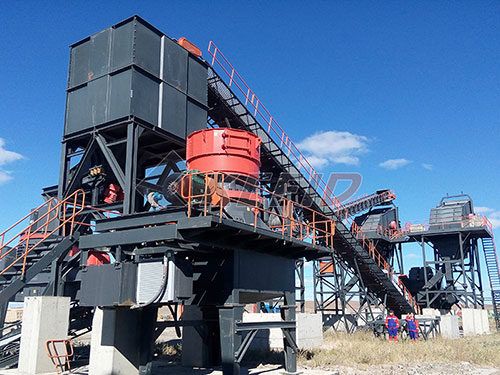
- Foundations & Support Structures: Check for cracks, settling, or corrosion in the reinforced concrete foundations supporting primary crushers (which endure significant dynamic loads), vibrating screens, and conveyor pedestals. Ensure all anchor bolts are tight and undamaged.
- Plant Layout & Access: Evaluate traffic flow patterns to segregate pedestrians from heavy equipment. Inspect access roads for stability and width adequacy. Verify that emergency escape routes are clearly marked and unobstructed.
- Dust Suppression Infrastructure: Examine water storage tanks, pump houses, pipeline networks for spray systems at transfer points (hoods & seals on chutes), and the condition of baghouse filters or electrostatic precipitators.
3. Mechanical Equipment Inspection: Core Components
This forms the heart of the operational assessment.
- Primary Crusher (Jaw/Gyratory/Impact):
- Check wear parts: jaw plates/liners/mantles/blow bars for excessive wear or cracking.
- Inspect tension systems (hydraulic or mechanical) on jaw crushers.
- Listen for abnormal noises indicating loose components or bearing issues.
- Verify lubrication system functionality—check oil levels, temperature gauges,and look for leaks.
- Secondary & Tertiary Crushers (Cone/Impact/VSI):
- Similar checks on liners/wear parts; cone crusher settings should be verified for product gradation control.
- Inspect rotor assemblies in impact crushers for imbalance or crack indications via non-destructive testing if possible.
- Vibrating Screens:
- Examine screen decks/cloths for blinding (clogging), tears,sagging or excessive wear affecting sizing accuracy.
- Check vibration isolation springs/rubber mounts for degradation or breakage.
- Inspect drive motors,v-belts,and bearingsfor alignmentand overheating signs .
- Conveyor Systems
- Check belt alignment;misalignment causes premature wearand spillage .
- Inspect idler rollersfor free rotation; seized rollers damage belts .
- Examine scrapersat head pulleysfor effective cleaning .
- Test emergency stop cables/pull cordsalong entire lengthfor immediate response .
4.Electrical&Control Systems Inspection
Modern Chinese plants increasingly feature sophisticated automation .
- Power Distribution :Inspect main switchgear ,transformers ,and motor control centers(MCCs)for cleanliness ,proper labeling ,and absenceof corrosion .Verify grounding systemsare intact .
- Motor&Drive Inspection :Check all electric motors(especially crusher&screen drives )for proper amperage draw under load(via thermal imaging ),unusual vibrations ,and adequate cooling .
- Automation&PLC Systems :Review control panel integrity .Verify that interlocks(e.g.,conveyor startup sequences )function correctly to prevent material pile-ups .Check human-machine interface(HMI )clarityandalarm log historyfor recurring faults .
- Safety Circuits :Test all hard-wired safety devices independently from PLC :emergency stops ,belt slip switches ,blocked chute detectors ,zero-speed switches .
5.Safety&Operational Practice Assessment
The most advanced equipment can be rendered dangerous by poor practices .
- Machine Guarding :Ensure all rotating parts(shafts ,couplings ),pinch points(nip points on rollers ),and drive beltsare fully guardedwith fixedor interlocked guards per GB standards .
- Fall Protection :Inspect work platforms ,walkways around screens/crushers ,and laddersfor guardrails(toeboards&mid-rails ),non-slip surfaces,and structural integrity .
- Lockout-Tagout(LOTO ) :Observe procedures during a simulated maintenance task .Verify isolation pointsare clearly identifiedand personal locksare used .
- Personal Protective Equipment(PPE ) :Check availabilityand enforcementof mandatory PPE:hard hats,safety glasses ,high-visibility vests ,hearing protection,and respiratorsin high-dust areas .Monitor noise levelswith dosimetersin operator cabinsand key work zones .
- Dust Exposure Monitoring :Review respirable crystalline silica(RCS )monitoring data .Observe effectivenessof local exhaust ventilation(LEV )at transfer pointsandenclosure integrity .
6.Environmental Compliance&Housekeeping
A clean plant is generally a safe,efficient one .
- Dust Emission Control :
1.Source Control :Observe effectivenessof water sprays,mist cannons,fog systemsat loading/unloading points,crusher feeds,and stockpiles .
2.Path Control :Check enclosuresof conveyors,crushers,screensfor leaks .Inspect baghousefilter bagsfor tears,pulse-jet cleaning cycles,differential pressure readings .
3.Receptor Control :Evaluate perimeter dust curtainswalls/trees adequacy .Review real-time PM2.5/PM10 monitor dataif installed per local regulations .
- Noise Pollution :
Measure sound levelsat plant boundarycompliance with GB standards .Check useof acoustic enclosureson noisy equipmentlike compressors,certain crushers .
- Water Management&Spill Prevention :
Inspect sediment basins,wastewater treatment systemsfor stormwater runoff .Check oil/fluid containmentaround fuel stations,lube skidsto prevent soil contamination .
- Housekeeping :
Systematic removalof spillage materialunder conveyors,build-uparound equipmentprevents slip/trip hazards,firerisks,and reduces secondary dust generation .
7.Post-Inspection Reporting&Action Plan
The inspection culminates in a clear,directional report .
1.Detailed Findings Report :
Categorize findingsas Critical(mandatory immediate shutdown risk ),Major(requires planned shutdown repair ),or Minor(general improvement ).Each finding must include photo evidence,specific location,violated standard reference,and clear description .
2.Risk Assessment Matrix :
Prioritize corrective actionsbased on severity likelihood combining safety production environmental impact factors .
3.Corrective Action Plan(CAP) :
Provide actionable recommendationswith suggested methodologies,timelines(immediate short-term long-term ),responsibility assignments(management maintenance operations ).
4.Benchmarking&Best Practice Sharing :
Compare plant performanceagainst industry benchmarksin China(e.g.,ton/kWh energy consumption,wear part cost per ton,downtime percentage ).Suggest adoptionof proven technologiesfrom leading Chinese manufacturerslike SANY,Zoomlion,Shaorui which offer smart crushing solutions predictive maintenance features .
Conclusion
Inspecting a Chinese stone crusher plant is a multidisciplinary engineering endeavor requiring expertise in mechanical industrial safety electrical environmental science It moves beyond simple checklist compliance towards holistic operational excellence With China’s dual focus on industrial modernization green development rigorous inspections serve as vital catalyst driving plants towards smarter safer more sustainable operations ultimately contributing to higher quality infrastructure development globally The future lies in integrating these physical inspections with digital twin models real-time sensor analytics creating continuous virtual audit trails that predict failures before they occur setting new standard worldwide
