Customization of Chinese Iron Ore Crushing Plants: A Technical and Strategic Imperative
The iron ore mining industry in China operates within a unique and complex context: vast but often low-grade and heterogeneous domestic deposits, stringent environmental regulations, intense pressure for operational efficiency, and the ever-present imperative to feed the world’s largest steel industry. In this challenging landscape, the “one-size-fits-all” approach to plant design is obsolete. The customization of iron ore crushing plants has evolved from a competitive advantage into a fundamental necessity for economic viability, environmental compliance, and long-term resource sustainability. This detailed examination explores the drivers, methodologies, key components, and strategic benefits of tailoring crushing solutions to the specific contours of Chinese iron ore projects.
1. The Driving Forces for Customization
Several interrelated factors compel the move toward fully customized crushing plants in China:
- Ore Characteristic Complexity: Chinese iron ore is notoriously difficult to process. While reserves are substantial, a significant portion comprises low-grade magnetite and hematite with complex mineralogy. Ores often exhibit poor liberation characteristics, high hardness/abrasiveness (e.g., some Anshan-type ores), or are finely disseminated. Furthermore, “red ore” (hematite) and “black ore” (magnetite) may be blended from multiple mines. A custom plant design starts with exhaustive geometallurgical testing—including Drop Weight Testing, Bond Work Index, and abrasion index analysis—to define the precise comminution requirements.
- Site-Specific Constraints: Topography in mining regions like Hebei, Liaoning, or Inner Mongolia varies dramatically. A customized design optimizes plant layout for steeply sloping terrain versus flat land, minimizing costly earthworks and long conveyor runs. It also integrates local climate considerations, such as dust control systems for arid regions or freeze protection for facilities in northern China.
- Stringent Environmental & Social Governance (ESG): National policies like “Ecological Civilization” and “Carbon Peak/Carbon Neutrality” mandates impose strict limits on dust, noise, water usage, and energy consumption. A custom-designed plant can embed advanced mitigation technologies from the ground up: enclosed conveyors and transfer points with baghouse filters, optimized crusher cavity designs for reduced fines generation, water recycling systems for wet dust suppression, and strategic sound insulation.
- Lifecycle Cost Optimization: The focus has shifted from mere lowest capital expenditure (CAPEX) to minimizing total lifecycle cost (LCO). Customization allows for selecting crushers with optimal wear liner materials (e.g., high-chrome white iron for highly abrasive ore), designing for easy maintenance access to reduce downtime (a critical metric), and planning for future expansion or feed changes.
2. The Customization Process: From Ore Body to Operation
A systematic engineering process underpins successful customization: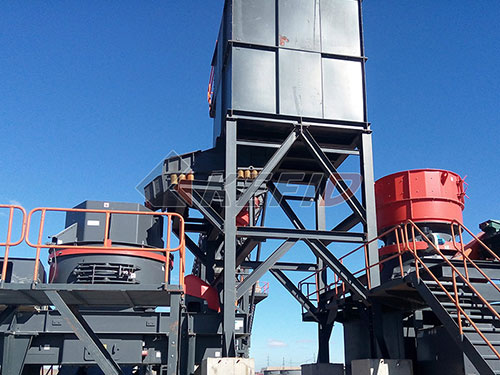
- Comprehensive Ore Testing & Flow Sheet Development: This is the cornerstone. Detailed characterization determines the crushing work index (CWi), abrasiveness index (Ai), moisture content, clay presence, and feed top size. Based on this data, engineers simulate various comminution circuits using software like JKSimMet or METSIM to compare options (e.g., three-stage open circuit vs. two-stage with pre-screening) before selecting the most efficient flow sheet.
- Equipment Selection & Configuration: This is where customization becomes tangible.
- Primary Crushing: For large open-pit mines with high tonnage, a custom solution might select a heavy-duty gyratory crusher for its ability to handle slabby feed directly from the mine face. For smaller pits or underground operations with constrained space,a robust jaw crusher with a specially designed feed hopper to prevent bridging might be optimal.
- Secondary & Tertiary Crushing: The choice between cone crushers and high-pressure grinding rolls (HPGR) is critical.HPGRs offer significant energy savings (10-20%) and produce a more fractured product beneficial for downstream grinding,but have higher upfront cost.Customization involves rigorous trade-off studies based on specific ore competency.For traditional circuits,the selection of cone crusher type—heavy-duty for secondary reduction or multi-cylinder hydraulic for precise tertiary crushing—is meticulously matched to duty.
- Screening & Material Handling: Screen deck configurations (size/type of panels), inclination angles,and conveyor widths/speeds are all customized based on required capacity,material flowability,and target product sizes.Pre-crushing screening(scalping)is crucial for removing fines that would choke crushers,a common issue with certain weathered Chinese ores.
- Plant Layout & Structural Design: A 3D digital twin model is developed to ensure an ergonomic,efficient,and safe layout.It optimizes equipment placement for maintenance access(minimizing crane requirements),integrates dust extraction ducting,and ensures structural supports do not interfere with material flow.This phase also plans for modular construction if site conditions warrant it.
- Control & Automation Integration: Modern custom plants are built around an advanced process control system(APC).This includes crusher automation systems(like ASRi for cone crushers)that adjust settings in real-time based on power draw and chamber pressure,coupled with integrated weighing(conveyor scales),particle size monitoring(e.g.,crusher camera systems),and centralized lubrication.All data feeds into a plant-wide SCADA system,paving the way for predictive maintenance.
3.Key Components of a Modern Customized Plant
Beyond primary crushers,a tailored system incorporates several specialized elements:
- In-Pit Crushing & Conveying(IPCC): For deep pits where truck haulage costs become prohibitive,custom-designed mobile or semi-mobile primary stations placed within the pit,coupled with long overland conveyors,dramatically cut operating costs(OPEX)and carbon footprint.This represents the pinnacle of site-specific customization.
- Ore Sorting & Pre-Concentration: For low-grade deposits,custom plants may integrate sensor-based sorting(XRT,Laser)or magnetic pre-concentration stages before final crushing.This removes waste rock early,saving energy in comminution,increasing head grade to downstream processes,and reducing tailings volume—a major strategic benefit.
- Dust Suppression & Control Systems: A customized approach goes beyond standard spray nozzles.It designs a holistic system combining sealed transfer chutes,dust extraction hoods at key emission points,and intelligent dry fog systems that adjust water droplet size based on real-time dust monitoring data.
4.The Strategic Benefits: Beyond Initial Cost
The investment in customization yields substantial returns:
- Maximized Resource Recovery: By designing precisely for the ore’s hardness and liberation size,a custom plant ensures optimal particle size reduction,facilitating maximum iron recovery in subsequent beneficiation stages(e.g.,magnetic separation).
- Enhanced Operational Efficiency & Uptime: Designs focused on maintainability reduce mean time to repair(MTTR).Optimal equipment selection reduces specific energy consumption(kWh/ton),a major OPEX component.Robust designs handle feed variability without choking or stalling.
- Reduced Environmental Footprint: Energy-efficient circuits lower Scope 2 emissions.Comprehensive dust containment protects local air quality.Efficient water management minimizes consumption.Tailings volume can be reduced via pre-concentration.All align perfectly with national ESG goals.
- Future-Proofing & Flexibility: A well-customized design considers potential future scenarios: declining ore grades,mine plan expansions,the addition of new processing streams.It builds in space,pump capacity,and power provisions,making future modifications less disruptive.
Conclusion
In conclusion,the customization of iron ore crushing plants in China is not merely an engineering preference but a strategic response to multifaceted technical,economic,and regulatory challenges.It represents a holistic philosophy that views the crushing circuit not as an isolated cost center,but as an integrated subsystem whose performance fundamentally dictates the entire mine’s profitability and sustainability.
The process—from exhaustive ore testing through intelligent equipment selection to integrated automation—ensures that capital investment translates directly into lower operating costs,increased resource utilization,and responsible environmental stewardship.As Chinese mining companies continue to pursue deeper,poorer,and more complex orebodies while facing global competition,the depth and sophistication of crushing plant customization will remain a definitive marker of industry leadership.The future lies in smart,custom-engineered plants that are as unique as the geological formations they are built to process
