Chinese Gold Ore Crushing Equipment Datasheet: A Comprehensive Technical Analysis
1. Introduction
The gold mining industry in China is a cornerstone of its domestic mineral economy, demanding robust, efficient, and increasingly sophisticated processing technologies. At the heart of any gold processing plant lies the comminution circuit, where crushing equipment plays a pivotal role in liberating gold particles from the host rock for subsequent recovery. This datasheet provides a detailed, objective analysis of the prevalent crushing equipment engineered and manufactured in China, examining their technical specifications, operational principles, application suitability, and technological evolution within the context of modern gold ore processing.
2. Ore Characteristics and Crushing Philosophy
Chinese gold ores are remarkably diverse, ranging from free-milling alluvial deposits to complex refractory ores locked in sulfide minerals like pyrite and arsenopyrite. The crushing circuit design is fundamentally dictated by:
- Ore Competence: Uniaxial Compressive Strength (UCS), abrasiveness (Ai index), and moisture content.
- Gold Liberation Size: Determining the target product size (P80) from primary crushing (typically 150-250mm) down to fine crushing for milling feed (often 10-25mm).
- Plant Capacity: From small-scale artisanal operations to mega-mines processing tens of thousands of tonnes per day (tpd).
- Downstream Processes: Compatibility with grinding (SAG/Ball Mill) or direct leaching circuits (e.g., heap leaching).
The overarching philosophy emphasizes high availability, energy efficiency, wear resistance optimization, and integration with automated control systems for optimal size reduction at minimal cost per tonne.
3. Primary Crushing Equipment
Primary crushers handle run-of-mine (ROM) ore, providing the first stage of size reduction.
A. Jaw Crushers
- Model Examples: PE Series (PE600×900, PE750×1060), JC Series
- Operating Principle: Utilizes compressive force via a fixed and a reciprocating jaw plate.
- Key Specifications:
- Feed Opening: 150x250mm up to 1500x2100mm.
- Capacity: 1-1000 tph, adjustable based on CSS (Closed Side Setting).
- Crushing Ratio: Typically 6:1 to 8:1.
- Drive Power: 15-400 kW.
- Advantages: Simple structure, reliable operation, low maintenance cost, handles high moisture/sticky ores better than gyratories.
- Typical Application: Widely used as the first crusher in stationary and semi-mobile plants for medium-hard to hard gold ores.
B. Gyratory Crushers
- Model Examples: PXZ Series (PXZ1417), HGT Series
- Operating Principle: A gyrating mantle within a concave bowl provides continuous compressive crushing.
- Key Specifications:
- Feed Opening: Up to 1500mm.
- Capacity: Exceeds 5000 tph for large models.
- Drive Power: Up to 800 kW or more.
- Advantages: Higher capacity and lower unit power consumption than jaw crushers at large scale; continuous action provides steady feed to downstream processes.
- Typical Application: High-capacity (>1000 tpd) greenfield or expansion projects where high throughput is critical.
4. Secondary & Tertiary Crushing Equipment
These stages further reduce ore size for optimal grinding mill feed.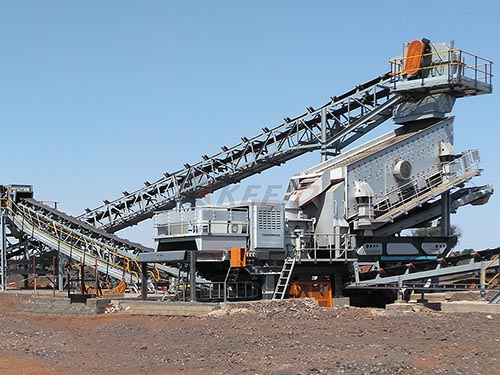
A. Cone Crushers
The workhorse for intermediate and fine crushing in hard rock gold circuits.
- Types & Models:
- Spring Cone Crusher (PY Series): Traditional design with spring-based overload protection. Cost-effective but less automated.
- Hydraulic Cone Crusher (HPT/HST Series): The industry standard featuring hydraulic adjustment, clearing, and cavity clearing. Offers precise CSS control and full automation compatibility.
- Cavity Types: Standard for secondary crushing; short-head for tertiary/fine crushing.
- Key Specs: Max feed size up to 350mm; product P80 range 10-50mm; power up to 630kW; advanced models feature intelligent liner wear monitoring systems.
B. Impact Crushers
Less common for primary hard rock but used in specific contexts.
- Operating Principle: High-speed impact from hammers/blow bars against ore on impact aprons/anvils.
- Models Examples: CI Series Horizontal Shaft Impactors (HSI), PF Series Impact Hammer Crushers
- Key Specifications: High reduction ratios (>15:1); excellent cubicle product shape; sensitive to abrasive ores leading to high wear costs.
- Typical Application: Processing softer oxidized gold ores or as part of a recycling circuit for waste materials.
5. Mobile & Semi-Mobile Crushing Plants
Reflecting global trends and domestic innovation in mining flexibility.
- Configuration: Integrate jaw, cone/impact crushers with vibrating feeders and screens on a single tracked or wheeled chassis.
- Models Examples: K Series Tracked Mobile Plants from leading manufacturers like SBM Group
- Key Advantages:
- Eliminate fixed infrastructure costs for truck dump pockets & conveyors ramps).
- Enable mine-face crushing with direct conveyor transport to the process plant or waste dump).
- Ideal for satellite deposits or mines with frequently shifting mining faces).
- Fast relocation/reconfiguration reduces operational downtime).
*6.* Technical Innovations & Features
Modern Chinese-manufactured equipment incorporates significant R&D-driven advancements:
- Intelligent Control Systems: Integration with PLC/SCADA systems using sensors for power draw, chamber pressure, CSS, temperature, etc. Real-time optimization algorithms adjust crusher parameters dynamically based on feed conditions)*
2 . Wear Material Technology: Use of advanced manganese steel alloys (e.g. modified Hadfield steel) composite materials (metal matrix ceramics)) Optimized cavity profiles ensure inter-particle crushing where possible, reducing liner wear)*
3 . Modular Design: Key sub-assemblies (main frame, drive system) designed for easier maintenance access, replacement, transportation)*
4 . Energy Efficiency: High-performance motors meeting IE3/IE4 efficiency standards coupled with optimized kinematics reduce specific energy consumption (kWh/t))
5 . **Dust Suppression & Noise Reduction: Integrated water spray systems at feed points combined with acoustic enclosures meet stringent environmental regulations.
7. Selection Criteria & Comparative Analysis
| Equipment Type |
Optimal Feed Size |
Typical Product P80 |
Max Capacity |
Advantages |
Limitations |
| Jaw Crusher |
Large Lump (<1200mm) |
~150-250 mm |
~1000 tph |
Robustness,Simple Operation,Low Capex |
Lower Reduction Ratio,Intermittent Action |
| Gyratory Crusher |
Very Large Lump (<1500mm) |
~150-200 mm |
>5000 tph |
Highest Throughput,Low Operating Cost per Tonne |
High Capex,Complex Foundation Required |
| Cone Crusher(Hydraulic) |
<350 mm |
~10-50 mm |
~200-2000 tph |
Precise Control,Excellent Particle Shape,High Efficiency in Hard Rock |
Sensitive to Feed Distribution & Fines Content |
| Mobile Plant(Integrated) |
Varies by Core Crusher) |
Varies by Circuit Design) |
Up To ~500 tph Tracked Units) |
Unmatched Flexibility,Rapid Deployment) |
Higher Operating Cost per Tonne than Stationary Units |
8. Market Context & Leading Manufacturers
China’s crushing equipment sector is served by both state-owned enterprises(SOEs)and dynamic private companies. Key players include:
• SBM Group: A global leader known particularly for its HPT Multi-Cylinder Hydraulic Cone Crushers series mobile stations),serving international markets extensively.
• Metso Outotec/Nordberg Local Manufacturing: While Finnish-origin technology),significant local manufacturing presence caters specifically Chinese market demands.
• Shanghai Jianshe Luqiao Machinery Co., Ltd: Renowned reliable jaw cone crushers across domestic mining projects.
• Zhengzhou Yifan Machinery Co., Ltd: Major supplier mobile portable plants suitable varied scales operation.*
The competitive landscape drives continuous improvement reliability performance while maintaining significant cost advantages compared Western counterparts—though premium models now compete directly technological sophistication rather price alone.*
9. Conclusion
Chinese-manufactured gold ore crushing equipment represents mature yet rapidly evolving technology spectrum capable meeting demands any scale complexity modern mining operation. From traditional robust jaw crushers highly automated hydraulic cone units flexible mobile solutions—the core strengths lie proven designs continuously enhanced through integration smart controls advanced material science.
Selection remains critical process requiring thorough analysis ore characteristics plant economics long-term operational strategy. The current trajectory indicates deepening focus total lifecycle cost optimization through predictive maintenance capabilities seamless digital integration broader mine management ecosystems—ensuring China’s position key global supplier essential mineral processing technologies foreseeable future.
